Buyer lands unit in coveted downtown Toronto building with second bid

08.13.19 | Media Mentions

A sucesfull sold listing 88 Blue Jays Way was featured in Globe and Mail. The listings was sold in only one day and this is it’s story:

88 Blue Jays Way, No. 2904, Toronto

Asking price: $769,000
Selling price: $760,000
Previous selling price: $517,900 (2017)
Taxes: $3,670 (2019)
Days on the market: One
Listing agents: Jim Burtnick and Richard Silver, Sotheby’s International Realty Canada

The action

This one-bedroom plus den suite in a new hotel and residential tower in the Entertainment District initially fetched an offer the seller deemed unacceptable. The same buyer came back with a higher bid when the unit was relisted at a higher price in late June.

“There was one other unit for sale at the same time – a mirror image of this unit on a higher floor – but they were asking significantly more, so it made ours more attractive,” agent Jim Burtnick said.

“[Overall] inventory is pretty tight right now, so for a good condominium like Bisha, which is quite popular with all the hotel amenities, there was certainly someone who wanted it and wanted a quick closing, and that was feasible in this particular case.”

What they got

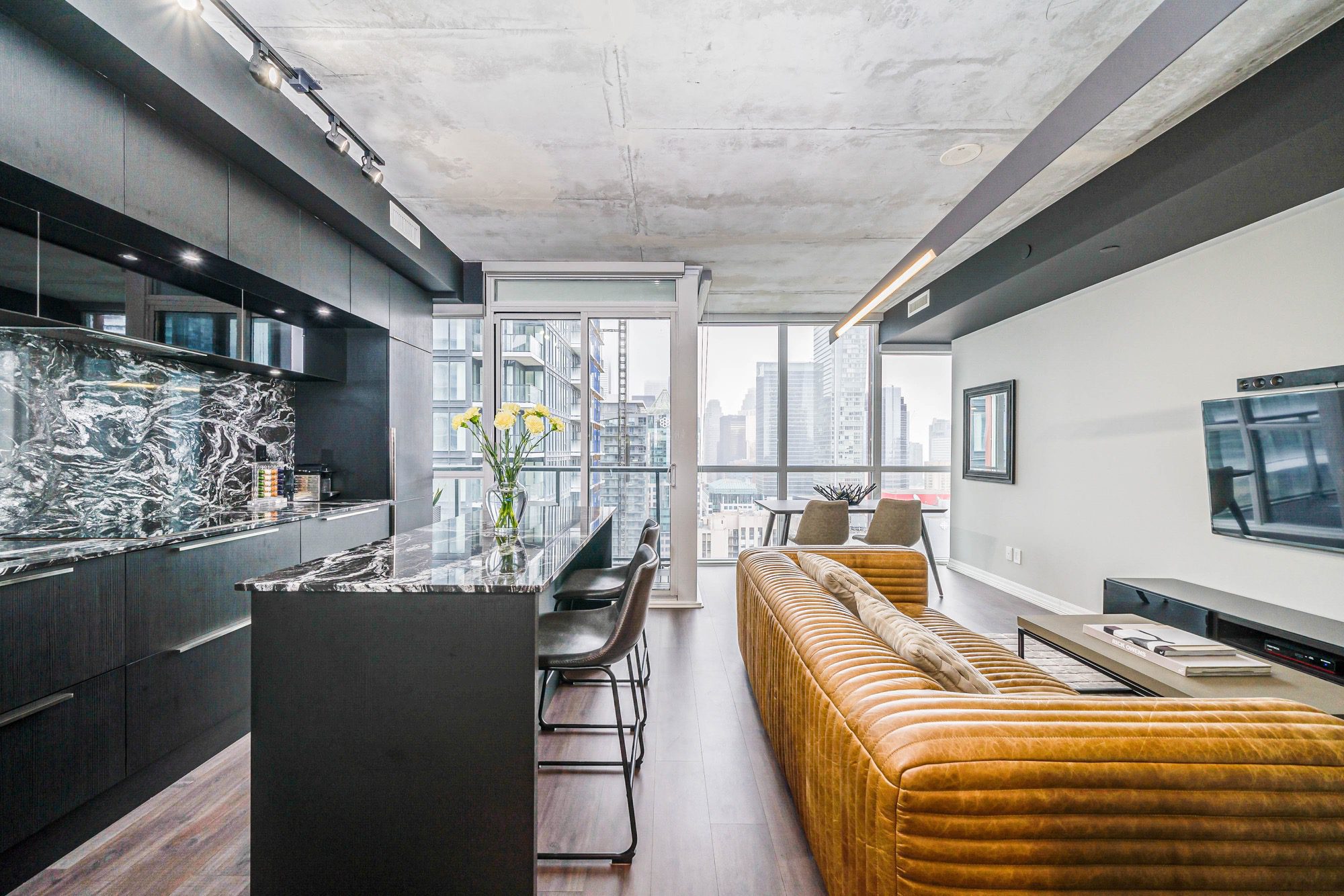
A few years ago, Bisha opened its doors with upscale hotel suites, trendy restaurants and private residences, such as this 665-square-foot unit with a locker and parking.

The interior design is modern with nine-foot ceilings and walls of windows along the living and dining area.

Sliding balcony doors also bring more light into the kitchen dressed with stone counters, centre island and stainless steel appliances.

Monthly fees of $559 pay for water, heating, concierge and access to recreational facilities.

The agent’s take

“[The building] is popular with the younger demographic; it’s got a bar on the main level in the lobby and a rooftop pool,” Mr. Burtnick said.

“[In addition], the seller kept the unit in great condition – with some electrical work done and work done in the bathroom – so there was very little wear and tear.”

What to Look For in a Results-Driven Real Estate Team

07.16.19 | Media Mentions

Jim and Richard were recently interviewed by Inman News about assembling an effective real estate team. Read the original interview at Inman.com.

For senior real estate advisors Richard Silver and Jim Burtnick, partnering brings a breadth of knowledge and a balance of skills.

Teamwork, like any relationship, requires negotiation and compromise. But for many luxury real estate agents, it pays dividends. A productive partnership can help reduce workloads for everyone while driving more business with a wider network of clients.

“My advice for people looking to partner who haven’t done it before: make sure that your strengths and weaknesses are not identical,” says Jim Burtnick, a senior real estate advisor with Canada Sotheby’s International Realty in Toronto, Canada.

You want someone who complements you: you might be strong in the customer service aspect but they might be strong in the networking aspect.

His business partner and fellow senior advisor Richard Silver agrees. “You’ve got people who are specialists in certain things,” he says. “There’s always a better person on the team to make sure the client is looked after.”

Watch this video to dive into how collaboration and shared accomplishments can make success so much more rewarding. “I think it’s really a case where the sum is greater than the parts,” says Burtnick.

Photo Essay: The University of Toronto Neigbourhood

07.15.19 | Toronto & Neighbourhoods

The University of Toronto is situated on the border of Queen’s Park in the city’s core, and it has continued growing since its foundation in 1827. Today, it is considered Canada’s premier university, and it’s known internationally for its influential research. It’s also centrally located in downtown Toronto, close to neighbourhoods like Yorkville and the Annex.

Location

The University of Toronto’s core campus stretches from Spadina Avenue to Bay Street, and from Bloor Street down to College Street, although some of its buildings surpass these borders. It’s connected to the Discovery District, which is named in part for the campus itself, but also because of the nearby hospitals in the region. It’s two kilometers north of the Financial District and minutes away from Yorkville. Queen’s Park is also nearby, which contains the Ontario Legislative Building.

History

The University of Toronto was founded in 1827 as King’s College after influential people including John Graves Simcoe (Lieutenant-Governor of Upper Canada) and John Strachan (Anglican Bishop of Toronto) wanted a college to be built in the growing city. The school’s original building stood three storeys tall. King’s College was initially a religious institution that aligned with the Church of England, but in 1849 it was renamed “The University of Toronto” to eliminate its ties to the church. Strachan went on to establish Trinity College (which is now a part of U of T’s many colleges) as a private Anglican seminary.

The university began expanding quickly at the turn of the century. It began constructing buildings for its newly introduced Faculty of Law, Conservatory of Music, and Faculty of Forestry, as well as two other campuses in Mississauga and Scarborough. As the university expanded, so did its grounds, and many buildings that were built between 1858 and 1929 can still be admired today.

Local Trivia

Northrop Frye, the Canadian renowned for his contributions to literary criticism, was a professor at the university
The ‘Toronto School of communication’ was established here
Ten Nobel laureates taught or were taught at the university, including Lester B. Pearson, John James Richard Macleod, Frederick Banting, and Oliver Smithies
The North American football league is rooted in the University of Toronto, with the first football game played at University College on November 9, 1861
A fire in 1890 destroyed the inside of University College and destroyed 33,000 books in the library.

The Good News

The region surrounding the University of Toronto is stunning. Historical touches throughout the campus are contrasted with modern buildings constructed in the 21st century.

These historic and modern structures are punctuated with trees and parks that offer ample green space. Multiple pathways in the region mean you can take different routes and always come across something new. You could find a different bench on which to read a book, a new cafe to get a latte, a farmer’s market for shopping in the summer, or even the waterfall behind Victoria College.

The central location also means it’s minutes from some of Toronto’s most well known neighbourhoods. Kensington Market and Toronto’s Chinatown are just a few minutes south from the school, and you can find trendy bars and amazing deals in the area. The Financial District is to the west, and it’s the GTA’s most vibrant employment centre. Bloor Street is located to the north, which provides a gateway to the prestigious Yorkville neighbourhood. The campus is also handy to major subway stations, putting the entire city at your fingertips.

The Bad News

Being close to a University campus, the area is home to many students. This means that you may encounter student parties and other loud behaviour. The area is bustling for eight months of the year, but the good news is that it quiets down when the students are home for the holidays. The historical buildings and central location also mean a higher price tag, so prepare to pay a heft sum if you’re not looking to live like a student.

Homes, Architecture, and Real Estate

The architecture of the area is a combination of Romanesque and Gothic Revival buildings dating between 1858 and 1929. Landmark buildings like Hart House have beautiful stained-glass windows and high ceilings. The Trinity College building has Jacobethan Tudor architecture, and its chapel has interiors of Indiana Limestone.

The Annex is where you’ll find the most residential space, with Victorian and Edwardian mansions built there between 1880 and the early 1900’s. There are also a handful of homes south of College Street, many of which are sectioned off to be rented to students who want to live in the area to be close to school.

Who Is Your Neighbour?

Students from the University of Toronto make up a significant portion of the transient and seasonal residents, contrasting with the over 15,000 permanent residents. The nearby Annex neighbourhood is made up of mid to higher income families with a median income of $61,000 according to the 2016 census. Single detached homes regularly sell for over a million dollars here, with condos selling in the $700,000 range.

The University grounds are surrounded by prominent Toronto neighbourhoods. Yorkville, an upscale residential and commercial neighbourhood, is only a ten minute walk away. Similarly, the Bay and Bloor area, known for its luxury high-rise condominiums, is close by. The campus is also two kilometers from the Financial District downtown.

The region is filled with exciting condo developments that are currently under construction. Theory Condos by Parallax Development Corporation will be a 30 storey tower located at 203 College Street. It will be a mixed use development, so in addition to its 309 residential units, it will feature office and retail space as well. Residents will be treated to a host of building amenities, including the building’s very own Starbucks at its ground level.

Design Haus at 233 College is another anticipated project in the area. It blends modern design with the classic red bricked architecture of Old Toronto. This boutique condo building has 116 individual residences, and are a great choice for students and professionals alike.

Parks and Green Spaces

The University of Toronto area is very dense with buildings, but it also has some of the city’s most treasured green spaces to sit down and read a book. These include lawns and flowers surrounding big buildings like Robarts Library and the numerous courtyards in the region. A designated area called Front Campus at King’s College Circle is a large green space in front of Convocation Hall. You’re also close to Hart House circle, a green area for the Hart House building.

The largest park in the area is of course Queen’s Park. Its large oval shape is outfitted with bike paths and benches throughout, as well as several monuments and statues commemorating historical events and people.

Recreation and Culture

The University of Toronto Athletic Centre (55 Harbord Street) is one of the largest gyms in the area, and it’s open to the public and students alike. Its ample facilities include several indoor swimming pools, basketball courts, rooms for dance and fitness classes, and a large main room that hosts competitive events, classes, and conventional fitness equipment like treadmills and elliptical machines. Hart House (7 Hart House Circle) also has an athletic centre and an indoor swimming pool. You can buy a membership and take drop-in fitness classes or registered programs, including archery lessons!

On the southwest corner of Bloor Street West and Spadina Avenue is the Miles Nadal Jewish Community Centre, providing the area with health and swimming facilities.

There are also many museums and galleries in the area.

  • The Royal Ontario Museum (ROM): One of the largest museums in North America. The Neo-Romanesque architecture of the original building is juxtaposed with the modern Crystal extension completed in 2007. Exhibitions regularly rotate, with special unique events that run weekly. Of note is the “ROM Friday Night Live,” which allows visitors to eat, drink, and dance while enjoying food from local restaurants and music spun from local DJs.
  • The Bata Shoe Museum: Probably the most unusual and unique Toronto attraction, the museum exhibits footwear from across the globe. The permanent collection contains over 12,500 artefacts. You’ll be surprised how much you’ll learn about shoes.
  • The Art Gallery of Ontario (AGO): Though not in the Annex exactly, the gallery is steps from the neighbourhood, exhibiting art installations from around the world. This museum also features rotating exhibitions, so it’s worth keeping up to date on what it’s featuring.

Churches in the area include Bloor Street United Church at 300 Bloor Street W, (416) 924-7439, Walmer Road Baptist Church at 188 Lowther Avenue, (647) 351-7222, and the Church of Jesus Christ of Latter Day Saints at 69 Walmer Road, (416) 921-8108.

Libraries

The University of Toronto’s Robarts Library at 130 St George Street, (416) 978-8450, has one of the largest collections in Canada. Attached to it is the Thomas Fisher Rare Book Library, which holds Canada’s collection of rare books and is accessible upon request.

Arts and Entertainment

Restaurants

There are some great eats in the area, and not all are student-focused — although there are the food trucks on St. George. Just West of the University is the Annex neighbourhood, with some of the best restaurants that the city has to offer and very much worth the ten-minute walk.

Transportation

The neighbourhood has access to several subway stations, including Spadina (at Bloor Street W and Spadina Avenue), St. George (at Bloor Street W and Bedford Road), Bay (at Bloor Street W and Bay Street), Queen’s Park (at College Street and Queen’s Park Crescent E), and College (at Yonge Street and College Street). Each station has frequent buses or streetcars seven days a week.

For drivers, the Don Valley Parkway is a ten-minute drive away, leading to the 401 or the Gardiner Expressway.

Medical Centres and Doctors

The area is surrounded by world class healthcare. The closest hospital to the University of Toronto area is Toronto Western at 399 Bathurst Street, (416) 603-2581 — on Bathurst Street between College Street and Dundas Street.

Other hospitals farther south of the area are:

Police Station

52 Division, 255 Dundas Street W, (416) 808-5200

Fire Station

Toronto Fire Station 344, 240 Howland Avenue

Toronto by Ross “Bist” Rheaume

07.10.19 | Toronto & Neighbourhoods

While scrolling our Instagram news feed, we came across Ross “Bist” Rheaume who is posting amazing shots of Toronto and we just have to share a a couple of his photos with you. Make sure to follow him at @bestofbist 


View this post on Instagram


This is one of my favourite hotels in the city, the absolutely stunning @ritzcarltontoronto For this picture I wanted to showcase its beauty in a cold winter setting. So I went to the hotel during one of the more cinematic times of day, “blue hour” (the short window of time after the sun sets). It was freezing cold outside, and as much as I wanted to hurry up to take a picture and get back inside, I instead pulled out my tripod to take a long exposure of the cars going by (this exposure was about 10 seconds long). In the end, the movement and energy of the cars, along with the beautiful orange light emitting from the hotel, gives the building (and this image) a sense of warmth amidst a cold winter night ?

A post shared by Ross “Bist” Rheaume (@bestofbist) on


View this post on Instagram


Even though I walk alone I’ll never be far from home ??☀️ Going to be sharing a bunch of travel photos from Paris and Egypt soon! Can’t wait ? In the meantime, #tbt to one of my favourite pics of the place I call home ? . . . . . #agameoftones #agameof10k #theimaged #gramslayers #lensbible #leagueoflenses #rsa_sky #skyline #ig_shotz #shotzdelight #master_shots #visualambassadors #artofvisuals #visualsoflife #watchthisinstagood #awesome_earthpix #citykillerz #cityscape #canadiancreatives #igerstoronto #torontoigers #memoirsoftoronto #mytoronto #awesome_photographers #createexplore #exploretocreate #canon_photos #canoncanada #cpfeatureme

A post shared by Ross “Bist” Rheaume (@bestofbist) on


Sale of the Week: The $3.8-million Baby Point mini-mansion that took a year to sell

07.8.19 | Media Mentions

A recent sold listing at 57 Baby Point Crescent appeared as a “Sale of the Week” feature at Toronto Life. The mini-mansion had an initial problem selling, but SilverBURTNICK & associates jumped in to save the day. Check out all the information about it here, or read the original article.

Address: 57 Baby Point Crescent
Neighbourhood: Humberside
Agents: Jim Burtnick and Richard Silver, Sotheby’s International Realty Canada, Brokerage
Previously sold for: $2,800,000, in 2010, prior to renovations

Listed at: $3,988,000
Sold for: $3,820,000

The property

A large, four-bedroom home on the Humber River, with an indoor pool in the basement.

The history

The sellers bought the house for under $3 million in 2010 and then did extensive renovations, including a kitchen upgrade in 2012. Now, with their adult children living elsewhere, they’ve decided to downsize.

The fate

The buyers were looking for a good neighbourhood for raising a child. The upscale Baby Point enclave offers privacy and recreation, with access to the Humber River trail.

The sale

The home was originally listed for sale in the spring of 2018 for more than $4.2 million, but it failed to move, and the sellers eventually hired a different brokerage. They brought in a professional declutterer, a stager, a painter and a new photographer, and they dropped the asking price by $262,000. When they relisted, in March, there were a few offers, but the sellers held out for more money, which they finally got in June.

By the numbers

• $3,820,000
• $21,083 in taxes (approximately)
• 7,733 square feet (including the basement)
• 84 days on MLS (in 2019)
• 7 bathrooms
• 6 parking spaces
• 4 bedrooms
• 2-car garage

Save Your Budget with Carson Dunlop Home Care Plan

07.2.19 | Toronto & Neighbourhoods

Purchasing a home, particularly when you’ve gone from renting to owning, can be stressful, especially when it comes to managing a new budget. Added regular expenses of property taxes, mortgage payments, utilities, and insurance alongside unexpected repairs and maintenance on a home can seem overwhelming to a homebuyer.

Since homebuyers, particularly those in competitive markets like Toronto, have budgeted so much of their savings to bring the biggest possible down payment to the table and other closing costs, the unexpected expenses can add a significant strain to their budget. According to a 2018 survey conducted by The Canadian Payroll Association, “One in 5 working Canadians say they could not come up with just $2,000 within a month for an emergency expense.” Unexpected expenses of this financial scope aren’t all that uncommon. Alan Carson of Carson Dunlop says,

It can be catastrophic if the furnace or air-conditioner quits unexpectedly, or if the refrigerator or the water heater breaks down. The Home Care Plan not only provides great financial protection against significant costs, it also provides peace of mind, and eliminates the frantic search for a competent fair-priced repair person on short notice.

For over 40 years Carson Dunlop has been a widely respected name in home inspection services.  One of the many items that makes them stand out is their unique and comprehensive Home Care Plan.

The Home Care Plan is tied in with their home inspections and helps alleviate some of the guesswork and the need to rely on an emergency fund. Alan says:

A home inspection does an amazing job of describing the present condition of a home. The Home Care Plan picks up where the home inspection leaves off, and protects our clients into the future. We have been involved with home warranties and similar plans for over 25 years and have never seen one that compares to this.

Who Qualifies?

You don’t just need to be a new home buyer to benefit from this extensive service plan. The Home Care Plan is available to anyone who has hired a Carson Dunlop inspection within the past 12 months. Not only do home inspections help current and prospective owners understand potential issues in their homes, identifying them before they become major ones, but they also help people plan their spending. This way people have the comfort of being able to allocate their savings towards home improvements and renovations, instead of simple repairs and appliance maintenance.

Common Claims

The most common claims put through The Home Care Plan are appliances, with dishwashers and refrigerators at the top the list. Without this plan homeowners can usually expect to pay several hundred dollars per repair. The average rate of claim for clients is once, every other year, with the cost of the annual renewal not increasing for those who have made a claim. Alan says,

Because this is an insurance policy, it expires every year, like your automobile or homeowner’s insurance policy. However, it automatically renews, and you continue to pay the $27 per month. You will receive a notice and a new policy document once a year.

A Small Monthly Fee

Whether you’re still climbing the ladder at work, or are retired and on a fixed income, The Home Care Plan is only $27 a month and can easily fit into a variety of budgets. Alan adds,

The $27 a month payment removes so many risks, from the heating and cooling systems, to appliances, to plumbing and electrical issues. A new furnace may cost $5,000 or more. That is a significant hardship for people on a fixed income. The Home Care Plan covers those unexpected expenses.

The plan also covers the water heater (unless it is rented), the dishwasher, stove, refrigerator, clothes washer and dryer, and additional coverage for emergency plumbing repairs, the whirlpool bath, sump pump, central vacuum system and garage door opener. Alan says, “A failed main sewer line under the front lawn typically costs $2500 to replace. The Plan provides coverage for that.”

Is It Worth It for Condo Owners?

Many condo owners don’t realize it, but they are often responsible for maintaining the heating and cooling systems within their units. So, they are responsible for maintenance beyond basic appliances. It’s estimated that the replacement of heating and cooling units can cost upwards of $5000 to $10,000. Alan says, “One might argue against purchasing the Plan in the first year, since many things are under warranty. However, most appliance warranties only provide 12 months’ coverage. Extended warranties are very expensive. We strongly encourage people to purchase the Home Care Plan before the first anniversary of a new build, and within 12 months of their home inspection.”

Getting Up Front with The Small Print

There are some items that will not be covered in your plan. Alan says,

Components that are non-functional or beyond their typical life expectancy are excluded from coverage. However, if those components are repaired or replaced, they are then covered under the Plan.

If a component or appliance cannot be repaired because the parts are not available, or when the cost of the repair exceeds the replacement cost, The Home Care Plan provides a fair market cash settlement for the item, and the home owner is able to replace it with the same or a different brand component/appliance.

Flexibility is one of the many benefits of The Home Care Plan, particularly for those who have two of the same items requiring coverage. Alan says,

Some homes have two furnaces, two air-conditioners or two refrigerators. The Plan only covers one of those, but the good news is that you don’t have to decide which one to cover until you have a problem. The Plan addresses the first appliance to need repair.

To find out more about scheduling a Carson Dunlop Home Inspection or signing up for the Home Care Plan CLICK HERE.