New Neighbourhood Video: Old East York

12.14.17 | Toronto & Neighbourhoods

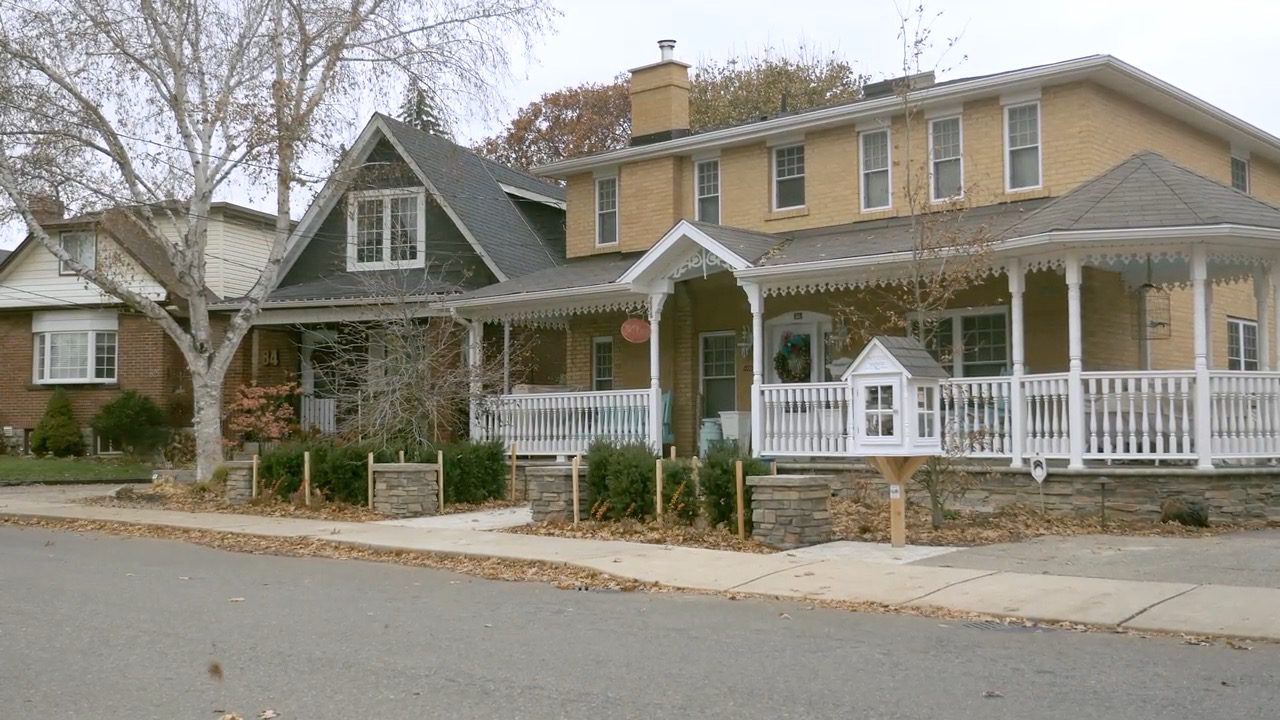
Old East York is a perfect neighbourhood for young families looking for large lots with big backyards and a driveway, to either build new construction or renovate. It’s close to parks, rivers and to the Lake.

Old East York has the best of everything in Toronto – it’s midtown oriented, so it’s close to downtown or uptown and it’s an affordable area just beginning to gentrify.

Learn more about Old East York with Jim Burtnick in the video below.

People of Toronto: Alex Bozikovic

12.5.17 | People of Toronto

Alex Bozikovic is a National Magazine Award-winning writer and staff editor at the Globe and Mail. Specializing in all things architectural, he also serves as the Globe’s architecture critic, and recently published his own updated version of the late Patricia McHugh’s book Toronto Architecture: A City Guide.

Can you describe your connection to Toronto, and, have you always lived here?

Yes, I’m more or less a native. I was born in North York and lived in the city in the suburbs for most of my life. I spent a couple of years away living in the New York area, but I have always been in Toronto and in the GTA. In fact, I have connections to several different places in and around the city. My mother grew up in Scarborough, my first home was in Downsview, I lived in North York, and then in York region, and now, finally, downtown. So a lot of places are home-ish. A lot of parts of Toronto are familiar to me.

What led you to become an architecture critic?

I was interested in cities and in urbanism and architecture growing up. Then as an adult in my twenties I decided I wanted to pursue architecture and urbanism as subjects, and just decided—more or less on my own—to chase those and educate myself. So I professionally sort of stumbled into covering architecture. One of the privileges of being a journalist is that you can write about things that you don’t necessarily know much about. If you push hard enough and ask the right questions you can find a way to do it.

So I started actually by writing for the magazine Azure; that was an important first step for me. They took me on when I was a freelancer. So through articles for that, for newspapers, and for other magazines, I started by writing about individual buildings – often houses, initially. And then I started to become aware of some of the larger questions about how cities are made. And where I can I’ve been trying to pursue some broader questions and broader themes.

Since I took on this role at the Globe I’ve had a lot of freedom to explore across a country – and sometimes out of the country—and to think in a holistic way about buildings and cities and the forces that shape them. It’s not just about individual buildings, but also about urban design, about urban planning, about broader questions that affect cities—around transportation, around the environment and climate change, and the social and economic context that shapes cities and buildings.

OCAD University by Vik Pahwa

What made you decided to update Patricia McHugh’s architecture guide as opposed to creating one of your own?

I got the call from the publishers McClellend and Stewart to discuss a new edition of this book. It had been out of print for a long time, but it was a book that continued to be read, continued to be in demand through libraries and book sellers. So it was a book that still had relevance. I had a copy of the book and had used it extensively, so I was excited to get the chance to revisit it.

It was the only comprehensive text on architecture and building in Toronto. It was also kind of intimidating in a sense because it was such a big project, and you do need to cover ostensibly two hundred years of history—not all of which I knew that well. In that sense, having Patricia McHugh’s edition to work with was reassuring, in that I could keep those pieces of her work that were still current and were still relevant, and also bring it up to date with some of the tremendous change that has happened in this city over the last 30 years. And put my own stamp on it.

Old City Hall by Vik Pahwa

McHugh was from the U.S originally. Do you think that being an outsider here shaped her perspective in a useful way?

I do. I think that outsiders who have come to the city—particularly Americans—have come here in many cases and seen what is good about the culture of this place, and have seen what is beautiful and interesting about Toronto. As outsiders, they’ve escaped the culture of self-deprecation. People from here tend to think of Toronto as being somehow inferior to other places. I mean, even if their own lives are good, even if their experiences of the city are positive, somehow life is better elsewhere.

I think if you come from somewhere else—as Patricia McHugh did—you don’t get that. So she loved the place, and she brought a critical eye and also a well-informed eye to the city. I’ve tried to do the same thing; I’ve tried to escape our usual restraints of thinking about Toronto, and tried to see the place through its history as what it is. As it really is.

[clickToTweet tweet=”People from here tend to think of Toronto as being somehow inferior to other places. Even if their own lives are good, even if their experiences of the city are positive, somehow life is better elsewhere.” quote=”People from here tend to think of Toronto as being somehow inferior to other places. Even if their own lives are good, even if their experiences of the city are positive, somehow life is better elsewhere.”]

I like to think that Toronto is full of places that an architecture critic would find interesting, but can you talk about a couple of specific buildings in Toronto that you think are particularly notable?

There’s one block that I like to take people to; it’s my favourite block in the city, which is part of the University of Toronto. It’s just east and south of St. George and Bloor, so on that block you have a few buildings that I think are extraordinary. You have Massey College, which was finished in the early 1960s, and is a really beautiful building that was designed by the Vancouver architect Ron Thom, which is a very personal and idiosyncratic version of modernism. It’s very warm; he uses a lot of natural materials, a lot of wood and brick, and it also has some ornaments, which looks back to Frank Lloyd Wright—ornament was something that wasn’t very popular through the 1960s, so this is a blend of different streams of 20th century architecture, and it’s very humane, and comfortable and beautiful. 

On the same block is another one that I think really represents the city, it’s called Woodsworth College. So Woodsworth College combines this couple of very grand Victorian mansions on St. George street with the brick and sandstone that was typical of houses in the Annex in the 1880s and 1890s—which still are very beautiful. And the new building that was added on to it is mostly a new addition from the 80s.

Woodsworth College by Vik Pahwa

It was designed by the architects KPMB very early on, just as they were starting their office, and it does a few things. Number one, it is very retiring. It’s a modern building that– in terms of the way it’s arranged on its site—defers to the older buildings that were there before. The materials it uses are stone and wood, which, again, are deployed in a contemporary way—deployed in a modernist way—but are very harmonious with what was there before. And it uses landscape. The architecture makes space for landscape—for a courtyard, you know, which is actually an important piece of it. So it’s modernism, but it’s modernism that defers to the 19th century streetscape. It uses details and materials that are very warm and humane, and is designed in a way to sit back, rather than to push forward.

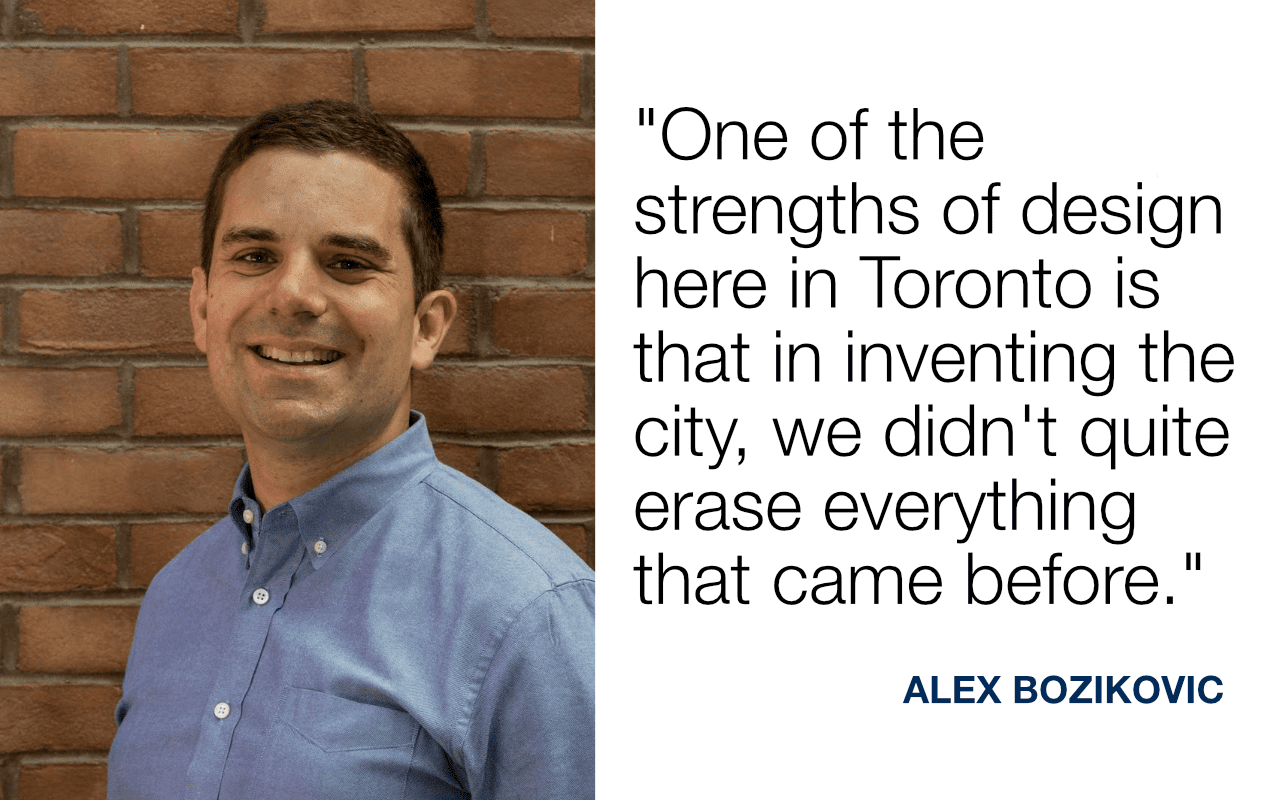
And I think that’s an important building in Toronto, because it represents maybe the most distinctive thing about Toronto architecture in the last hundred years, which is this: modernism in Toronto didn’t really overpower the 19th century city, and that’s an important thing because a lot of architects of the 1950s and 60s had a really hostile attitude towards the cities they were working with. They didn’t see a lot of value in older buildings, in older blocks, and in Toronto people did.  And the new buildings that were added, you know, in many cases people took care to preserve what was there before, and to not wipe out what had been good about the city. And I think that not many places have done that so well. And the result—when you have that conversation between the old and the new, the result… that product can be very beautiful, and I think that the presence of the past is important to architecture in Toronto. And that’s really one of the strengths of design here in Toronto; that in inventing the new city, we didn’t quite erase everything that came before.

[clickToTweet tweet=”Modernism in Toronto didn’t really overpower the 19th century city, and that’s an important thing because a lot of architects of the 1950s and 60s had a really hostile attitude towards the cities they were working with.” quote=”Modernism in Toronto didn’t really overpower the 19th century city, and that’s an important thing because a lot of architects of the 1950s and 60s had a really hostile attitude towards the cities they were working with.”]

What are your favourite cities, architecturally speaking?

Ohhhh, that’s a tough one. In terms of urban form, I would say it’s probably Amsterdam. You get a city that is consistently dense, so you get a lot of people and a lot of social life and a lot of commerce and a lot of culture, and all the benefits of having a lot of people living in an urban form that is also, very humane and very comfortable.  And there’s a coherence to the blocks that’s very pleasing.

On the other hand, I also like a certain amount of chaos, and a certain amount of disorder in cities is impossible to avoid. And in its own way it can be beautiful. And I love New York—as almost everybody does—even for the discontinuity, and sort of the way in which, you know, the  buildings in the city have accommodated people from so many different cultures, and there’s an interesting tension in New York between very tough constraints and really bold imagination. 

So two very different cities, which have their values; coherence and sticking together in Amsterdam, and jostling, boisterous and ambitious New York.

Hockey Hall of Fame by Vik Pahwa

Critique implies that you know what should be done. Given this, what should Toronto be doing in the architecture and urban planning department?

I think two things. Number one, Toronto has experience building new buildings that fit in with older ones, and I think we aren’t doing enough of that today. In a nutshell I think that more small-scale housing spread right across the city, both the old and new city, would be a great way of intensifying the city. I think it would be good economically and culturally for the city if we did that, if we built many smaller buildings—rather than a few towers—to spread out some of the people and the wealth into some of the neighbourhoods where many of us already enjoy living.

One more point though, about what Toronto should do. Architects use the term ‘vernacular’ to refer to the way that people build. And in Toronto in the 19th century there was a vernacular; you used brick, you built to a certain height, you used certain kinds of decoration and ornament to build your buildings. So there was a clear culture of building. Now we don’t have that so much any more, and I think it would be really interesting to explore what a new Toronto vernacular would look like. I think it would be really interesting if a lot of the new buildings in the city used good quality brick, and tried to use a certain traditional style, a certain consistency in their size and scale.

[clickToTweet tweet=”Toronto has experience building new buildings that fit in with older ones, and I think we aren’t doing enough of that today.” quote=”Toronto has experience building new buildings that fit in with older ones, and I think we aren’t doing enough of that today.”]

QRC West by Vik Pahwa

Should architects always be artists?

I think architecture at its best is art, but architecture is also the product of constraint. Buildings are shaped by technology, by economics, by planning restrictions, and by the culture of the place where they sit. They have to be. And to me, that’s what makes them interesting. Looking at the streets of Toronto, and looking at the buildings of Toronto, if you read them in the right way, you can understand a lot about the kind of place this is. Buildings reflect who we are. They way we build reflects who we are. So yes, architecture can be art—at its best it is art—but it is always something that is a product of a larger culture. And at its best it can do that while also being really beautiful.

What do you see as the proper role of an architecture critic?

For me, it is to explain to people why design matters to the way we live. To argue for examples of good design that are shaping the future we want to live in, and to help create an understanding of what makes for a good building, a good block and a good city. People don’t always understand why a building is good, or why a building is bad. They may not think about it. And I think it’s important to give people the tools to assess. I’m making judgments, but I also want people to develop the tools to make judgments for themselves, and to help build a better city.

JN00KV

New Video: Torontoism Team’s Vision

11.28.17 | Toronto Photo Essays

Here is our most recent video. Let us know what you think in the comments and please share on social media!!


The Effects of the Foreign Buyer’s Tax on Toronto’s Market

11.28.17 | Toronto & Neighbourhoods

As you probably know, there has been a lot of discussion over the Toronto property market. Labelled by media organizations as ‘the next Vancouver’ there’s been a significant increase in housing prices beyond what would be predicted from looking at historical data.

The provincial government eventually acted by passing the Fair Housing Plan in April 2017 – which included additional taxes on foreign buyers (the Non-Resident Speculation Tax, or NRST).

Today, we’re going to look at:

  • What caused the prices to increase so dramatically in Toronto
  • What the Fair Housing Plan is comprised of
  • The effect of the Fair Housing Plan on Toronto
  • What the long-term prognosis for property values in Toronto is.

Here we go!

Why did property values in Toronto go crazy in 2016?

Before we get to the Non-Resident Tax and the consequences for Toronto property values, we need to understand the long-term property trends and what happened in 2016.

From looking at TREB data charting MLS average house prices in Toronto, it’s obvious that prices have been increasing steadily since around 2009.

1

This is pretty consistent with global trends. Urbanization is happening at an unprecedented rate and cities everywhere are getting more competitive as a result. What’s more, fluid global capital looking for a place to call home often looks to real estate. Together, these forces drive up property values in cities.

However, when you look specifically at 2016, you notice a significant increase beyond the norm. So what happened?

To answer that question, we need to go back to Vancouver.

The Vancouver property market

vancouver-night

The Vancouver property market is by all accounts a property market that defies market forces and keeps going up. And there are a few reasons for this.

First, the rational economic ones:

  • Vancouver is a really nice place to live. Lots of people want to live there and there’s limited supply both in terms of housing and available land (there’s only so much ‘Vancouver’). Therefore, housing is expensive.
  • High prices attract real estate investors. People see opportunity and buy a second or third house.

However, there is a series of secondary reasons that have pushed Vancouver into a high-stakes housing bubble. One, but not the only reason is the role of foreign and domestic capital investment in real estate.

Investors, both foreign and domestic, look to Vancouver as a place to invest additional capital. A relaxed regulatory environment, a stable economy, and a solid property market made Vancouver an ideal place to park extra revenue for a healthy return. For example, the percentage of foreign buyers, at its peak, crossed 5 percent, higher even than the 4 percent rate in New York City.

Property costs in Vancouver eventually reached a point that provincial government felt it needed to act.

In August 2016, the provincial government implemented a 15 percent foreign buyers land transfer tax with the objective of cooling the Vancouver property market and bringing affordability back to the city. In short, they wanted to make Vancouver less attractive for global financial markets, reducing demand for investment property and therefore, making the city more affordable.

Which brings us to 2016.

With an additional 15 percent tax on foreign ownership, Vancouver wasn’t as attractive a destination for global capital. Investors started looking for other real estate markets to enter that had many of the same benefits, like a stable economy, and fair regulatory environment. They looked to Toronto.

downtown-vancouver

As more capital flowed into Toronto, houses became more expensive compared to one year earlier. In July 2016, YoY price increase was 16.6 per cent. By November, it was up to 22.7 per cent. Basically, the rate of increasing value was going up as supply failed to keep up with demand.

5

It’s clear that in August 2016, the Toronto property market started heating up, partly due to the reduced ROI of investing in Vancouver.

But there are other reasons for the accelerating demand. Toronto’s increasing strength as a global city and it’s 100,000 new immigrants annually are driving prices organically, according to Richard Silver of Sotheby’s International Realty Canada. What’s more, the national movement of people further fuels rising prices in 2016:

Business opportunities in both Alberta and Newfoundland that were tied to the oil industry brought people back to the business hub of the country in the GTA.

Combined, these factors caused prices to increase, and the spike drove government action.

How Toronto responded to the 2016 spike

This brings us to the Non-Resident Speculation Tax. Fast forward to April 2017 and we see affordability in Toronto has reached a crisis point:

  • Vacancy rates are extremely low, under half of what is considered healthy (source)
  • There’s a rent strike happening in Parkdale
  • Average cost of a home is at an all-time high
  • It’s the least affordable its been over two decades.
2

Clearly, there is not enough housing supply to go around. The problem reached a tipping point and in April, and just like in Vancouver, the provincial government was forced to act.

On April 20, 2017, they announced the Ontario Fair Housing Plan, a plan to protect renters, increase housing supply, and provide better and more financial and policy regulation around the Toronto housing market.

Included in this plan were provisions like:

  • Expanding rent control from building constructed before 1991 to all buildings in Toronto
  • Developing under-used government-owned land, like the West Don Lands, with mixed-use affordable and market-rate residential and commercial
  • Vacant home taxes to reduce speculation/capital parking
  • Increasing property tax (and cracking down on tax evasion) on secondary homes.

And of course, the plan included a 15 per cent Non-Resident Speculation Tax, aimed at reducing the flow of global capital.

So did it work? Did the NRST and the rest of the provisions cool the market?

The Great Cooling

Since April 2017, the market has certainly cooled. According to Richard:

[the market] has definitely slowed, but we as a team are just working harder. It allows us to do our job of negotiating rather than just getting clients to higher numbers as we were forced to do last spring.

You can see this in the data by looking at two main market indicators and comparing them YoY between January and September 2016 to 2017. It gives a sense of where the market was after the Vancouver decision and where the market went after the Toronto decision. We used TREB data to look at total sales and housing price. These indicators build a picture of how hot or not a market is.

3

As you can see, between January and September, the number of new listings plummeted after the legislation came in as fewer people were selling their homes and fewer people were buying them.

The sale relationship can be seen in price changes between January and September 2016 to 2017:

4

By September this year, YoY change in property values was essentially flat. Before the legislation, home prices could increase 15-20 percent in a year. By September 2017, that was down to 2-3 percent.

When it comes to foreign buyers, there’s definitely been an impact. However, it’s not because the tax increase makes Toronto property unattractive in terms of returns. Rather, it’s uncertainty about the role of government in the market. That uncertainty is a risk investors are unwilling to take, and they’ve begun to shift their focus elsewhere, especially Montreal.

According to Tracy An:

If [Montreal] had something over $800,000 it would take over two years to be sold… now , it can be sold in two weeks.

As long as there are more attractive markets, global investment will simply move on. It’s what happened in Vancouver and it’s happening in Toronto. And until there’s an incentive to come back (like profitable rental property) or no other, more attractive market to move into, global investment will continue to decline.

These graphs indicate that around the time of the Vancouver decision the Toronto market was booming, and the legislative response has been effective in curbing the market’s growth, if not substantially reducing price and number of listings. Because Toronto’s a growing city with a number of high-paying industries like consulting, AI, tech, medical research, and financial services, there’s only so much cooling that can happen.

In terms of market cooling, keeping market level the same rather than working to reduce prices counts as a win.

toronto-urban

Long-term prognosis

There is a flipside to this market cooling.

In Vancouver, the new foreign tax provided some relief from spiralling housing prices. However, it looks like that may have only been temporary. The CBC reported in August 2017, one year on from the tax’s implementation, that:

Analysts say home prices have continued to escalate, sales are on pace with pre-tax expectations and houses are largely still out of reach for most residents.

Essentially, the CBC (and others) found that it was more of a temporary lull rather than a significant cooling effect on the Vancouver property market would be.

The same thing might happen in Toronto. While foreign buyers have been scared off by the government interference in the market, the fact that rental markets can be so profitable (even with rent control) means that investing in Toronto might be too tempting to resist. However, there hasn’t been a significant return yet, particularly when there are other profitable markets that investment can go to. For some buyers, it’s definitely a game of waiting to see what the government does.

And while the Toronto legislation has a much larger scope and thus is likely to have more of an impact, there’s still a chance that the 2018 property market will be right where it was without this regulatory control.

More significantly, the Fair Housing Plan runs a risk of actually reducing affordability. Rent control, for example, is a superb tool to get votes but does little to improve the long-term affordability for the city as it reduces the incentive to build new rental housing. What’s more, while the city is making positive steps by beginning to redevelop areas like the West Don Lands, there’s still a lot of work to do, says Richard:

The land north of the City in the Oak Ridges Moraine must be allowed to be developed. Recently we had a listing of a beautiful house on 91 acres on the escarpment and the property could not be severed under current rules; another 90 homes could be built with beautiful one acre lots, in the meantime, the land just sits there.

Oak_Ridges_Moraine_map

Conclusion

Municipal housing markets are entering new and unchartered waters.

Hot markets are common and even a decade on, memories of the 2008 financial crisis and its over-leveraged buyers make housing a global challenge. Additional challenges around global migration patterns, growing income inequality, short-term rentals like Airbnb (and how to regulate them) combine to strain housing stock.

Toronto’s fair housing act combined new regulation, tenant rights, taxes, and municipal development plans to address housing supply. This sort of omnibus approach is going to be how housing challenges are solved given their inherent complexity.

Will it work? It seems to have cooled the market so far but looking at lessons learned in Vancouver in 2016/17 means that this could only be a short-term relief. And with rent control now implemented on such a broad scale, there’s far less incentive to build new rental housing the city desperately needs. However, depending on the level of municipal support for new developments, Toronto might be able to get the supply that it needs to bring the market in line with expectations.

SG00KV

A Guide to Preparing Your Condo for Sale

11.20.17 | Toronto & Neighbourhoods

Preparing your condo for sale can be tricky business. You have to take into account everything from the history of the market, where the market sits currently, the value of your condo, the value of the area around your condo, and even the perception of potential buyers. That’s a whole lot of material, and there’s an objectivity that’s necessary but difficult to achieve without the help of professionals—so that’s why we’ve gathered some for you.

Our first professional, Rizwan Malik, Sales Representative at Sotheby’s International Realty Canada, and he’s provided some advice about the sale process. Our second professional is Luanne Kanerva of Katu Design, who stages houses and condos for sale for Torontoism. She’s got the tips necessary to bring the best out of your condo, making it as appealing as possible. So let’s dive in!

Getting Started

Rizwan-Malik-smaller1

What are the basics? How different is preparing to put your condo up for sale versus, say, a house? Chances are you or someone you know has done the latter before, but maybe not the former; however, with condos gaining in popularity more and more every year, it’s important to nail down the differences so you’ve got them locked in when you finally make the decision.

Luckily, it’s pretty simple says Rizwan:

Putting a condo up for sale is quite similar to putting up a home for sale, however, there are some differences. When it comes to freehold, you own the property and can decide where to put the for sale sign or even the lockbox to assist agents in showing the property. This isn’t the case with a condo. The Condo board or property management will dictate where you’re permitted to place the lockbox. Also, you’re not allowed to have a For Sale sign because the lane outside the front door is common. Lastly, the condo board may not allow open houses. That is another thing to keep in mind.

When you’re in control of only one part unit in a whole building, it becomes a lot more about working with the management of that area than with your own wishes, but you should want to work together. The condo board doesn’t always have to serve as a gatekeeper, they want business as much as you want to make a sale, so why not work out the kinks with them and then find out a way you can use the rules to your advantage.

Don’t forget to order the status certificate

Rizwan provides insight into the kind of mistakes even the most experienced people don’t realize they make:

One of the biggest mistakes I’ve noticed that people make when selling… is not ordering the status certificate. This document is generally $100 and is purchased from the property management and speaks to the financial health of the building. Most condo purchases are conditional on the new buyer reviewing this document with their lawyer.

Ordering this in a timely fashion (read: early) means the sale can run smoothly and efficiently, because it’s something the prospective buyer doesn’t need to ask for, wait for, and then review. It can conceivably be kept at the ready for anyone interested and they can immediately take it to their lawyer.

Sellers or realtors who wait until the property is sold to order this document run the risk of holding the property for more than 10 days. The condo management, based on the condominium act, has only 10 days to do process this, or face consequences. 

lakeshore-boulevard

Make sure the property looks as close to the photos as possible

On the day of, a lot can go over your head or slip your mind because of how much else you’ve had to do to prepare on the back end. Rizwan’s got some practical advice about the showings:

Try to make sure the property looks as close to the marketing photos as possible. It doesn’t have to be 100 percent but as close as possible, because that is what the buyers fell in love with and that is what got them to arrange for the visit.

If you sneak attack a prospective buyer, they won’t just become disinterested, they’ll be turned off of the whole idea. The greatest method of selling is to just put your best foot forward (or, in this case, pictures), and act honestly.

Put your valuables away! If there is a potential that something might fall/break then pack it away. Don’t tempt fate!

Rizwan understands there’s a real danger that comes with strangers in your home, no matter how innocent the situation. Things can always go wrong and it’s not worth having your priceless vase on display for only the possibility of a sale.

These are the questions you need to prepare yourself for

So what are some of these oft-forgotten questions? Rizwan listed these:

  • How much money is in the building’s reserve fund?
  • When was the last financial audit?
  • Any special assessments from the condo board?

The best way to have these answers is by ordering the status certificate at the start of the listing or even before you’ve moved on to the listing portion of the selling process. With that piece of material, any relevant question will be easily answered.

If you have tenants, here’s what you need to do

If the property is tenanted, you have to provide 24 hours notice before all showings. I usually suggest offering tenants a complimentary cleaning every two weeks while the property is being shown, because it is in the Seller/Landlord’s interest for it to show at its best.

So, be civil, and be accommodating. Give your tenants time, and they’ll appreciate it.

When it comes to informing the buyers about tenants, don’t be afraid to do it. It’s not so difficult and they may want the property for exactly the same reason! 

It will appear on the listing that the property is tenanted. In some cases if the purchaser is an investor they may choose to keep the tenant (if the tenant wishes to stay).

If not, once again, you’ve got to be accommodating to both parties. Ultimately, it’s your property, and you may do with it what you will, but treat the subject gingerly and express your support to the tenant during the process, whether it’s just a transition of the landlord or they must leave.

Remember: Space sells

Once you have all your documents ready, it’s time to prepare the property:

Sellers should prepare the condo no different than a home. Condos are typically much smaller than homes so therefore, should have even less clutter. It is crucial to show the space in its best possible way.

This is a perfect way to segue into the excellent advice we received from Luanne! Let’s explore the more aesthetic, appealing side of the process.

533 Richmond Street
533 Richmond Street

The tentpoles of staging

Luanne Kanerva starts off simply. These are the tentpoles of making a condo look great:

Lighting, flow, and perception of size and use of space.

Show off your property’s capabilities. Leave the space open to imply how much could go on there, and how it could be used for a variety of purposes, or work with a variety of aesthetic looks.

Buyers comment on the above characteristics because as prices increase the condos that are in their price range become smaller. Sellers need to ensure their spaces are bright and well lit. Some condos don’t have windows in all the rooms so it is very important to have sufficient light… [and] selling is not the time for mood lighting. Layers of light are great. Even if there is an overhead light, there is no reason not to have a lamp to create light at different levels.

8-park-road-toronto-2

Without the aid of natural light, which almost always brightens and opens up a room, use multiple lights to achieve the same effect. Keep quality high, with bulbs at their brightest unless purposefully dimmed – though avoid that as much as possible, as you want the buyer to create their own ambience, not inhabit yours.

Make sure there is a natural flow to the space

Next very important thing is flow, says Luanne:

Flow is how the buyer or buyers’ gaze moves from room to room. Is there a natural feeling?

This is where de-cluttering, and thinking smartly about where you place your furniture comes in handy. You, again, want the potentially small space to seem open. That means creating a path with which the eye follows easily, to the point that it doesn’t even know it’s following a path. That natural look and flow is exactly what makes somewhere foreign feel homey, and inviting. 

Paint rooms the same or similar colours, and use the same design elements throughout.

Luanne’s Rules on Clutter

  • Clutter has to go. Buyers want to see your house, not your stuff.
  • Every surface should have no more than three decor items on it.
  • If it is not furniture, then it should not be on the floor.
  • Don’t buy more storage, get rid of stuff.
  • Never have the back of your furniture facing the entrance of the room or cutting the room in half if there is any other option.

The buyers want to see a finished home, not a half-done project

Buyers do not want to look at a half-finished project. They want to see a finished home and imagine themselves living in it, their way. And this is where sellers usually make a mistake by doing it “their way”. This just makes the property seem less accessible, since the seller’s taste might not be what the buyer is looking for. On the other hand, it’s important for the property to be in move-in condition and buyer usually pay more for such properties. Just make sure to keep it neutral:

Repair, upgrade, or paint. Getting it done first will pay off. It shows you care about your property. Sellers should not undertake projects that they are not going to do well or that are of a particular taste – such as country theme dining room. The risk is too high.

Pick neutral colours for the walls

Colours, furniture placement, lighting, and flow: the elements of a good staging. We’re back to it, but with a harder focus on specifics—colours, furniture and trends.

Colours tend to change with the trends and the seasons. Right now… light grays and warm grays for neutral walls; neutrals and light colours. Add colour in the art or accents. Blues are on trend right now, blue accents can be added anywhere.

Keep the larger stuff simple, and add specificity and flourish in the details, so they don’t detract. 

I wouldn’t paint a living room blue but a bathroom or bedroom would be great. Red or burgundy dining rooms, and green or yellow kitchens and baths are bad choices for selling.

8 Park Road | Lots of light

Every room should have a purpose..and the purpose should show!

Rooms should be set up so a buyer can immediately see the purpose of the room. That means you need furniture, even though it might seem that the rooms look bigger without it:

If you have a small bedroom, show a bed which fits. Always show the largest bed that will fit comfortably. Some people think rooms without furniture look bigger but that is not true at all. With furniture, a buyer can see what fits and what else might fit.

You must think about the sale from a buyer’s point of view, not from your own

You might think about how the room looks from where you sit at your desk, or from in your bed, but the buyer isn’t going to sit on your bed or at your desk, they’re going to keep with the flow and take a cursory look at all of it from the best vantage point they have: the entrance. 

Luanne says it’s important to bring in an outside perspective.

Have an honest friend walk around and tell you what they see when they are in your condo. We often become oblivious to our space because we see it every day.

Remember, buyers are buying a dream of what their lifestyle could be like if they lived in your condo, says Luanne:

Sellers need to show the best possible lifestyle—not overcrowded closets and broken-down furniture they have had since college.

8-park-road-toronto-4

Last Thoughts

There are updates buyers will notice, and updates they won’t notice at all, so you’ve got to keep in mind what may at first seem important but later seem frivolous because of how little attention was paid to it:

Sellers often focus on what they wanted to change while they lived in a space. But the things buyers notice are updated paint, light fixtures, switches and outlets. The things that date a space. So frivolous would really only be something seller is hyper focused on that most buyers wouldn’t notice. I find it is usually something specific to each seller! That is where a professional can really help focus on the most cost efficient updates.

The market is now, and if you have the ability, this is exactly the kind of information that’s going to put you at ease in what can normally be a pretty stressful situation. But you don’t have to go through this alone. If you want to sell your condo, contact us and we’d be happy to help you and answer any of your questions.

AS00KV

Richard Silver: The Changing Face of Canada

11.15.17 | Business

Richard Silver 0013 small

It’s all a question of mathematics and global economies. China and India lead the world in growth and their growing middle classes are each the size of the population of Canada and the United States combined.

Asia Pacific is now and will continue to be the leading player in the world and will continue to extend into our markets and community in the Greater Toronto Area. Parents realizing this change will push the second language as Mandarin and it may become the second language in non-Asian homes supplanting French.

We are still in the foothills of Asian investment in Canada. Property rights as we know them in Canada do not exist in most countries and in China, the land is leasehold to the government for 70 years. There are also restrictions on home ownership…If you live and work outside of a centre like Beijing or Shanghai, you need government’s approval to move to those cities.

[clickToTweet tweet=”Asia Pacific is now and will continue to be the leading player in the world and will continue to extend into our markets and community in the Greater Toronto Area.” quote=”Asia Pacific is now and will continue to be the leading player in the world and will continue to extend into our markets and community in the Greater Toronto Area.”]

The ultra-wealthy have money and property all over the world and they are looking for security, health care, education and relatively clean air. They are very family oriented and will buy legacy properties for their children and parents. They are very pragmatic in purchasing, not driven by architecture as much as a community with proximity good schools, universities and hospitals. Community gardens and parks are also seen as having great benefit.

As you have probably heard the Chinese government has tightened restrictions ($50,000 per family member per year) but the growth there is so large, that companies and “High Net Worth Individuals” (HNWI) are looking overseas for Investment. As long as Canada is the clean, safe location for foreign investment, we will continue to be in the top five destinations for foreign consumers. Just as it did decades ago and will in decades to come, the face of our neighbourhoods will be changing.

RS00KV