Richard for Mansion Global: Toronto’s Healthy Luxury Real Estate Market Predicted to Carry Over to 2017

02.17.17 | Media Mentions

Mansion Global quoted Richard Silver in one of their recent articles about Toronto’s luxury housing market. Here are a few of the most important points from the article. And you can find the full version here. 

By Becky Strum. Originally posted on Mansion Global, February 15, 2017

Toronto’s housing market has been experiencing a strong price growth over the last few years, thanks to tight inventory, population growth and low interest rate. According to TREB, Toronto saw the strongest sales increase of any other Canadian city in 2016. And while the average price was 20 per cent higher in December 2016 than the year before, the luxury market experienced a 32 per cent increase in prices. 

“We have a lack of inventory, and like a lot of cities, like New York and Chicago, there’s only so much space for new developments,” Richard said. “There are a lot more people coming into the market than there are people leaving the market.”

What neighbourhoods are considered to be Toronto’s luxury market?  

Well, there C02, also known as Toronto’s “posh” district, located north of Queen’s Park and the beautiful 19th-century building housing Toronto’s legislative assembly, and includes Yorkville. Then there is the Annex, Rosedale and Moore Park. And outside the city centre, you have

the C12 – the most expensive district in the Greater Toronto Area, with an average sales price of $2.5 million, according to TREB. It includes posh neighborhoods like Lawrence Park, Windfields and a collection of estate-lined blocks called the Bridle Path, residents of which have included late singer Prince and former newspaper mogul Conrad Black. The neighborhood was also used to film the home of “Mean Girls” queen bee Regina George. 

“In that area there are massive houses selling for huge prices. That seems to be very popular for those who want an acre or two-acre estates,” said Richard.

This is the district with the fastest growing prices. The average sale price has increased by 31 per cent since 2014, and the median sales price has jumped by 40 per cent, according to TREB.

Local buyers are fueling the growth 

Taimur Khan, a senior analyst at Knight Frank says that “local buyers have fueled most of the growth thus far, though foreign investors have played a role at the top of the market—particularly those taking advantage of the weaker Canadian dollar against the U.S. dollar and dollar-backed currencies.”

In 2016, 55 per cent of sales to non-resident foreign buyers in the GTA, including suburbs, were sales of a primary residence for a family member. A lot of parents from China or Saudi Arabia for example, invested in properties for their kids who attend universities in the GTA, or bought them as second homes for themselves.

However, the Mansion Global writes that “the significance of foreign buyers in Toronto is much more limited than in fellow cosmopolitan, luxury hubs like New York or London, experts said. Foreigners accounted for only 5% of the city’s home buyers in 2016, with the average home costing them just under $1 million, according to TREB.”

When Vancouver’s Foreigners’ Tax was implemented at the end of 2016, some suggested it will bring more foreign investors to Toronto. TREB says there is no evidence to support these suggestions, but it’s actually local buyers who have driven Toronto’s strong price growth, thank’s to city’s strong economy, low levels of unemployment and low interest rates.

SK00SK

Richard for CBC News: Foreign home buyers love Toronto for the schools

02.6.17 | Business

Richard Silver, a Sotheby’s realtor and past Toronto Real Estate Board president who works with foreign buyers, told Metro Morning host Matt Galloway that most of his foreign clients are coming to Toronto for educational and business opportunities, not just to park their money offshore, and that a foreign buyer tax would be a bad idea.

TREB is making a concerted effort to lobby against a possible foreign buyer tax on homes in Ontario, arguing that such a tax would be ‘misguided’ when just 4.9 per cent of its member agents acted on behalf a foreign buyer in 2016.

But Silver also said TREB’s figure significantly understates the proportion of foreign buyers in the GTA, as it only captures home resales — not sales of new construction.

Matt Galloway: Who are the foreign buyers that you’re working with?

Richard Silver: You know, it changes. Right now we have been doing a lot of business with Asia, with people from mainland China. What we’ve done is, we work for a very international company, we’ve gone out and added people to our team who speak Mandarin. We’ve gone to Asia three times, I’m about go to Delhi again for a weekend conference in a couple of weeks. You have to go out, you have to meet people, you have to understand their sensitivities, what’s driving them to buy.

A lot of it focuses on the education. So having great education in the city of Toronto, both in the post-secondary and secondary, I think is very, very important, because that’s what they’re looking for.

MG: Language skills are one thing. Going there is something different. What do you learn about who the potential buyers are when you’re actually on the ground in those countries?

RS: It’s really from the questions. A lot of people have the questions about … they know about Toronto, they know about Vancouver, they want to know which is the city that you should buy in. They want to know mostly about education. Seriously, you have to have an idea of the ratings of all of the private schools, the public schools, the universities. And you can know that those are the locations that people are going to be looking in. It has to be accessible to a university or a private school or a very well-rated public school.

MG: So the belief that you’re seeing is that people actually want to live here.

RS: Oh, definitely.

MG: Because in Vancouver, one of the huge problems that people pointed to is that this was essentially money that’s being parked offshore, that people were coming, buying properties, the properties are empty, it led to empty neighbourhoods, empty buildings, we’ve seen this happening all around the world. That’s not what you are seeing?

RS: I think that that is probably part of the case, not in the case that we deal with, we deal with people who are really coming here … you know, sometimes we have to decide, what is a foreign buyer? Is a foreign buyer somebody who’s already applied for and got their permanent residency? And, is it because they want their children educated in Canada?

We see a lot of husbands continuing to work in mainland China, they send their wife and their children to Toronto so their kids can go to university here. And after university, there’s an automatic three-year work permit that goes with being a foreign student in Canada. So that is an option that you wouldn’t get in other countries.

MG: So based on that, and the business that you’re doing, how much of a presence do you think foreign buyers are in this city’s market right now?

RS: Well, remember that the statistic from the Toronto Real Estate Board is about five per cent — they say 4.9 per cent. And I wouldn’t disagree with that, in that that is what the agents are dealing with who deal mostly with resale. Toronto Real Estate Board figures are resale buyers. They’re not people who are buying new construction.

So I would think that there’s also a lot of investment in the new construction. And in that new construction, the buildings that are being built, Toronto Real Estate Board doesn’t get that information very much from the builders, it’s not reported on the Toronto Real Estate Board. So, I would say there’s probably another five to ten per cent there that’s definitely foreign buyers.

READ MORE: LOCAL BUYERS OUTNUMBER FOREIGN BUYERS IN NEW CONDO CONSTRUCTIONS

MG: Now this is interesting, because it’s a point of dispute. The real estate board in Greater Vancouver said that foreign buyers made up something like four per cent of transactions in that city. Sales have slowed dramatically since the foreign buyers tax came in. So how do you explain that, if it’s only four per cent in Vancouver?

RS: Well, I don’t think it’s dissimilar in Toronto as well, from the board viewpoint, because the board deals with resales, they don’t deal with builder projects.

MG: And that’s the discrepancy?

RS: And that’s the discrepancy, I think. I think if you were to add the two, you’d come up with a higher figure. But the ones the Toronto Real Estate Board deals with, the ones we deal with in our market place, are people who have come basically for schooling. They’ve come because Toronto is the centre of arts and culture, and they can speak their own language.

MG: What has it done to affordability in this city? Because in Vancouver, people pointed — and this led to accusations of xenophobia and more, but people point the finger and say, ‘the market is being torqued because of offshore money coming in.’

RS: Part of the problem is, when you travel around the world and you look at the other G8 countries and you go to the main cities that those countries are led by economically, our prices are very, very low in comparison …

MG: That’s cold comfort, though, to people who can’t afford to get into our market.

RS: It is, but there’s always … I remember buying my first house, I lived in a house and there were seven or eight people living in the house with me, and I bought that house, and they were paying me rent, and it was just one of those things that we did. You need to get into the marketplace at any point, and these days people are getting into the marketplace in condominiums, smaller condominiums.

MG: There have been calls for Ontario to introduce a foreign buyers tax like the one in British Columbia. What would that do to the people that you’re working with?

RS: You know, it wouldn’t do much, and I think that’s the same problem in Vancouver. I think what it will do is, and I think what is happening is, Vancouver and B.C. are going to start feeling the effects of the tax more in terms of building, in terms of construction, in terms of lumber, in terms of finishing, carpentry and everything. I think that is really going to hurt their economy, and it’s already starting, they’re already starting to see that. I would really not suggest it in Ontario as well.

MG: Are you seeing buyers who are looking at Toronto because of what’s happening in B.C.?

RS: Not as much … to me, Vancouver is a completely different city. I always say, Toronto is the place where you come and make your money, Vancouver’s where you go and spend your money. You know, it’s absolutely beautiful, there’s lots of recreation around it. Toronto’s a place very focused on business. And I think for certain groups, that’s going to be very prominent for them. They want to be where the business is.

ORIGINALLY PUBLISHED ON CBC NEWS

Jim Burtnick: Toronto’s Real Estate Continues to be a Safe Investment

02.2.17 | Business

For anyone expecting to see a downturn of Toronto’s housing market, the Canada Mortgage and Housing Corporation says 2017 won’t be the year.

At a recent condo seminar held by the CMHC, the group laid forth it’s predictions for the upcoming year. Jim Burtnick, a member of Torontoism, broker and senior vice president at Sotheby’s International Realty Canada, was in attendance. He says CMHC is pointing at rising prices and a somewhat dwindling supply, but the health of the market is expected to remain strong.

CMHC sees sales coming in somewhere between 100,000 properties sold and the 113,000 we saw in 2016. Burtnick says that’s not enough to call it a retraction.

Not so much a slow as a maintain-where-it’s-at. I mean, the difference between 110,000 and a 113,000 sales is not huge. That is three-thousand less than last year. So almost basically the same and it would be the third straight year where sales were above 100-thousand sales.

Shrinking Vacancy Rates And Condo Bidding Wars

One of the biggest impacts we’ll see in the coming months is on the rental market. CMHC says competition for condo rentals remains high.

“Literally there are people lining up,” says Burtnick. “Like if you put a condo out for rent you’re getting multiple people bidding on it.”

About 80,000 people move to the GTA every year. They come from overseas – Toronto attracts the highest number of immigrants in Canada – or from other provinces like Alberta and Newfoundland & Labrador where the falling price of oil has impacted those economies. That creates a lower vacancy rate.

Currently, as Burtnick points out, the vacancy rate is below one percent. But that could drive more builders into the sector.

A healthy market is somewhere in the neighbourhood of 4 percent. So you’re actually seeing some of these pension funds getting into the rental market and they’re building new purpose-built rental properties because that’s going to give them the kind of ROI on their fund that they need to finance their pensions.

Another of the CMHC’s predictions shows apartment resale inventory is dropping. That can lead to bidding wars, according to Burtnick, because there’s less condo inventory available.

He says that Toronto used to have around a 4-month supply of condos ready for new buyers, now that supply has dwindled to around 1.5. Because there are simply fewer options, people are willing to spend more.

READ MORE: WHO ARE THE CONDO BUYERS IN TORONTO?

Toronto

Affordability And Rising Prices

While prices may not rise as much as they have in the last couple years, they’re still expected to head higher. That creates a problem for many first time homebuyers whose income is outpaced by the price of a new home.

High prices are causing more people to look at the GTA’s suburbs as a viable option for home buying. CMHC shows prices rising in the areas surrounding the downtown core by more than 20 percent, while Toronto-proper–where prices are already high–is expected to see a hike of a little more than 14 percent.

“The city’s become so expensive that the only options are outside the core so more people are looking out there and that’s driving up the price outside the core,” says Burtnick.

The CMHC also shows that high prices throughout the GTA are effectively pushing some would-be buyers out of the market. The downpayment for a home costs more than the average Torontonian makes.

Toronto’s becoming a city like Manhattan in New York, where you’ve got to have a lot of money to be able to afford to live there. They’re suggesting that, just based on fundamentals of people’s actual income versus the purchase price, it’s becoming problematic.

But what the CMHC’s numbers don’t show, according to Burtnick, is an increasing reliance on the Bank of Mom & Dad.

“A lot of parents are helping kids get into the marketplace,” says Burtnick. “So even if their income isn’t enough to justify the purchase price they’re supplying typically a health deposit so they can get a foothold on the real estate market.

There was a period a few years ago when many believed too many buildings were being built. It fed into fears of a bubble in the real estate market. Even today Burtnick says it’s not uncommon for people to point to the number of construction cranes and say the sky is falling.

But if supplies are dwindling to the point that bidding wars are common, or that it’s causing prices to rise so much that the average person simply can’t afford it, shouldn’t that show that we’re not building enough? According to Burtnick, neither is true. When he looks at the CMHC numbers he sees the city growing to fit it needs.

Certainly if you look at the overbuilding aspect, we’re not overbuilding in any stretch. We’re basically maintaining our natural need based both on immigration and based upon natural birth and death rates.

The reason that prices continue to rise in the GTA, putting even more pressure on buyers, is a lack of supply according to Burtnick. Getting through the approval process for new buildings simply takes too long.

“It’s taking too long for developers to get projects approved and shovels in the ground so that they can provide new inventory.”

Students from all over the world seek education in Ontario

Read more: top 6 universities for international students in ontario

Employment Growth vs. Shrinking Dollar

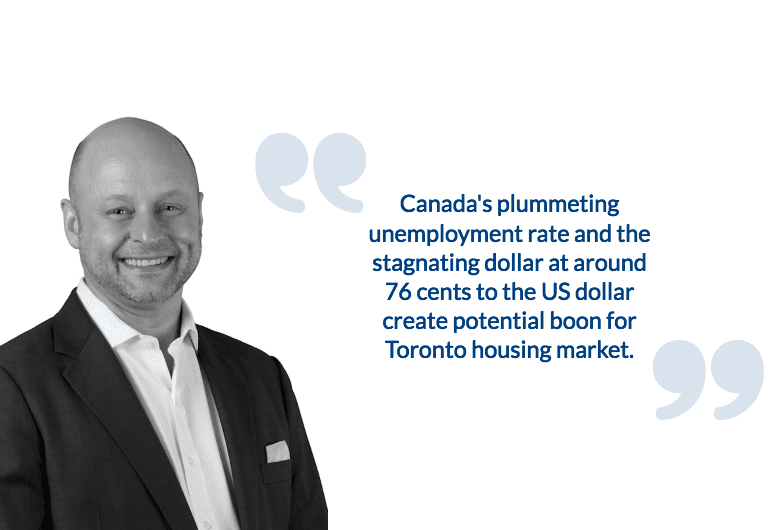
Looking at the broader picture, Canada’s unemployment rate continues to plummet, but the dollar has also stagnated around 76 cents to the US dollar. Burtnick sees that as a potential boon for Toronto’s housing market.

“What a lower dollar means is certainly Canada becomes more attractive from a point of view of an exchange rate,” he said. “So from a foreign point of view it makes us look on sale and relatively inexpensive.”

He points out that this could attract foreign buyers, but just as likely their may be Canadian expats looking to return to the market.

“They might see this as an opportunity to get a good bang for the buck, especially if they’re getting paid in US dollars.”

The tumult south of the border could have a further impact for the region as well. Canadian universities are reporting an influx of applications from the United States. A poll by the Globe and Mail reports a spike of between 20 and 80 percent for the 2017-18 academic year compared to the previous year.

But while it may be easier for students to come here, Burtnick doesn’t anticipate as many people coming looking for jobs.

It’s not like they can just come here and start working right away if they need to work. Because you’d have to have a work visa if you’re not a Canadian citizen. I think some people are looking for education coming up here. Certainly our education system is a lot more affordable than the US.

Toronto is experiencing influx of new residence not only from foreign countries, but also from other parts of Canada

The Interest Rate Question

One of the big questions over the last few years, and one that will continue into 2017, is when will the Bank of Canada raise interest rates? BoC governor Stephen Poloz has intimated that he has no plans to move rates given the unpredictable times we’re living in. But as Burtnick points out, the U.S. Secretary of Treasury Janet Yellen has intimated she could see as many as three rate hikes throughout the year.

That would attract investors to the U.S. bond market and although the Bank of Canada hasn’t raised their benchmark rate, for banks to raise money for mortgages they’re going to have to offer a better bond rate for people who are putting up the money for these mortgages. So if the US raises their benchmark rate I can see our mortgage rate going up.

Regardless of what happens on the international stage, Toronto’s housing market still looks like a safe investment to many buyers. An equilibrium has been reached between supply and demand that creates opportunity for investors, but still leaves some room for new buyers to join in on the fun.

TT00ML

International Real Estate: London is still London

02.1.17 | Business

From the United States to Great Britain, there is a lot of anxiety about the future and that kind of instability can have a strong impact on housing prices around the globe. While the situation South of the border is still too fresh to fully assess the situation, there is much talk of what will happen to real estate in Britain following the country’s decision to leave the European Union.

One recent forecast found that housing prices in the UK will rise between 1 per cent and 4 per cent in 2017, a sharp drawback from 2016 gains. The same forecast also pointed to a possible drop of housing prices in London.

Uncertain Times

simon

In times like this, it’s not uncommon for homebuyers to look abroad for more stable options. Canada can often look like an attractive destination for people who want to park their money in a safe and secure economy. Brexit has created uncertainty in the UK, but whether it’s enough to draw people away from a city like London remains to be seen.

Simon Tollit doesn’t think it is.

Tollit, who is a Real Estate Professional in London, England with Sotheby’s International, says there’s more to the story.

It’s creating uncertainty, but Brexit is not the reason why the UK and London are seeing a deteriorating property market. That’s all down to down to Stamp Duty.

Stamp Duty Land Tax (SDLT) is a government tax home buyers must pay when buying a property. Tollit says if a person buys a property for 1.5 million pounds, they pay 12 per cent on the stamp value. So if the home sells for 10 million pounds–which isn’t unheard of in London–the buyer pays 12 per cent on the total between 1.5 million and 10 million pounds.

“So basically it’s made it very, very expensive,” said Tollit, who points out that in the last year the government also increased the Stamp tax on additional homes and investment properties a further 3 per cent. Tollit says that’s the main reason housing prices have fallen in London.

Sherille visited Sotheby's International Realty offices in London in December 2016. Simon Tollit is on the left.
Sherille visited Sotheby’s International Realty offices in London in December 2016.

Looking Abroad

Sherille Layton was born in the UK but immigrated to Canada with her husband in 1999.

We came here on holiday and just fell in love with Toronto. We applied back then and got our visa within 3 months. In fact, we got our visa I think seven days before 9/11. Now it’s taking people three years, so we were very lucky.

The newer visa restrictions may also make it harder for anyone thinking of moving to Canada. But Layton says she attended an immigration summit in December and saw some signs that people were moving here.

I was sitting next to an immigration lawyer and [they said] a lot of people are going through Quebec to get their visas because it’s faster. So I think there’s definitely a lot of eyes on Canada.

London Is Still London

Tollit has a hard time believing Brexit would be the impetus for anyone moving abroad.

I can’t think of one person who said ‘right, on the back of Brexit I’m selling. It might be one of many reasons why someone would sell, but it’s not a defining reason.

Especially when it comes to international buyers, the appeal of living in London outweighs the potential drawbacks of a post-Brexit world. Some are [concerned about Brexit], but if you’re looking for a long-term investment or you’re looking for a home, you’re going to spend time in London.

He says anyone with business in the city or country isn’t likely to be scared away by the changing political tide.

Guys who’ve got 5,10 million pounds to spend generally are pretty intelligent, switched-on people by the virtue of the fact they can spend 5, 10 million pounds on a property. So they’re not stupid and they’re guided by experts. So as long as properties are priced correctly there is still a market.

Sherille agrees, saying the rising cost of living will definitely have an impact on the housing market, but people will always want to live there. Just like the rising cost of living in Toronto is not driving away population, but attracting it.

I think probably the first part of the year people will just try and buy because they don’t know what the future is going to be like. Although, anybody that I know still in the UK were quite shocked about the whole Brexit thing.

And while London may be seeing a bit of a dip, people are still buying throughout the country. In fact, another recent study from Halifax points out that the number of first-time buyers in the UK reached an all-time high in 2016.

Richard and Sherille in London during The Torontoism Team international trip in December 2016.

Still Some Movement

That said, there does appear to be some movement. Whether that’s related to housing prices is hard to say, but Sherille says Toronto remains an attractive market for buyers.

If you look at the Toronto real estate market 2016 was another record year. The average price of a home was 730-thousand dollars. The market increased by 17 percent. And she expects 2017 to be quite similar.

There’s a lot of turmoil in terms of the G8 countries. Who knows what’s going to happen in the US. England’s all over the place. France, Italy. We might look boring but we’re pretty steady.

The Torontoism team recently joined the UK-Canada Chamber of Commerce, the 94-year-old non-governmental body that serves as an authority on trade and investment between the two countries. Sherille says they’re reporting a lot of movement between the UK and Canada.

There’s been a lot of immigration lawyers becoming members of the Canada Chamber of Commerce, so that would also suggest there’s going to be quite a bit of movement this way.

Can you keep up with the fast paced market?

The Road Ahead For The UK

So while you may start hearing a few more English accents over the next few months and years, don’t expect bangers and mash to be added to the top of every menu in the city.

“London is still London,” said Tollit.

It’s still very much an economic powerhouse and we’ve still got the time zone, we’ve still got a good legal system, a fundamentally strong economy, the service sector’s good, schools are good. So all of those factors are always going to play into people wanting to live there.

Tollit says Brexit does not signal a doom and gloom scenario for London. The market is simply pausing for breath. After all, the city’s real estate market has grown steadily for the last few years.

You can’t have 10, 12 per cent growth year-on-year forever. It’s just unsustainable. So it’s a cycle we’re going through. We’ve been here before and we’ll come out the other side.

TT00ML

People of Toronto: Luke Anderson – StopGap Foundation

01.30.17 | People of Toronto

The role of an engineer is to solve a problem. And I believe that the work that I’m doing now is helping solve a problem.

On a windy afternoon in the first week of 2017, I sat in the bustling lounge of the Centre For Social Innovation on Spadina Avenue and listened to Luke Anderson talk about some of the problems that he is working hard to solve. Problems such as the steps that lead from the sidewalk into a store, for instance – an architectural feature so ubiquitous that I’d never even thought about them, or noticed them, or wondered how on earth someone in wheelchair deals with them.

Anderson started dealing with them 15 years ago, when an accident left him partially paralyzed and made – by his estimates – almost two-thirds of Toronto off-limits to him. Determined to change this, Anderson started up the StopGap Foundation, a non-profit devoted to installing ramps in Toronto-area businesses. The Foundation – which has grown to include 30 or 40 volunteers – has its office at the CSI at 215 Spadina but is responsible for inspiring the installation of hundreds of ramps across the country.

What is your connection to Toronto?

“I grew up just North of Toronto, and did my undergrad at the University of Waterloo. But a passion for mountain-biking took me to B.C. after I graduated in 2002. A mountain-bike crash caused a spinal cord injury and resulted in a need to come home and be back with close friends and family for my rehabilitation and, just, new life, really. Learning how to navigate my way through a world that’s really not well suited for someone who uses a wheelchair.”

And you weren’t the only person being cut off by this lack of accessibility.

“No, it wasn’t just myself who then wouldn’t be going into a business, it was the friends I was with who would also be barred from shopping there because they wouldn’t bother going in if I couldn’t. I also started to realize that parents pushing strollers, delivery people, elderly, other mobility aid users – they all had an issue with this situation. And nothing was being done about it. The city wasn’t doing anything to alleviate some of these issues. New buildings were being built – and are still being built – with stepped entryways. And I wanted people to start talking about this problem. I wanted people to start thinking about great ideas that could help overcome these issues. And my frustration really reached a tipping point where I needed to figure out a way to get this issue on people’s radar.”

And this frustration turned into the first StopGap ramps in 2011?

“The first project really, I kind of took it on as a side project. I was working full-time as an engineer, and I wanted to experiment with this concept of gifting thirteen business in a neighbourhood with free ramps, just to see what would happen. That’s really where I thought the project would end. I didn’t think that it would stimulate so much interest, and when it did, we realized that there was a real need – from small business owners that were participating, because they responded really well to what we were doing. And community residents responded really well.

The media picked up on our project and wrote stories about it. It all pointed towards doing more of that work. So we moved to different neighbourhoods throughout the city and developed some really great experience on how to effectively implement our project. And then we’d been getting requests from other communities wanting to take on this project as well, so we put all that learning into a document and put together other templates and resources and shared them with those communities.”

[fvplayer src=”https://www.youtube.com/watch?v=5UxUhiFE2Eg” splash=”https://torontoism.com//images/2017/01/a-stop-gap-story.png” width=”780″ height=”586″ caption=”A StopGap Story”]

Can you name some of the Toronto neighbourhoods where you’ve installed ramps?

“The Junction neighbourhood was our very first, Kensington Market was an early one. The Danforth. Mount Pleasant Road was another, The Beaches. College Street, Bloor, Bloor Street West. We’ve been all over the place. Leslieville. The most recent one was maybe Queen West, and, like, East Danforth neighbourhoods.”

How has StopGap grown and changed since it began?

“Well, since 2011 those 13 ramps have expanded into over forty different communities right across the country, with over twelve hundred ramps. People have started up their own version of it. So they take on their own chapter of what we’ve started here. And using our information and our resources, our templates and our consultation they do it all under their own steam. But oftentimes we will hear from business owners on a one-off basis. So business owners will contact us and say ‘Hey, we would love a ramp. We noticed that our neighbours have them, they love them, we want one now too!’ So we’ve developed a Ramps on Request program that allows us to respond to those requests. So we’ll hire a contractor and build a ramp.”

Luke with Lowe's Canada volunteers
Luke with Lowe’s Canada volunteers

You quit your job two years ago to run Stopgap, and are now its only full-time employee. What does that entail?

“Well, there’s a lot going on. We’ve developed a school program where we visit schools to talk about what we do and invite school groups to be a part of what we’re doing. So kids go out and talk to business owners in their neighbourhood, write letters to them, and those business owners are then in touch with us and we allow the kids to be involved with painting the ramps and delivering them. That’s super exciting. And part of my day involves working on our school program. Part of my day involves coordinating volunteers to help us deliver ramps, paint ramps, build ramps, spread our message far and wide. We have a social media presence that always needs to be updated and populated with information about what we’re doing. We have an active board, so another task is getting our board members to help out with what we’re doing. Fundraising, grant writing, helping us with PR and promotions– that’s just a few things out of many.”

Tell me about some of the other people who make StopGap work.

“My good friend Michael Hopkins helped get the initiative off the ground during the first couple of years doing a number of ramp projects in different neighbourhoods here in Toronto. Michael is now raising a family and therefore has limited free time, but he is still helping out in spirit. A number of friends and my immediate family were also a part of the project during its infancy and continue to help out on a volunteer basis whenever there is a need. Then there’s our core group of volunteers who are always around to help out. We’ve had some great corporate support. Corporate groups have been helpful by giving donations and further involvement where they come into our workshop and help paint ramps as part of a team-building exercise. Much like a Habitat for Humanity model they benefit from that experience and so do we.”

The first StopGap ramps were temporary. Have they been replaced something permanent?

“All of our ramps are removable. They’re all temporary, light-weight, and they’re to be used on a request basis, so they’re not to be left on the sidewalk full-time because they violate current building code and bylaw. Encroachment bylaw. And we have a waiver that outlines how they should be used. Business owners who participate take on any risk or liability. They take on the responsible use of the ramp. We’ve developed a sign that business owners can put in their window to let people know that they do have a ramp available. But generally what we’ve found is most businesses tend to leave them out. But they’re taking matters into their own hands when they do so.”

stop-gap-snakes-lagers

The request-basis system seems very inconvenient for both business owners and potential customers, but a restaurant did get into legal difficulty a few years ago because they left their ramp out all the time. How would you like to see this resolved?

“The idea of permanency is an ultimate goal of ours. The name StopGap is strategic; it’s not a perfect solution. We hope that one day we won’t have to see these ramps or build these ramps because when a municipality re-does their sidewalks, for example, they might raise the elevation of the sidewalk to meet the height of the steps. But we have to start somewhere, and this is where we need to start; just with getting people aware of the issue. Not only that but posing a possible solution.”

Are there any more accessibility-minded places that Toronto could learn from?

“Yeah, yeah, for sure. I’d say the Scandinavians have it pretty good because they design with everybody in mind. And that’s the type of design methodology that we need to start adopting. So I think countries like Sweden, cities like Stockholm – where I’ve visited, so I experienced first hand how incredible that is, to be able to – in most cases – navigate independently throughout a city like that.”

Besides stairs, what are some of the other major barriers to accessibility in Toronto?

“Well there’s physical barriers, right? Our transit system is horrendous. There are doorways that are problematic for people who can’t manage a fob system of door opening. The list goes on and on. But beyond the physical barriers, we commonly use language that doesn’t put the person first. So whenever we refer to someone with a disability we should be putting the person before whatever disability they have. So ‘a person with hearing loss’ or ‘a person with vision loss’ is a more empowering way to refer to someone in that situation.”

[fvplayer src=”https://www.youtube.com/watch?v=QBp5RVScxI0″ splash=”https://torontoism.com//images/2017/01/luke-anderson1.png” width=”780″ height=”586″  caption=”Luke Anderson’s TedTalk”]

You do a fair bit of public speaking now. What’s that like, and when did it start?

“I started doing speaking engagements about a year after sustaining my spinal cord injury. I was incredibly nervous before my first engagement, so nervous that I almost made my stomach upset! I still get nervous, however, I have become much more comfortable in front of an audience and have developed a passion for sharing my story. Regardless of the age group, there’s a similar response that I get when I wheel into an auditorium or a conference room. I see looks of fear and apprehension.

A lot of people haven’t met somebody who uses a wheelchair – they certainly haven’t been part of a presentation like the one that I give. And they’re not sure. There are looks of … I’m looking for the word that describes the look on the face of a kindergarten kid as well as on a bank executive. And it’s.., maybe an ignorance. It’s an ignorance, but as soon as I start telling some stories and cracking some jokes those looks change from looks of fear to real curiosity and interest. So I know I’ve done my job when I see that transition happen.”


You can help too!

  • If you’re interested in building a ramp for your business, visit StopGaps website here and contact them with your request.
  • If you want to help Luke Anderson and the StopGap Foundation by volunteering, sign up here!
  • If you want to donate or become a sponsor of the StopGap Foundation, you can do so here.

JN00SK

Rightsizing: When is it Time to Leave Your Home?

Rightsizing: When is it Time to Leave Your Home?

01.24.17 | Downsizing

A few days ago I was called in by a client to give them an idea of the price they could expect for their house…that is my job and I love doing it. However, the situation that I came across I see too often. The Seller had stayed in their house too long.

Not only was the house in bad shape and devaluing daily but the Seller had aged to the point where he could not climb stairs or walk without assistance. In his large two storey home he was restricted to one room on the main floor with a caregiver coming for one hour every weekday. His mind was sharp but he was overwhelmed with the prospect of moving anywhere and felt that he had few options. He realized that selling the house would put him in a financial position to easily live in assisted living and his quality of living would have changed for the better, but seemed paralyzed to move forward. Luckily, I do have service providers that can help ease the burden in these situations but sadly they become Estate sales too often during the process.

Clients in this position often worry too much about their children’s wishes and not their own needs. They are so concerned about their independence that they do not realize that they are no longer safe alone in the house but are also not taking advantage of some of the options that exist as we age.

In the last 12 months I have run into a similar situation at least four times and each time I come away realizing that the Sellers have stayed too long. Maybe friends and family did not broach the subject when they should or maybe the Sellers felt that their physical outlook would alter with time. The question we must always be asking ourselves and others: “Is this the safest and best living situation?”

I am a lot happier to assist in a lifestyle change than an Estate sale….so let’s all make a commitment that we will not stay too long, making the right move at the right time. Remember, it is not downsizing but RIGHTSIZING!!!


Click here to read our comprehensive guide to Rightsizing