The Psychology of Real Estate: Why Aren’t Buyers Buying?
Toronto Real Estate Market | October 2026 and Beyond
Are economists asking the wrong questions about today’s real estate market? Maybe we should listen more closely to psychologists.
For decades, we’ve looked to economists to explain the housing market. We study interest rates, inflation, employment, housing inventory, affordability and consumer confidence. These are important indicators, but they don’t always explain what we’re seeing on the ground.
In Toronto’s October 2026 real estate market, we are seeing something particularly interesting: good homes, in desirable neighbourhoods, attracting attention but not necessarily offers.
Buyers are looking. They’re visiting open houses, examining listings, comparing properties and asking questions. Yet many are reluctant to commit.
Why?
I believe the answer lies partly in buyer psychology: the difference between being able to afford a home and feeling confident enough to buy one.
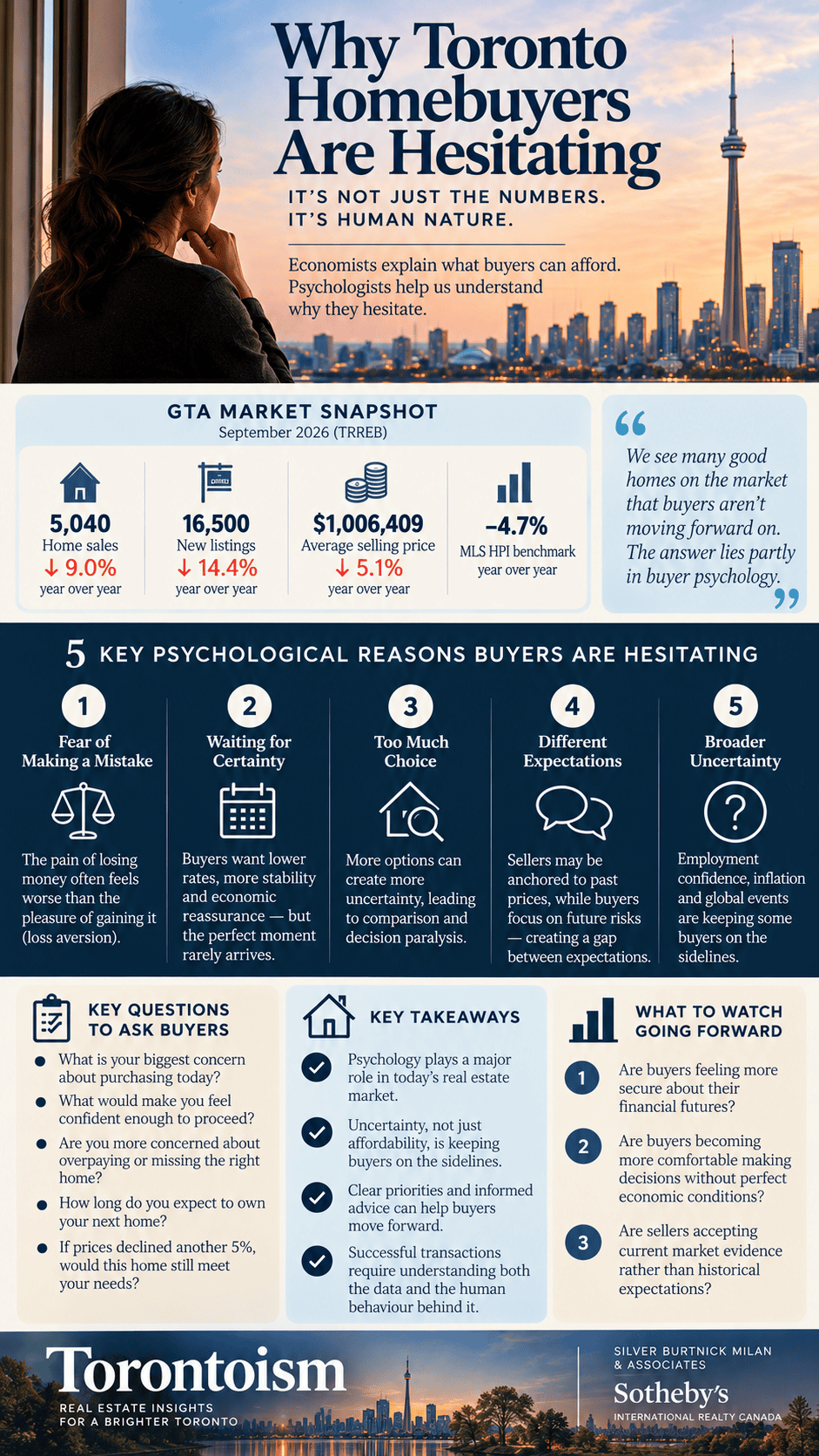
Economists can help explain what buyers can afford. Psychologists can help us understand why they hesitate.
1. Buyers are more afraid of making a mistake than missing an opportunity
One of the most important concepts in behavioural economics is loss aversion, associated with psychologists Daniel Kahneman and Amos Tversky.
Simply put, the pain of losing money often feels greater than the pleasure of gaining an equivalent amount.
For Toronto homebuyers, this can create an interesting dilemma.
A buyer may find a beautiful home in Cabbagetown, Rosedale, Yorkville or another desirable neighbourhood. The home meets their needs, fits their budget and offers the lifestyle they want.
But one question dominates their thinking:
“What if I buy today and the price drops another $100,000 six months from now?”
That fear can outweigh all the positive reasons to purchase.
Ironically, the same buyer may have been prepared to compete aggressively for that property when the market was rising.
The psychology has changed, even if the house hasn’t.
2. Buyers are waiting for certainty that may never arrive
Many buyers believe they are being financially prudent by waiting.
They want lower interest rates, more favourable economic news, greater job security and reassurance that property values have stabilized.
But housing markets rarely provide an unmistakable signal that the perfect moment to buy has arrived.
When prices rise, buyers worry about overpaying.
When prices fall, they worry about further declines.
When prices stabilize, they wonder whether the recovery is sustainable.
The result is decision paralysis.
The question for REALTORS® is no longer simply, “Are you ready to buy?”
It may be more useful to ask:
“What would you need to feel confident enough to make a decision?”
That question opens an entirely different conversation.
3. What the October 2026 numbers tell us
The latest figures from the Toronto Regional Real Estate Board support the argument that uncertainty is influencing buyer behaviour.
GTA housing market — September 2026
Home sales
5,040
↓ 9.0% year over year
New listings
16,500
↓ 14.4% year over year
Average selling price
$1,006,409
↓ 5.1% year over year
MLS HPI benchmark
−4.7%
Year-over-year change
Source: TRREB, October 6, 2026.
These numbers are important because they suggest that buyers are not simply responding to a shortage of properties or high prices. Some are responding to the uncertainty surrounding their future.
Indeed, TRREB specifically identified employment confidence, inflation and borrowing costs as reasons prospective buyers remain on the sidelines.
The Bank of Canada’s September decision to hold its policy rate at 2.25%, alongside concerns about inflation and trade uncertainty, reinforces the importance of economic stability in household decisions.
However, we must distinguish between psychological hesitation and genuine financial constraints. Not every hesitant buyer is irrational. Some are making entirely sensible decisions about job security, monthly payments and financial risk.
4. Too much choice can become another obstacle
For years, Toronto buyers complained that they had too little choice.
Now, in some market segments, they have more time to compare homes and negotiate.
You might expect that to make buying easier.
But additional choice can produce additional uncertainty.
A buyer finds a home they like but immediately wonders whether something better will appear next week. They compare one property against another, revisit listings online and focus increasingly on minor imperfections.
The home that initially seemed ideal becomes one of many possibilities.
This is sometimes called choice overload, although research shows its effects vary considerably by situation.
For REALTORS®, the solution is not to push buyers into decisions. It is to help them establish clear priorities and evaluate properties against those priorities.
5. The emotional gap between buyers and sellers
There is another psychological issue in today’s Toronto housing market.
Many sellers remain emotionally attached to prices their neighbours achieved in 2021, 2022 or during other stronger market periods.
Buyers, meanwhile, are looking at today’s economic environment and anticipating tomorrow’s risks.
Sellers may be anchored to yesterday’s values.
Buyers may be anchored to tomorrow’s possible discounts.
The result is a gap between expectations.
Research published in the American Economic Review has demonstrated how reference prices and loss aversion can affect housing decisions and market turnover.
A property can be well presented and desirable, yet fail to sell because the seller’s expectations and the buyer’s perception of risk do not align.
This is where knowledgeable real estate advice becomes particularly valuable.
6. The questions REALTORS® should be asking
Instead of relying exclusively on conventional qualification questions about price, location, bedrooms and financing, I believe we should be asking more revealing questions.
|
Questions for buyers |
What we can learn |
|---|---|
|
What is your greatest concern about purchasing today? |
Identifies the real obstacle |
|
What would make you feel confident enough to proceed? |
Reveals the decision criteria |
|
Are you more concerned about overpaying or missing the right home? |
Explores competing fears |
|
How long do you expect to own your next home? |
Establishes the relevant time horizon |
|
If prices declined another 5%, would this home still meet your needs? |
Tests financial and emotional resilience |
|
What would happen if you postponed your purchase for another year? |
Makes the cost of waiting visible |
|
Is there a specific property concern we haven’t resolved? |
Separates hesitation from genuine objections |
These should be open, supportive conversations, not techniques for pressuring buyers.
The purpose is to understand whether someone needs more information, more financial security, a different property or simply more time.
7. What sellers need to understand
Sellers also need to adapt to the psychology of this market.
A buyer who sees a home sitting unsold for 60 or 90 days may assume something is wrong with the property, even when there is no serious defect.
That perception can become a self-reinforcing problem.
Sellers should focus on credible pricing, excellent presentation, transparent property information and prompt responses to legitimate buyer concerns.
A price reduction may help when the asking price is the obstacle. But lowering the price alone will not necessarily overcome uncertainty about condition, financing, location or the broader economy.
We need to diagnose the reason a home isn’t selling before prescribing the solution.
8. Looking beyond October 2026
As we move toward 2027, I believe we should pay attention to three psychological indicators alongside traditional market statistics.
First, are buyers beginning to believe that their financial futures are more secure?
Second, are buyers becoming more comfortable making decisions without waiting for perfect economic conditions?
Third, are sellers increasingly willing to accept current market evidence rather than historical expectations?
The next Bank of Canada rate announcement is scheduled for October 28, 2026. It will provide another important economic signal, but a single rate decision is unlikely to resolve all the uncertainties affecting homebuyers.
We should also monitor the relationship between open-house attendance, repeat showings, offers and completed transactions. Those behaviours may provide useful local evidence of changing confidence before it becomes obvious in headline statistics.
The most important question of all
After decades working in Toronto real estate, I find this market particularly fascinating.
We have sophisticated tools, enormous amounts of data, artificial intelligence, economic forecasts and access to more property information than ever before.
Yet the final decision to purchase a home remains deeply human.
People are buying security, comfort, lifestyle, stability and a vision of their future. They’re also accepting risk.
The challenge for real estate professionals is to understand both sides of that equation.
Perhaps we should stop asking only:
“Why aren’t buyers buying?”
And start asking:
“What is preventing buyers from feeling sufficiently confident to make one of the most important decisions of their lives?”
Economists can help us understand the market.
Psychologists can help us understand the people in it.
And successful REALTORS® need to understand both.
Richard Silver, Sales RepresentativeSilver Burtnick Milan & Associates Sotheby’s International Realty Canada Torontoism.com — Toronto Real Estate Insights
#TorontoRealEstate #BuyerPsychology #TorontoHousingMarket #RealEstateTrends #HomebuyerConfidence #TorontoRealtor #RealEstateInsights #SilverBurtnickMilan #SothebysRealty #Torontoism