Jane Darville has said that healthcare is in her DNA. By this, it seems she means that she has always been drawn to it as a career—for certainly, it is the trajectory in which her decades of work have run. Two years after its opening, Darville became the Executive Director of Toronto’s groundbreaking AIDS hospice Casey House which recently became the first and Canada’s only stand-alone HIV/AIDS specialty hospital with outpatient programming, and later served as the Vice President of Clinical Services at York Central Hospital—now the Mackenzie Richmond Hill Hospital—as the Executive Director for Vancouver’s Canuck Place Children’s Hospice, and as the Vice President of the health care consulting firm CSI Consultancy. Now retired, she is still involved in healthcare on a volunteer basis, as well as chairing the Patron’s Committee of the National Ballet of Canada.
Much of your career has taken place in Toronto. What is your connection to this city?
I was born and raised in Brantford, which is about seventy miles southwest of Toronto, and I moved to Toronto after high school when I started my post-secondary education. So from about age 18 on. Many of my strong friendships are here…and my career grew here, my life grew here. So I actually think of Toronto as ‘home’.
What drew you to health administration as a career?
Well, originally I trained as a nurse.. and after I finished training and I got a diploma in public health nursing I started off in community work. Working for VON [Victoria Order of Nurses] actually, back in the 70s in downtown Toronto. I was a visiting nurse and had walking areas. It was great; a young, exciting thing to do when you’re 22—as I was with my first job. And I just sort of naturally fell into doing more administrative things—being a team leader. And then I went to work for the Homecare program—it’s now called the CCAC, but at that point, it was the Homecare program. They had coordinators based in hospitals to arrange for people to go home, who needed care—nursing, physio, all that sort of stuff.
And so I was their coordinator back in Toronto General [Hospital] where I trained. That was really more of a management job because you were coordinating services, you weren’t doing care. I mean, I haven’t done physical nursing care since I was probably 25. And then I went back to school and got other degrees in administration. I just liked that work. But I also liked being in healthcare. So I just gradually got other jobs that were more administrative, and there you go.
How did you become involved with Casey House?
When I was a manager at Metro Homecare—it was in the early to late 80s—when people living with AIDS were really sick, and no one really knew what was going on, and people were frightened. And people in healthcare were a bit frantic. Anyway, we were bringing these men (they were mainly men at the time) onto the program, I was given the project of seeing how to do that, and what to do so that we could bring them home out of the hospital and take care of them.
So I was involved in that project, and June Callwood and her group had just started to meet about the potential of creating a hospice for people with AIDS, and somehow I got invited to—I think probably their second meeting—to talk about whether Homecare could help in this situation.

Casey House

I went to the meeting, and in June’s inimitable way, if you went to a meeting you were IN the meeting. You were at the next meeting and the next meeting. So from about the second or third meeting I was just involved in the whole development of the program, and the whole hiring of staff, and everything. I was one of the original members of the Steering Committee. So that was in the mid-80s.
And then we transitioned from the Steering Committee to the first Board, and I was on there for a few years, and then I actually went to work at the Ministry of Health and came off the Board because—being a Ministry employee—I couldn’t be on the Board.
So I was off for about four years or so, and in the meantime, they had gone through a couple of executive directors. It was a difficult time, you know, still people weren’t funding it properly…anyway, they were looking for an executive director and they called me, and I didn’t know if I could do all the external stuff because I’d never done it. I went down to some event there and thought ‘well, maybe I can do this job’. So I applied and got it.
What are your most enduring memories of your time at Casey House?
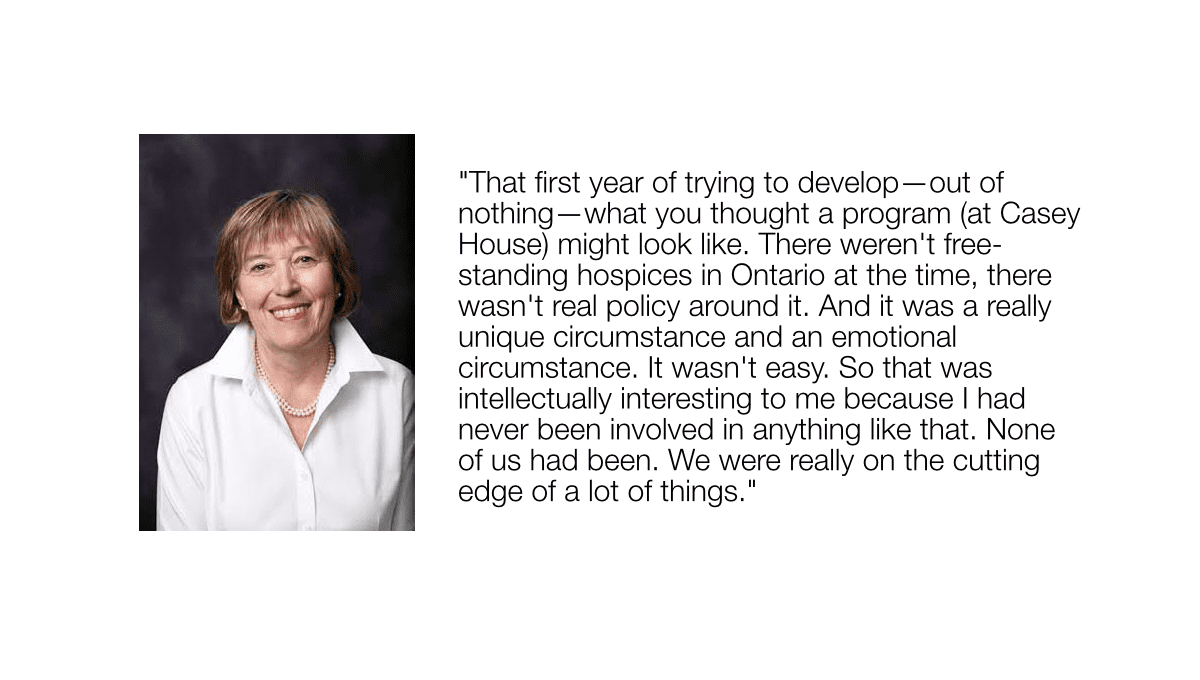
You know, I think being on the original Steering Committee. That first year of trying to develop—out of nothing—what you thought a program might look like. There weren’t free-standing hospices in Ontario at the time, there wasn’t real policy around it. And it was a unique circumstance and an emotional circumstance. It wasn’t easy. So that was intellectually interesting to me because I had never been involved in anything like that. None of us had been. We were really on the cutting edge of a lot of things.
And I guess it was interesting to watch the evolution of how AIDS went from something that was frightening and not acceptable to where people were becoming more accepting of it and understanding it more. That was a great time to be involved, actually, and there was a transition from having difficulty getting donors to support the hospice (although we had government funding), to it being a more interesting charity to support.

Did you ever run into prejudice in those early years because of your involvement with Casey House and AIDS?
Yeah. Probably from some people who may have wanted to date me. But not career-wise, because it did start to change and become more acceptable, so career-wise, actually, it was a good move. Personally, my women friends and more enlightened male friends thought it was great that I was doing what I was doing. It was the only hospice in Canada, we were getting more publicity, and people thought that it was doing such a valuable thing, that I sort of rode on the coattails of that, actually, when it started to change.
[clickToTweet tweet=”It was interesting to watch the evolution of how AIDS went from something that was frightening and not acceptable to where people were becoming more accepting of it and understanding it more. That was a great time to be involved.” quote=”It was interesting to watch the evolution of how AIDS went from something that was frightening and not acceptable to where people were becoming more accepting of it and understanding it more. That was a great time to be involved.”]
What does the Executive Director of a hospice do?
Oh God… well, you know, it’s a small healthcare organization, so you have to be a jack-of-all-trades, for lack of a better word. So you’re responsible for the solvency, the quality of the care that is given, the policies, the interaction with the Board, and in places like Casey House, you also have a very external face. You have to be able to represent the organization. Well, all CEOs or Executive Directors do. You have to be able to explain the organization, you have to be able to be the public face and the public spokesperson for it.
You also worked at Canuck Place. A lot of people would find it very depressing working in a palliative care or end-of-life setting with children.
Palliative care covers a broad range of things, end of life being one part of it. So at Canuck Place, the definition of that is; that the children, because of the disease that they have, won’t live into adulthood. So their life expectancy is probably sixteen or seventeen at most and for some not even that. So a big part of the program in the children’s hospice was providing respite care at intervals as their disease progresses. You know, you’d see them over long periods of time, with some of their syndromes, and they would be in for respite for periods of time as you would… you know, watch their disease progress, basically. And of course, there’s the end of life there, as well. It’s sad some days. It’s terribly sad.
Where do you think healthcare is being done the best now?
I don’t know if I can say where it’s done best… there’s just so many different components to healthcare. There are areas where we aren’t doing as well as we should. There are still issues around mental health. Wwhen you look at reports that were written a decade or so ago they would often refer to mental health as the orphan of healthcare. Now, in the last few years, that’s changing a bit, and there’s more and more focus being given to mental health. I think there’s still a lot to be done in terms of preventative care; we talked for years—since I was first a nurse—about the importance of prevention, and how we should be giving it more money, and that story still hasn’t been told. It’s still the case that in Canada, and in a lot of places, the money that we spend on healthcare is the money we spend when we’re already sick. That’s the way it is right now.
[fvplayer src=”https://www.youtube.com/watch?v=HD1pNnThkic&feature=youtu.be” splash=”https://torontoism.com//images/2018/02/Screen-Shot-2018-02-16-at-11.59.54.png” width=”780″ height=”461″ caption=”Compassion lives here”]
Are there particular changes you’d like to see made to hospices or palliative care in Canada?
It needs more money. To be blunt. I don’t know what the current stats are, but you know, in my day (which wasn’t all that long ago) if you looked at the percentage of people across Canada who had access to specialized palliative care, the percentage is low. It used to be way less than 50 per cent. More like 30. I don’t know what the current number is, but probably not that much more.
What are some of the biggest improvements you’ve seen in healthcare over the course of your career?
I think there’s certainly been improvements in acute care, surgical techniques, less invasive surgeries, more research being done. So there’s a lot of progress in health, and I think there’s a lot of respect amongst the different components of healthcare. We all know what each other does, and what we can do and what we can’t do, and I think there’s been more of a realization of how we’re interdependent—or I like to think there is.
I guess when you look at community stuff, there’s still work to be done in terms of access across provinces to a certain level of home care. Provision of palliative care. And we all know that healthcare is related to socio-economic status and education and poverty, and that’s still out there. It seems like ever since I’ve been in healthcare we’ve been talking about child poverty, and we’re STILL talking about child poverty, and what can be done.
[clickToTweet tweet=”We all know that healthcare is related to socio-economic status and education and poverty, and that’s still out there. It seems like ever since I’ve been in healthcare we’ve been talking about child poverty, and we’re STILL talking about child poverty, and what can be done.” quote=”We all know that healthcare is related to socio-economic status and education and poverty, and that’s still out there. It seems like ever since I’ve been in healthcare we’ve been talking about child poverty, and we’re STILL talking about child poverty, and what can be done.”]
You were awarded the Queen’s Jubilee Medal in 2003. Looking back, what do you see as some of your most satisfying accomplishments?
It just has to be Casey House. And close behind would be Canuck Place. But I had great jobs. When I was working for Homecare for many many years I had lots of accomplishments there—to know that what you were doing allowed people to be at home and get better or not get better.
But in terms of jobs for me that really made me grow, and were interesting and crazy and wild at the same time, it would have to be the two hospices, and Casey House in particular, because I was so involved in the early stages with Casey House, and through that whole sort of societal thing around AIDS. It wasn’t just about Casey House. It was about the whole AIDS issue.
Donate to Casey House | Donate to Canuck Place
JN00KV