Current inventory levels give GTA buyers their strongest negotiating edge in years.

03.6.26 | Business

Active listings across the Greater Toronto Area recently climbed to nearly 18,000, bringing our local inventory to a 5.8-month supply. This transition into a buyer’s market provides a unique window for those looking to right-size or transition into a larger property without the typical frenzy. 🏠 Professionals and families now have the luxury of time to compare options and find a home that truly aligns with their lifestyle.

With benchmark prices adjusting by 8% year-over-year, the opportunity to secure a favourable deal is more accessible than it has been since early 2021. 📉 Success in this market comes down to identifying motivated sellers and leveraging the current oversupply, especially within the condo segment, where supply is mounting. When we help our clients navigate these listings, we prioritize strategic search patterns and sharp negotiation to ensure every purchase is a long-term win. ✨

Save this insight for the next time you’re reviewing GTA market trends.

Thinking about making a move in this market? Send me a DM and let’s chat.

SilverBurtnick & Associates Sotheby’s International Realty Canada 💻 www.torontoism.com ✉️ 📞 416-960-9995

#TorontoRealEstate #GTARealEstate #RealEstateToronto #RealEstateGTA #TorontoRealtor #TorontoRealtors #OntarioRealEstate #RealEstateOntario #TorontoHomes #GTAHomes #TorontoLiving #TorontoHomeStaging

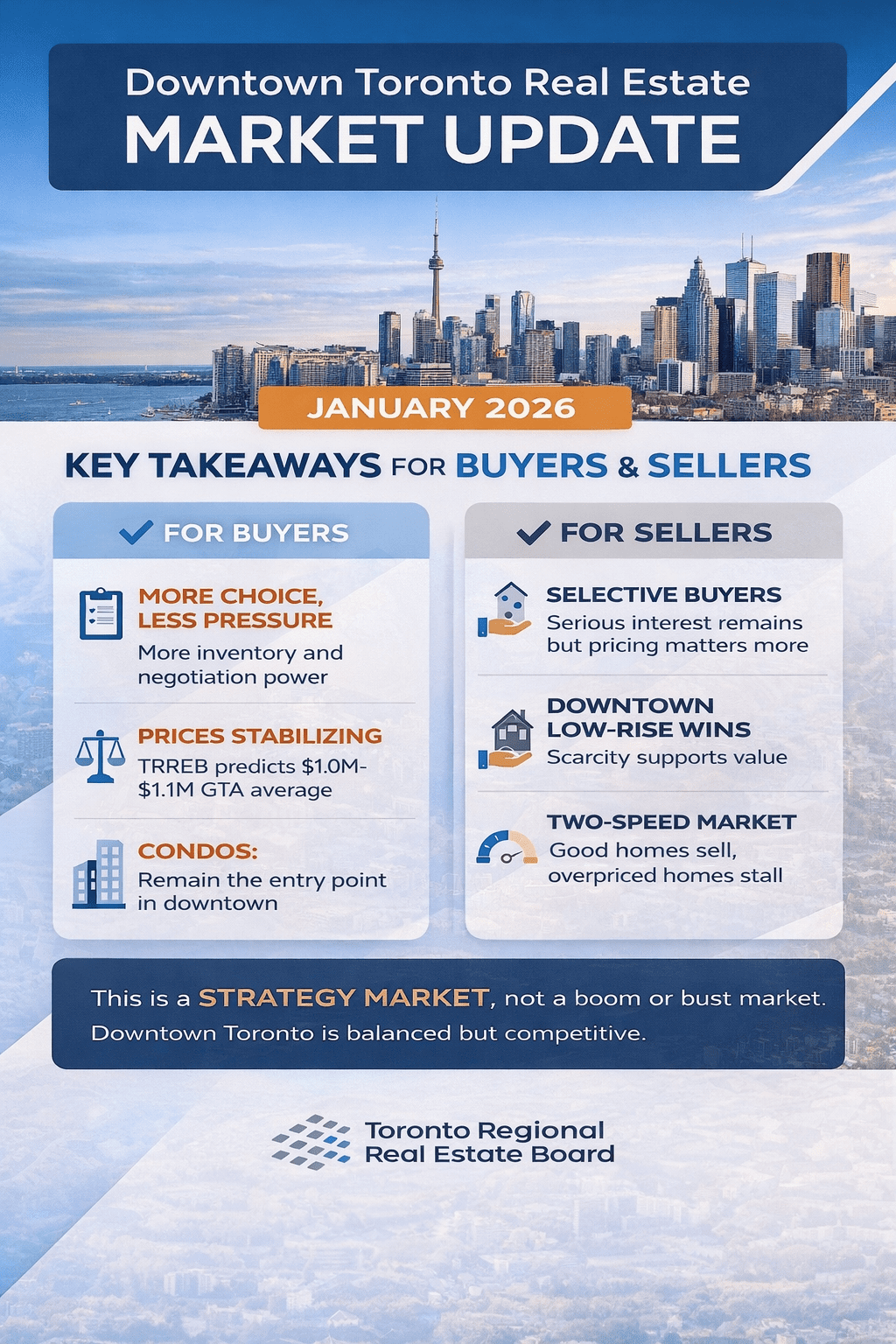
Downtown Toronto Real Estate: What Buyers & Sellers Need to Know for January 2026

02.4.26 | Business

The Big Picture (The “Pressure Point”)

Downtown Toronto is at a turning point, not a crash point.
The market is being shaped by three forces:

  • High population growth

  • Persistent housing shortages

  • Affordability pressure, not collapsing demand

This creates an opportunity for prepared buyers and strategy requirements for sellers

2026-MYIR_flattened


For Buyers: Why January 2026 Matters

1. You Have More Choice — and More Leverage

  • Inventory levels are higher than the last few years, especially in condos and townhomes

  • Buyers are no longer rushing; negotiations matter again

  • First-time buyer interest has rebounded strongly, particularly in the City of Toronto

What this means:
Well-priced homes sell. Overpriced homes sit.


2. Prices Are Stabilizing — Not Free-Falling

  • TRREB forecasts average GTA prices between $1.0M–$1.1M in 2026

  • Most price softening already occurred in 2024–2025

  • Early 2026 is expected to resemble early 2025, with gradual improvement later in the year

Downtown takeaway:
This is a window, not a bottom-picking exercise.


3. Condos Remain the Entry Point

  • Condo apartment prices declined modestly year-over-year

  • Rental demand remains strong due to immigration and delayed homeownership

  • Downtown condos benefit most from employment, transit, and lifestyle density


For Sellers: The Market Has Changed — Strategy Matters

1. Buyers Are Selective (and Informed)

  • Buyer intentions are lower than pandemic peaks, but more serious

  • Homes that are priced correctly sell faster

  • Homes that “test the market” get ignored

Seller reality check:
Pricing and presentation matter more than they have in years.


2. Detached & Low-Rise Homes Still Win Downtown

  • Scarcity of ground-oriented housing remains a structural issue

  • Multiplex zoning changes may add supply over time, but not immediately

  • Larger lots and redevelopment-friendly properties hold long-term value


3. Expect a Two-Speed Market

  • Well-priced, well-located homes → strong interest

  • Overpriced or compromised properties → longer days on market

There is no “average” sale anymore.


Rentals, Immigration & Downtown Demand

  • Immigration continues to support strong downtown rental demand

  • Many households rent longer due to affordability gaps

  • Purpose-built rentals and investor condos are adding supply, but absorption remains healthy

Investor takeaway:
Cash-flow pressure is short-term; long-term demand remains intact.


What This Means for Downtown Toronto in 2026

This is not a boom market.
This is not a bust market.
This is a strategy market.

  • Buyers who are prepared can negotiate well

  • Sellers who are realistic can still achieve strong outcomes

  • Downtown Toronto remains one of Canada’s most resilient real estate ecosystems


Bottom Line (In Plain English)

Buyers:
✔ Less competition
✔ More choice
✔ Real negotiating power

Sellers:
✔ Serious buyers are still there
✔ Pricing must be right
✔ Professional strategy matters more than ever


Source

Toronto Regional Real Estate Board (TRREB), 2026 Market Outlook & Year in Review – The Pressure Point


How to Keep Your Family Safe and Warm During Winter Storms in Toronto

01.15.26 | Uncategorized

As a powerful blizzard dubbed the “Blizzard of ’26” barrels into the Greater Toronto Area (GTA), it’s important for residents to take the necessary steps to protect their homes and families. With up to 35 cm of snow expected and temperatures dropping to a bone-chilling -22°C, preparedness is paramount. This winter storm serves as a reminder of how quickly weather conditions can change, and for those in the midst of right-sizing, downsizing, or upsizing their homes, the stakes are even higher.

The Problem: Navigating Snow and Cold in Winter

The current weather alert for the GTA has been upgraded to orange, suggesting severe weather impacts that could cause significant damage or disruption. This is the heaviest snowfall of the season so far, and it’s affecting everyone from local professionals making their daily commutes to families considering second homes worldwide. Schools are closed, roads are chaotic, and airports are seeing numerous delays and cancellations. These conditions can create stress and confusion when making housing decisions.

The Pressing Issues for Homeowners

1. Heavy Snowfall: With substantial snow accumulations, roofs may become burdened under the weight, leading to potential leaks or structural damage. Homeowners need to ensure their roofs are inspected and cleared when necessary.

2. Chilling Temperatures: The extreme cold can cause pipes to freeze and burst, potentially leading to significant water damage. It’s crucial for homeowners to ensure their pipes are insulated, especially in older homes.

3. Dangerous Driving Conditions: The combination of snow and ice reduces visibility and makes travel hazardous. This has implications for those looking to sell or purchase homes, as viewing properties in such conditions is challenging.

4. Power Outages: Heavy snow and winds increase the likelihood of power disruptions, leaving homes without heat. Families should have backup heating solutions in place to avoid discomfort or danger.

Agitation: Why Pay Attention Now Is Critical

For GTA residents, failing to prepare for winter storms can be costly. Whether you’re right-sizing or downsizing your home, it’s crucial to be proactive. Here’s why:

– For those looking to move: Snow-covered roads and properties make it difficult to assess the conditions of new homes, potentially leading to unexpected repair costs.

– For local professionals: With commuting impacted by road closures and delays at airports, working from home becomes a necessity, highlighting the importance of having a warm and functional home environment.

– For those with second homes: Checking on properties abroad or even within Canada is challenging during such severe weather, and ensuring all homes are winter-ready can prevent damage and high maintenance costs.

Potential Risks and Costs

Consider the costs of ignoring winter preparations. A burst pipe could incur thousands in repair costs and even more in disruption costs. Similarly, structural damage from excessive snow load can lead to costly emergency fixes. Without adequate heating during power outages, discomfort is inevitable, and the risk of cold-related harm cannot be overlooked.

Solution: Safeguarding Your Home and Family

Here are actionable steps for homeowners to minimize damage and enhance safety:

1. Prepare Your Home

– Check Your Roof: Make sure your roof is in good condition to withstand the snow load. Hiring professionals to clear heavy snow may be necessary.

– Insulate Pipes: Wrapping pipes with insulating materials can help prevent freezing and bursting.

– Weather Stripping and Caulking: Ensure that windows and doors are sealed properly to prevent cold air from entering and warm air from escaping.

2. Emergency Planning

– Stock Supplies: Keep an emergency kit with food, water, batteries, flashlights, and blankets in case of a power outage.

– Consider a Generator: An alternative power source can keep critical systems like heating and lighting operational during outages.

– Community Support: Know your neighbors and check on each other. This is particularly important for elderly residents or those with young children.

3. Smart Travel Decisions

– Stay Updated: Pay attention to travel advisories and plan any necessary trips within the city accordingly.

– Remote Solutions: Use technology to uphold work commitments. Many businesses accommodate remote work, which can be crucial during inclement weather.

What’s Next?

As the snow tapers off, frigid air and potentially more snow are on the horizon. Maintaining preparedness is key for the remainder of the winter. Keep your family safe and your home intact by continuing to monitor weather updates and advisories.

By taking these steps and keeping a level head, homeowners in the GTA can effectively manage and mitigate the effects of severe winter weather. Whether you’re planning to move, resize your living space, or simply ride out the storm in your current home, readiness is imperative.

Remember, the blizzard won’t last forever, and after the snow melts, the Greater Toronto Area will remain a hub of opportunity and a wonderful place to call home.

SilverBurtnick & Associates
Sotheby’s International Realty Canada
💻 www.torontoism.com
✉️
📞 416-587-3300

#TorontoRealEstate #GTARealEstate #RealEstateToronto #RealEstateGTA #TorontoRealtor #TorontoRealtors #OntarioRealEstate #RealEstateOntario #TorontoHomes #GTAHomes #TorontoLiving #TorontoHomeStaging

Toronto Real Estate in 2026: What REALTORS®, Buyers, and Sellers Really Need to Know

01.13.26 | Uncategorized

As we move into 2026, one thing is clear: the Toronto real estate market is no longer driven by hope, hype, or momentum alone. It is being shaped by realism, pricing discipline, and buyer selectivity.

The notes many REALTORS® are sharing privately right now tell a consistent story—one that buyers and sellers also need to understand clearly if they want results.

Let’s break it down.


1. Silence Isn’t Rejection—But It Is a Signal

One of the most common frustrations REALTORS® are voicing is simple:

Sales are not responding.

This doesn’t necessarily mean a property is “bad.” It means:

  • Buyers are overwhelmed with choice

  • Buyers are cautious, analytical, and price-sensitive

  • Listings that miss the mark—even slightly—are ignored

In 2026, buyers don’t negotiate first—they disengage first.

If a listing isn’t compelling on price, presentation, or positioning, the market doesn’t push back with offers. It simply moves on.


2. No One Wants to Catch a Falling Knife

Buyers today are not afraid of buying real estate.
They are afraid of buying at the wrong moment.

This mindset—often described as “not wanting to catch a falling knife”—means:

  • Buyers wait for confirmation, not predictions

  • They watch price trends closely

  • They expect value, not optimism

This is especially true in Toronto condos and discretionary move-up purchases.

Hope is not a strategy.
Data, timing, and pricing are.


3. The Investor Market Has Largely Stepped Back

Another critical shift heading into 2026:

The investor market has, for the most part, disappeared into past cycles.

Higher borrowing costs, tighter cash-flow math, increased taxes, and regulatory uncertainty have:

  • Removed speculative buyers

  • Reduced bidding pressure

  • Changed who sets the market value

Today’s Toronto market is being led primarily by:

  • End-users

  • Rightsizers

  • Long-term planners

This is a healthier market—but it behaves very differently.


4. Prices Haven’t Returned to 2022—and That Matters

Let’s be direct:

Toronto prices have not rebounded to 2022 levels—and may not for some time.

Key reality checks:

  • Peak pricing occurred in early 2022

  • Many segments remain 20–25% below those highs

  • Some areas are down approximately 24.8% from February 2022

This isn’t a crash—it’s a re-pricing.

Sellers anchored to 2022 are competing with:

  • Lower comparables

  • More inventory

  • Buyers who have options


5. Volume Is Improving—but Prices Are Softer

Here’s the nuance many headlines miss:

Sales volume is increasing—but prices remain soft.

What this tells us:

  • Buyers are active again

  • Transactions are happening

  • But only when pricing reflects reality

This is a functional market, not a frothy one.

For REALTORS®, this means:

  • More deals—but harder-earned

  • Strategy matters more than speed

  • Skill matters more than timing


6. What Buyers Need to Know in 2026

If you’re buying Toronto real estate in 2026:

  • You have leverage—but not unlimited power

  • Well-priced properties still sell quickly

  • Quality homes in prime locations remain competitive

Smart buyers:

  • Focus on long-term livability

  • Understand replacement cost

  • Use data, not emotion

This is a window of opportunity, not a fire sale.


7. What Sellers Need to Know in 2026

If you’re selling:

  • Pricing correctly from day one is critical

  • The market will not “test” with you

  • Overpricing leads to silence, not negotiation

Successful sellers:

  • Accept today’s market, not yesterday’s peak

  • Invest in presentation and marketing

  • Work with REALTORS® who tell the truth—not just what’s comfortable

The market rewards clarity and realism.


8. What REALTORS® Are Really Watching Heading Into 2026

Behind the scenes, REALTORS® are focused on:

  • Absorption rates, not headlines

  • Buyer behaviour, not forecasts

  • Strategy, not slogans

The professionals who will thrive in 2026 are those who:

  • Educate clearly

  • Price honestly

  • Guide confidently

Because in this market:

Hope is not a strategy.


Final Thought: Toronto Real Estate Is Resetting—Not Retreating

Toronto remains:

  • A global city

  • A supply-constrained market

  • A long-term growth story

But 2026 demands precision, patience, and professionalism from everyone involved.

Those who understand that reality—buyers, sellers, and REALTORS® alike—will make smart decisions and successful moves.


Sources & Market Context

  • Toronto Regional Real Estate Board (TRREB) Market Watch Reports

  • MLS® historical pricing data (2022–2025)

  • Bank of Canada rate environment analysis

  • CREA national housing trends

(All figures referenced reflect widely reported GTA market data and professional industry analysis.)

Looking Ahead to 2026: The Case for Greater Transparency in Ontario’s Organized Real Estate

12.22.25 | Toronto & Neighbourhoods

As we approach 2026, Ontario’s real estate professionals are at a critical juncture—one that calls for more open dialogue, greater transparency, and stronger accountability within our real estate institutions. While the Toronto Regional Real Estate Board (TRREB), the Ontario Real Estate Association (OREA), and the Real Estate Council of Ontario (RECO) each serve essential roles in supporting, regulating, and advocating for real estate professionals, the evolving market landscape and shifting member expectations call for a renewed focus on communication and disclosure.

Understanding the Roles

Each institution plays a distinct and important part in the framework of Ontario real estate:

  • TRREB is the largest real estate board in Canada, providing MLS® services, data, advocacy, and tools that allow members to operate professionally and effectively.

  • OREA offers professional development, lobbying, and provincial-level advocacy on behalf of REALTORS® and the real estate profession.

  • RECO is the provincial regulator, focused on consumer protection and ensuring all registrants comply with the Real Estate and Business Brokers Act (REBBA).

These organizations have played a vital role in shaping Ontario’s trustworthy and efficient real estate environment. However, as we move into a more transparent and digitally connected era, it’s time to examine how they can better serve their most important stakeholders: their members.

A Call for More Disclosure in 2026

We believe that 2026 presents an opportunity for these institutions to adopt clearer, more consistent disclosure practices. This isn’t a critique—it’s a constructive call to evolve with the times. In a business built on relationships, trust, and access to timely information, our member organizations must lead by example.

Here are a few areas where improvement can bring tangible benefits:

  • Governance Transparency: Board decisions, policy shifts, and organizational priorities should be more accessible and clearly communicated to members.

  • Financial Disclosure: Greater clarity on how member dues are allocated—especially on large boards and in associations—is key to building long-term trust.

  • Member Engagement: More open forums, Q&A sessions, and digital feedback loops would ensure that the voices of members are not only heard but also acted upon.

  • Clearer Lines Between Advocacy and Regulation: In a climate of increasing scrutiny, it’s vital to maintain clearly defined roles between advocacy bodies like OREA and regulators like RECO.

Positivity With Purpose

This is not about tearing down the institutions we rely on—it’s about strengthening them through modern governance and better communication. Ontario REALTORS® are highly educated, engaged professionals who deserve transparency from the organizations that represent and regulate them. In turn, that transparency will foster a more empowered, informed, and united membership.

The Time Is Now

As market conditions shift, as technology reshapes client expectations, and as our profession evolves, so too must the institutions that guide us. The call for transparency isn’t a passing trend—it’s a foundation for the future.

We at Silver Burtnick & Associates believe that 2026 can be a pivotal year for organized real estate in Ontario. Let’s make it one where transparency, collaboration, and progress lead the way.


Connect With Us

Our team—Richard Silver, Jim Burtnick, Celia Alves, Jose Sanchez, and Bill Johnston —is dedicated not just to serving clients but also to advocating for a stronger, more accountable real estate industry.

For market insights, professional real estate services, or to connect with our team, visit www.Torontoism.com.


New Year, New Home? Discover How Downsizing Can Lead to a Bigger Life in the Greater Toronto Area

12.22.25 | Uncategorized

Thinking about a fresh start for the new year and considering a change in your living situation? Whether you’re right-sizing, downsizing, or upsizing, a lot is going on in the Greater Toronto Area (GTA) real estate market that you should know about. With trends evolving and the promise of a new beginning, this could be the perfect time to find a home that truly fits your needs.

The Problem: Navigating a Changing Market

Real estate in the GTA is always bustling, but the current market presents some unique challenges and opportunities. Here’s a quick look at what’s happening:

– Rising Interest Rates: The average mortgage rate is about 6.19%. This is still better than in the past, but it may affect how much home you can afford.
– Low Inventory: There are fewer homes for sale, which can make it harder to find the right place without facing a lot of competition.
– High Demand for Niche Features: Homebuyers now look for specific features, like wellness amenities and energy-efficient systems.

What This Means for Different Buyers

– Right-Sizers: If you’re looking to adjust your space to better fit your current needs without really going bigger or smaller, it’s important to know exactly what you need versus what is just nice to have.
– Downsizers: If you’re thinking about moving into a smaller home, the high demand might mean acting fast once you find the right place.
– Upsizers: Wanting more space to accommodate a growing family or lifestyle change? Be ready for limited options and act quickly.
– Local Professionals: The market’s hustle can feel overwhelming, but planning early and staying informed is key.
– Owners of Second Homes: If you have properties elsewhere, consider how Canada’s market movements fit into your global strategy.

Agitation: The Real Impact of Market Changes

The GTA’s housing market can be tough to navigate, especially when you’re juggling a busy life or considering a big change. The following points highlight how these market trends can affect you:

– Fewer homes mean more competition. This makes it hard for downsizers and upsizers to find exactly what they’re looking for.
– Higher interest rates mean higher costs. This can affect your monthly budget and the overall price of buying a home.
– Changing Preferences: As people want specific home features, the homes that fit your unique needs can become hot commodities.

Feeling the Pressure to Make a Move?

When everyone is trying to buy at the same time, it can make it seem like you need to rush your decisions. This can lead to settling for a home that’s less than ideal or paying more than you wanted.

## Solution: Steps to Turn Market Challenges Into Opportunities

Navigating the real estate market doesn’t have to be stressful. With the right preparation and guidance, you can find a home that fits perfectly into your lifestyle. Here’s how:

1. Take Advantage of Timing

While others are busy with the holiday rush, December can be a good time for serious buyers to start planning. Use this quieter period to:

– Research neighbourhoods for your specific needs.
– Review mortgage financing options and rate scenarios.
– Work with real estate professionals to learn about new listings early.

Why now? Starting your search and planning in December gives you a head start and puts you in a good position when the spring market picks up.

2. Get Financially Ready

Understanding your finances is critical before buying a new home. Here’s what you should focus on:

– Review Your Budget: Know your credit score, expenses, and savings. Consider debt-to-income ratios, which help figure out how much loan you can afford.
– Explore Financial Help: Look into programs that offer low down payments and consider any equity you have in current or other properties.
– Pre-Approval: Get pre-approved for a mortgage to understand your purchasing power and save time later.

Why now? Starting financial preparations early can help you make quick decisions when you find the perfect home.

3. Embrace Multigenerational and Flexible Living

Trend alerts show many homeowners are choosing to accommodate multi-generational living. Even if you’re downsizing, smart use of layouts and features can provide ample space for family and guests.

– Convert areas like garages to functional spaces for the extended family.
– Look for homes with versatile layouts that offer flexibility.

Why now? This trend reflects a bigger lifestyle shift, giving you the chance to think creatively about your living space.

4. Pay Attention to Market Trends

With AI making its way into real estate, today’s luxury buyers are interested in niche features such as air filtration systems and home automation. Following these trends can help you stay competitive in the housing market:

– Use technology to enhance your home search with current listings and features.
– Consider adding appealing features that may increase your home’s value.

Why now? Incorporating trending features can make your new home more enjoyable now and more desirable later.

Conclusion: Your New Year’s Real Estate Resolution

Finding a home in the Greater Toronto Area that fits your life perfectly takes careful planning but can lead to happier days ahead. Whether upsizing, downsizing, or right-sizing, knowing the market and having a strategy allows you to approach these changes with confidence.

Thinking about a move? The best time to start is now.

Remember, a new home can mean many things, including fresh opportunities and a better fit for where you are in life. Start your journey today toward making a bigger life, no matter your size or preference. Make new memories in a space that feels just right!

SilverBurtnick & Associates
Sotheby’s International Realty Canada
💻 www.torontoism.com
✉️
📞 416-587-3300

#TorontoRealEstate #GTARealEstate #RealEstateToronto #RealEstateGTA #TorontoRealtor #TorontoRealtors #OntarioRealEstate #RealEstateOntario #TorontoHomes #GTAHomes #TorontoLiving #TorontoHomeStaging