People of Toronto: Elizabeth Farkouh

09.21.17 | People of Toronto

It’s not every day that you run into a teenager trying to add more material to her school’s curriculum, but that’s exactly what Elizabeth Farkouh has been doing for the last four years.

Farkouh came to Canada in 2008, when she and her family moved from New York to the Yonge-Lawrence area of Toronto. Enrolled in Havergal College (one of the oldest all-girl private schools in Canada), Farkouh became interested in the phenomenon of under-age drinking and eventually convinced her school to add more information about the negative effects of drinking alcohol to their health studies curriculum.

Although she has now graduated from grade 12, and is preparing to study Global and Public Health Sciences at New York’s Cornell University, Farkouh is still deeply concerned about alcohol miss-use by adolescents. She even joined the Alcohol Working Group – an offshoot of the Toronto Cancer Prevention Coalition and was quite willing to interrupt her summer cottage vacation to share her thoughts for Torontoism.

How did Toronto seem to you when you first got here from New York? How has this impression changed over the years?

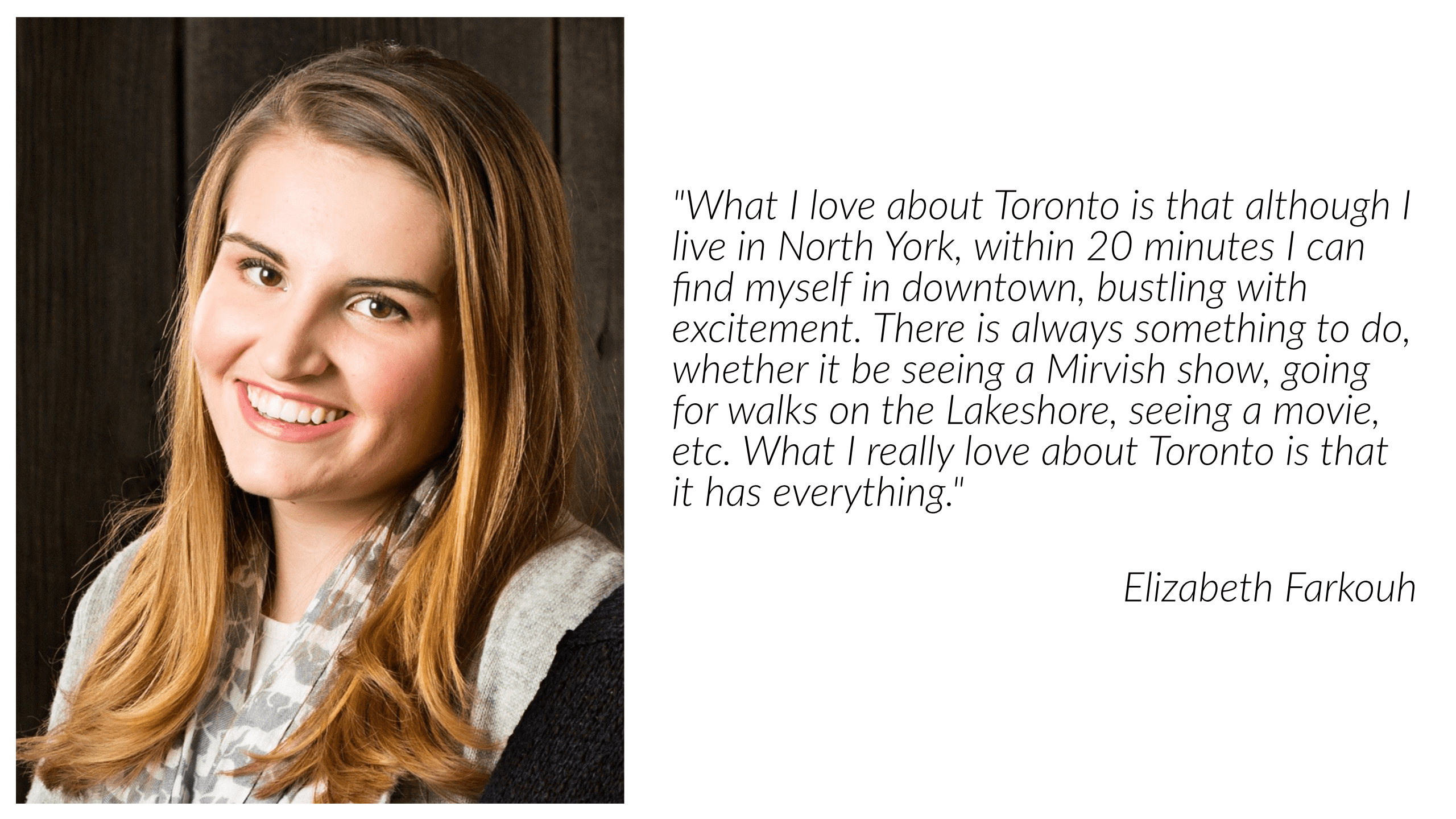
I was born and raised in NYC, so coming to Toronto (and especially my North York area) was a big change. It was calmer, and there was a really big sense of community. What I love about Toronto is that although I live in North York, within 20 minutes I can find myself in downtown, bustling with excitement. There is always something to do, whether it be seeing a Mirvish show, going for walks on the Lakeshore, seeing a movie, etc. What I really love about Toronto is that it has everything.

Havergal is a pretty old and prestigious school. What made you choose to go there, and what was it like being a student once you got there?

My mom actually attended Havergal, so once I got in, it was a no brainer. Havergal is an amazing school. What I loved most about Havergal is that they allow you (and want you) to explore all of your passions, and they will support you along the way. In other words, I didn’t have to pick academics or sports or arts – I could do all of them. Moreover, every aspect of the school had a supportive department/faculty. My science classes taught me so much about critical thinking and analysis, and my co-curricular involvement with theatre made me more creative and engaged in school life. 

Have you always been interested in health?

I probably have always been interested in health – from a young age, because my parents are both doctors, so they taught me the importance of maintaining good health. And of course my parents raised me in a household where drinking wasn’t acceptable, smoking wasn’t acceptable, so I was always raised in a household where we were taught to make good decisions.

How did you become interested in the underage drinking phenomenon?

In middle school – grade seven and eight – I hadn’t really heard about drinking at my age. Nobody really talked about it – perhaps it did go on, but nobody really discussed it in any way. But in grade nine I noticed that quite a few of my peers started to talk about drinking, and maybe talked about parties they were at where they had seen alcohol or maybe even taken part in drinking alcohol themselves, and that’s when I kind of started to be exposed to this issue.

And I was just curious, so I googled it and found an article that read ‘Underage binge drinking is the number 1 risk factor for developing early-onset dementia’. That was something that I’d never really heard about and that’s when I really became specifically interested in alcohol, and alcohol issues regarding youth.

So after learning a bit and becoming concerned, what did you do?

The first thing that I did was put up anonymous posters around my school. It was basically a picture of one brain of a fifteen-year-old male non-drinker, and then a fifteen-year-old male heavy drinker. And you could actually see how the brain activity is greatly decreased in the heavy drinker – and this is done while they were sober, so the effects are long-lasting. So I put a picture of these two brains up in bathroom stalls, I put it in the locker room, areas where students could just take it in, it wasn’t in a classroom environment, so they weren’t busy learning something else, it was just something in their own space that they could take in.

I didn’t have my name on them, because I just wanted to start a dialogue about it, and I didn’t want it to be about me in any way. I just wanted them to take the information for what it was. And then after that, we had an assembly at school, so I gave a presentation to around 600 people about the issue. So that was kind of nerve-wracking. And that’s when I attached my name to what I had done.

What was the response to the posters and the presentation?

I was actually expecting the response to be quite negative because drinking is something that quite a few teenagers do, but it was actually overwhelmingly positive for the most part. And I had a few friends tell me that they were really proud of me and that it took courage to do this, and they were really appreciative of the fact that I was sharing this information. A lot of people were really appreciative.

There was some negative response. A few people said that perhaps it wasn’t true, or the information wasn’t real, but you know, I think that’s probably just a defense mechanism or just people who don’t want to believe it, which is fine, you know. There’s always going to be a negative response to things.

farkouh 6

You also managed to get a bit more information about alcohol and its effects into the health curriculum.

I went to the Director of Curriculum at my school, and I spoke with her, and she put me in touch with the head of the physical education department at my school. Then I created a lesson plan for grade eight students on underage drinking. And after that, I met with the physical education department of the junior school and they allowed me to give a presentation to grade six students at the end of the year.

But hopefully, I’ll be able to establish an actual lesson plan that teachers can use for the future. And my hope down the road is that this will eventually be in the provincial curriculum, but obviously, that’s a long way away.

Can you tell me more about what you added to the grade eight curriculum?

So now they’re teaching the grade eight students, that drinking damages the developing brain. For example, the hippocampus is the brain structure which is responsible for memory, and it’s actually ten percent smaller in underage binge drinkers. They’re taught that it reduces their memory, their learning and comprehension.

Also, the developing brain is more susceptible to addiction, so they’re now learning that – for example – if you start drinking at age 13, your chances of developing alcohol dependence are so much higher than if you start drinking at age 21.

Is there more you’d like to add?

I’m trying to put in the cancer component; that alcohol is a carcinogen. Because we learn from a young age that tobacco causes lung cancer, but we don’t really hear about the effects of alcohol as a carcinogen. That’s just not something that’s really talked about in the health curriculum.

Given all of the different causes one could become concerned with, why do you think this one resonated so much with you?

Almost everybody knows the risks associated with smoking, but alcohol is something that most people don’t know. I mean, you see cancer organizations will host fundraisers that say, literally, ‘raise a glass to conquer cancer’. Alcohol and cancer, and alcohol and the developing brain, is just something that I think a lot of people don’t know and don’t understand. And that’s why I’m so passionate about it.

Now that you’ve graduated, are you doing anything else about under-age drinking?

I’m still a member of the Alcohol Working Group, which works to educate people about the carcinogenic effect of alcohol. But I’ve just been kind of sitting on this and thinking about it. Just exploring the ideas and seeing how I can pursue this further.

I’m currently looking into a program called Alcohol EDU, which is an online interactive educational program regarding alcohol. And I want to contact them to ensure that they have the information about carcinogenic effect of alcohol in their program, and also about the effect of alcohol on the developing brain, because this is a program that’s sent out to many high-school students and a lot of colleges in the States.

Are you thinking of pursuing any other alcohol-related issues besides education?

One thing I’d kind of like to open up the discussion about is actually when the legal drinking age is. Because the brain isn’t actually fully developed until age 25. So theoretically, the legal drinking age should be 25, but that’s kind of unrealistic. But you know, if we were even able to put it to 21, that would just prevent a lot of damage to the developing brain, and it’s actually been proven that in countries like the States with a higher drinking age, people actually do drink later, and that reduces public health problems in many ways.

I also think it’s interesting that tobacco advertising is completely illegal, but alcohol advertising is everywhere. And you know, kids are exposed to alcohol advertising almost every day. And I’m interested in how alcohol is portrayed in films that are available – for example, not rated R – but are available to teenagers and to children, and how alcohol is portrayed in these films, because often it’s glamorized, and this is shown to kids who aren’t even at the legal age yet. So I find that really interesting too, and that’s something I want to pursue.

The words “Toronto” and “condo” have become synonymous. There’s no avoiding them. It seems as though every week more are commissioned, and half a week later a cluster of three or four high-rise, garden-topped buildings appear.

Different people will experience this influx of infrastructure differently, but there’s no denying it’s changing Toronto, and the change poses questions to the city’s population. “Do I take advantage of this? Get in on the literal ground floor? Do I leave the city because I don’t like condos? Do I invest in the condos, buy, sublet, and remain where I am? Do I just want a condo because it’s something new when I should really just renovate?” This last question, paired with the question of who’s asking it, is the most important in this case.

Think Broad and Think Long Term

What is best, and for whom? Richard Silver, Senior Vice President of Sales at Sotheby’s International Realty Canada, understands this well:

Adding value to any property is less expensive than selling and buying. For example money spent on improving kitchens and baths usually will garner a return on the money spent. But not everything is as impressive, interesting, or attention-grabbing as that.  Not all renovations are equal. Maintenance must be done, but it does not have that wow factor.

And although finances are arguably the most important indicator when choosing relocation or renovation, it is not the only indicator.

A long-term perspective is the only way to consider your options when it comes to housing. Health is long term. Employment is long term. Overall livability is long term.

tumblr_mrxt5xnKml1s0teago2_400Not all renovation investments pay off equally: the maintenance doesn’t have that wow factor but it has to be done.

Age and Health

The housing market is a tough market to get into right now. There are some options for buyers, but each is as expensive as the next. This means, generally, it’s people in their middle age who hold the power; they can afford the luxury of choice. Put another way, younger, less established people in their 20s and early 30s must either work with a lot less to achieve the same or reassess and minimize their options.

Right away on buying you have a 4% land tax, and on selling you have moving expenses including commission. That could be money put into improving your property.

Seniors, too, have got the short end of the stick. Silver says,

I suggest [seniors] if they have to move at all plan on when and where to move before they’re forced to move. In other words, they should make the choice instead of having the choice made for them. There’s nothing sadder than speaking with a senior who needs my help and realizing they’re past the point of control. Someone who has outstayed their life in the house: Living on the main floor because they can no longer do the stairs or worse.

All of this means one must take into account their health.

Currently, seniors don’t have to worry too much about long-term employment. Chances are they have got a pension plan from years of work, and between 55 and 65 years of age, they transition to become dependent on said pension. This means, after a few years, it all comes down to their health and in another ten years, whether they’ll be in decent shape or not. How well will they be able to move? Not properties but even around the house. Will they have to install railings? Bars in the shower? Do they have to make their home wheel chair accessible? What about a room for a caregiver? Speaking of caregiver, will that be a family member? Family adds another layer of decision-making and planning for a senior. Silver adds:

A lot of what should be empty nesters end up with their nests full again. Kids, and then grandkids end up living with their parents. A smaller, two-bedroom condo would make the return impossible.

So, which way is best when it comes to a factor of health? It’s too easy to say the answer is different in every case. Ultimately, it comes down to planning. As long as you’re ahead of the curve of your physical and mental health, renovation yields the greatest long-term benefits. The only major issue is finances.

MV5BNjY3MzY0NzIxNl5BMl5BanBnXkFtZTcwOTUxMTg0NA@@._V1_SY500_CR0,0,748,500_AL_Sometimes age has the final say when it comes to planning your investments.

Finances, Employment, and Location

Until you hit retirement, every major decision made hinges on finances. Do you have enough money to do whatever it is you’re doing? That applies to buying, moving, and renovating, among other issues. If you have prepared well enough for retirement, you may well be okay spending your money on the home you know you’re going to settle into and stay for the long haul. If you are like folks in middle age, or especially those who are younger, just getting into the market in general, it becomes a little more complex.

Buying outside a city centre is almost always cheaper, but then there’s the commute. Silver says when it comes to Toronto, a bad location is a cause for concern.

Toronto has huge issues with transportation, means the closer you are to your work the better. In Toronto, you will never have an issue the closer you are to subway/transit system.

The other thing to remember is the commute to the city (where, inevitably, your job lies). You can afford to be picky with a lawn or the kind of stone you wanted in your front yard, but location is key. If you’re far away from your job to the point that it affects your ability to work, that in turn affects the money you make, and infects the rest of your decision making. For example, with less money, you no longer can afford the luxury of picking the kind of stone you want.

The Conclusion: Pros and Cons

Dissecting reams of advice from professionals can feel a lot like sifting mud for gold: tiring and potentially fruitless. Let’s just cut to the chase, but let’s do it in a way that’s slightly more hopeful, with the bad news first, and the good news to follow.

What are the cons of relocation?

Everything, if you don’t have the money. There are the aforementioned taxes and fees, which are hefty. There’s a lot of general stress in buying, not to mention moving and selling.

What are the pros of relocation?

If you can handle it, financially and physically, it can mean a lot of money in the short term, especially if you then move somewhere where you live beneath your means. Theoretically, you’ll also move closer to where you work, considering the commute issue in Toronto. If you’ve got all that going for you, and the money to make it happen, relocation makes a lot of sense.

the-money-pit-1986 Be prepared that renovations can take longer than the initial outline and become financially and mentally draining.

What are the cons of renovation?

Maybe your lifestyle changes in a way you don’t expect, or you take a gamble on an idea for a living room, and it flops. The idea doesn’t pan out and maybe it causes the value or look to suffer, therefore hindering your ability to sell should you want to. If you outstay your welcome, as Silver warns, you’re in for years of hardship. Without a house that’s flexible or without being flexible yourself, it can cause a lot of problems. And this goes for construction. It almost always takes longer than the initial outline and if that causes you a lot of internal stress, financially or mentally, it can be draining, and you may come out on the other side less happy and resentful of the change you’ve made to the house.

What are the pros of renovation?

All of the moving fees, the shopping around for realtors, the interviews, going from seller to “buyer” in a tough market — all of that’s gone. You get to improve the home in which you’ve settled, and if you settle, theoretically you’ve decided the commute (if you’ve got one) isn’t too bad, and you’ve got the money to shape and rearrange the property to your slowly shifting lifestyle.

If there’s anything to glean from all of this, it’s to weigh your options, and to be self-aware. If you’re self-aware, smart about your health and your finances, you can consider all opportunities as objectively as possible. In real estate, there’s no room for subjectivity.

Be prepared, and good luck out there.

AS00KI

10 Reasons why Toronto is a great city for leading a healthy and active lifestyle

08.17.17 | Lifestyle

If you’re looking for a city that offers a healthy lifestyle, Toronto is a fantastic option. Boasting the largest population in Canada, it offers an impressive blend of career and business opportunities, safety, diversity, arts and culture, and healthy living.

Whether you’re looking to relocate yourself or your family or to invest in a piece of real estate, Toronto is a bustling city that will continue to grow in terms of its economy and quality of life. It is a safe bet whether you’re moving from within Canada or from overseas for many reasons and we’ve decided to explain a few of those.


1. Healthy Restaurants

Let’s start with the most important thing – food. There is no shortage of healthy restaurants to be appreciated in Toronto. Ever since organic and vegetarian cuisine has been growing in popularity, Toronto’s restaurant scene has responded accordingly in its offerings. Regardless of where you live in Toronto, rest assured, there will be healthy restaurants nearby.

We recommend:

If you live on College Street, for example, you can enjoy the nearby Grasshopper Restaurant, known for its meat-free menu (hence the clever restaurant name). Its exposed brick and wooden furniture decor provide a hip ambiance for those dedicated vegetarians as well as those non-vegetarians looking to explore new cuisine options. They have a second location in the Junction.

If you live closer to Kensington Market, Hibiscus Café is a comforting vegan restaurant serving delightful soups. If you up for a a carb-rich meal, you can order a delicious savoury crepe stuffed with ingredients including but not limited to chocolate and brie cheese.

These are just two options, but rest assured, there are healthy dining options at each corner in Toronto.


2. Cycling Lanes

If you enjoy cycling, Toronto is an ideal destination for you. The city’s network of bicycle lanes offers comprehensive coverage of the downtown core. These lanes are separated from primary car traffic, making it safer and quicker to get around on bicycle than other major cities.

Not to mention that you don’t even have to own your own bike to cycle. Bike sharing in Toronto is very well developed and there are stations all around the city. Bike Share just added 120 new stations and a 1,000 new bikes, making it possible for more people to enjoy cycling without the burden of owning and maintaining their own bikes.

New kid on the block, Dropbike, is similar to Car2Go because it allows you to locate one of their available orange bikes using your smartphone. It will first become available around the U of T and Ryerson University and their website advertises rides starting at $1 per hour. As for Bike Share, you can choose between a membership at $90 per year, with the following usage fees:

  • 0-30 minutes = no charge
  • 31-60 = $1.50
  • 61=90 = $4
  • Every additional half-hour = $7

or you can opt for a short term membership, starting at $7 for a 24 hour pass and $15 for a 72 hour pass.

There are a number of cycling trails around the city. If you’re in the West End, make sure to check out Etobicoke’s West Bike Trail or Humber Valley Trail. For Eastenders and Downtowners, there’s the beautiful Tommy Thompson Park Trail, with no cars to ruin your cycling trip and the well known Waterfront Trail, perfect for a family cycling trip.


3. Proximity to Green Spaces & Water

According to EcoHealth Ontario, 92 per cent of studies resulted in a statistically significant relationship between mental health and proximity to nature within a city. It was also discovered that green spaces have a positive effect on physical health, presumably due to the resulting opportunities for physical activities and relaxation. Fortunately for us, Toronto is unique in its rich mix of green space and water within its urban design. Its downtown core also features a beautiful harbour.

You can spend a whole day cruising across the Toronto harbour and visiting the Toronto Islands. Central Island is a quaint getaway from the downtown bustle and offers a romantic day trip for any couples looking to ride a bike throughout this gorgeous island.

If you’re looking for a park to visit in Toronto, Trinity Bellwoods is a local favourite. Its central location makes it a perfect destination for picnics with friends or family. But we also have to mention The Don River Valley Park and of course Toronto’s biggest park – High Park.

Further away from the downtown core, there’s the gorgeous Scarborough Bluffs Park featuring a 15-km stretch of scenic lookout spots along Lake Ontario.

In the summer, you can go for a swim near Toronto by visiting one of its many nearby water locations. Elora Quarry is located about one hour away from downtown Toronto and features incredible landscapes as well as a beach area for sunbathing. St. Mary’s Quarry is deemed the biggest freshwater swimming location in the country and offers a floating dock for the purposes of jumping into the water.


4. Air Quality

Compared to other major international cities, Toronto has good air quality. According to the World Health Organization, Canada’s average pollutant air particle size is 13 micrograms per cubic meter of air. This is low compared to China, for example, with pollutant particulates of 55 micrograms per cubic meter of air or Delhi, India with particulates of 150 micrograms per cubic meter of air.

Toronto outperformed the national average with a relatively impressive average particulate size of 7.9 micrograms per cubic meter of air. The air feels clean in Toronto and the data supports this anecdotal observation.


5. Healthy Grocery Stores

If you value a selection of organic grocery stores in your city, Toronto is an excellent option for you. You can buy locally-sourced fruits and vegetables and organic meat products in various outlets throughout the city.

According to blogTO, Torontonians rank Big Carrot, located on the Danforth, as one of the city’s best healthy grocery stores. It stocks a huge variety of organic grocery items and sells prepared organic food items as well. If you live near Leslieville, Raise the Root is a popular destination for organic groceries. For those living in the Junction, The Sweet Potato is a good option. Overall, Toronto boasts a wonderful assortment of organic grocery stores and farmers’ markets allowing you to cook healthily for you and your family.

Check out our list of the top 10 local food stores in the city.


6. Public Sports Programs

Toronto has an attractive offering of athletic programs available to the public.

Kayaking

If you enjoy kayaking, there are kayak rentals available at Woodbine Beach for as cheap as $25 per day. If you want to try rock climbing with friends, you can book an introductory course at the oldest rock climbing school in Ontario, located near Milton. Otherwise, if you’re interested in joining an intramural sports team, the City of Toronto offers many opportunities to get involved in local athletics.

Golf

Toronto is an excellent city for golfers. There are local golfing options for all budget levels. Don Valley is an excellent golfing destination for those on a tight budget. It’s within walking distance from York Mills subway station and green fees range from $58 – $70. While round times can be slow at this course due to its proximity to the city and inexpensive entry, this location provides excellent value and well-designed golf courses.

If you’re looking to splurge on a premium golfing experience, you can visit Copper Creek. This golf course is considered one of the best in Canada. It’s located near Toronto in a town called Kleinburg and green fees range from $125 – $190 CAD.

Skiing

Interested in making the best of Canada’s snowy weather and planning a ski trip? Toronto has plenty of nearby ski hills! Blue Mountain is a popular local skiing destination due to its beautiful natural landscapes and proximity to the city. It offers day and night skiing on its 40+ trails. Full day passes start at $70 CAD. Mount St. Louis Moonstone is another nearby skiing option. It’s about an hour away from Toronto and features 35 trails. Charging about $56 for a day pass, this hill is ideal if you’re looking for an affordable day trip destination.

7. Arts and Culture

For many people, having access to local arts and culture is critical to maintaining a healthy lifestyle. Toronto has an incredible arts and culture scene for anyone with such desires. Notable film festivals such as the Toronto International Film Festival occur on a yearly basis.

New York has Broadway and Toronto has its Entertainment District. Dynamic theatre performances are given consistently if you like musicals or just about any other genre of theatre. Mirvish Productions is a must for musical lovers, while Soulpepper in the Distillery District or the Second City will impress comedy fans. And let’s not forget Buddies in Bad Times Theatre, the world’s largest queer theatre, featuring art, dance, drama and music.

Many famous and local musical artists perform on a weekly basis if you enjoy live music. Just recently Drake’s OVO festival went down at the Molson Amp featuring a huge replica of the CN Tower.

Museums and Galleries
Toronto’s museums and art galleries provide an insight into the local and international history and artistry. Famous for not just its looks, the centrally located Royal Ontario Museum offers fun for all age groups. The AGO, a well-known institution, gained some new popularity among the younger crowd recently when they started with their monthly First Thursday parties. Not to be missed are also The Hockey Hall of Fame and the Aga Khan Museum.


8. Free Healthcare

It goes without saying that it’s difficult to lead a healthy lifestyle if you’re unable to access healthcare services.

Thanks to Canada’s universal healthcare environment, Toronto promises accessible healthcare to anyone in need of regular health-related services, regardless of your income level, age or race.

Furthermore, the Canadian government regularly invests in public education campaigns in an attempt to reduce the risk of injuries and health issues for its citizens.


9. Toronto’s Smoke-Free Laws

As an extension to the previous point, Toronto guarantees a healthy environment with its strictly regulated smoke-free governmental policies.

There is a no-tolerance legislation with regards to smoking inside public facilities. Moreover, every retail site is required by law to display a no smoking sign on its doors at all times.

Government officers are frequently deployed into stores that sell age-restricted products such as tobacco to test for compliance. These officers investigate merchants’ records and behaviours for proper IDing procedures, training documents, and other such operational factors that ensure the integrity of the provincial legislation.

10. Occupational Health and Safety Policies

If you intend on moving to Toronto for employment purposes, you can be confident that your health will be treated as a priority by your employer. The Occupational Health and Safety Act mandates employers to protect your health.

This comprehensive act protects your right to refuse to carry out work where your health or safety is in danger. Unlike other major international cities with more lax occupational health policies, Toronto’s robust program places your right to a healthy lifestyle at the forefront.

Toronto is a great place to live if you’re striving for a healthy lifestyle. With its world-class health-related policies, cultural and culinary offerings, and fitness-oriented design, it offers an impressive environment for anyone.

Read more about why you should consider moving to Toronto

DB00SK

When is enough, enough? A very sad story for all Torontonians

08.11.17 | Toronto & Neighbourhoods

Originally, this article was published on March 20, 2013. Four years ago!! Nothing has changed. This is a very sad case of the City of Toronto Building Department abdicating its responsibilities to the neighbours. It has cost thousands to fight the City’s fight. This is not to be taken lightly by any homeowner as it can happen to you tomorrow.

Hey, John Tory, the City needs to step up to compensate the neighbours!

In March 2013,  there was a meeting at City Hall between the neighbors surrounding 2 St. James Court, just north of Wellesley Street East at Wellesley Avenue and the owners of the property, Mr. and Mrs. “Nasty” Norm Rogers (not my name for him but from others with past dealings, where he has enjoyed making other neighbors lives hell…Google his name). A notice was sent out by a Land Use Consultant hired by Mr. Rogers and encouraged (supposedly) by Buildings and Heritage however neither they nor the city councillors were in attendance.

Over 12 years ago the Rogers bought a small one bedroom coach house on a very small lot in a back alley that was protected under the Heritage designation that is in the area. When they could not get the approvals that they needed to build a large two bedroom plus home with a garage, they allowed the existing home to fall to pieces so that the project was no longer Heritage but would now be considered to be “New Construction”.

The Rogers started to build a structure made of concrete and rebar with a concrete and rebar “fence” and a concrete and rebar Garden Shed at the rear. After 8 years of intimidating the neighbours (last spring they brought in a gang of pot-smoking Bikers to work construction on the site), they were closed down by the City Building Department when it was found that they had again overstepped what was allowed. Suggestions have been made that the Survey was altered…

The Land Use Consultant had probably drunk the Kool-Aid provided for her by the Rogers and at times seemed shocked by what she learned from the neighbours and Mr. Rogers when questioned. It turns out that Mr. Rogers felt that it was necessary to build a foundation that went under the house to a depth of 8 feet and then filled it in with dirt even though it has (as one neighbour noted) walls, doors and electric plugs in the walls.

It was also very easily noted from the plans that the “garage” that was part of the house, could easily be altered to be included in the gross floor area.

The Rogers, at last, threatened the group that because this was now considered by the City to be “New Construction” if the neighbours did not approve a two-storey addition over the parking garage, that a third Storey would then be built at the front of the house. Please note that although many options were laid out to the Land Use Consultant by the neighbours, they were refused by Mr. Rogers who insisted on having two large bedrooms and a built-in garage. Please note that in the area only 10 per cent of the houses have a garage and maybe another 50-60 per cent actually have parking.

SO WHERE ARE WE TODAY?

No solutions were achieved. The City has not done its job and protected the surrounding owners from someone who has made their lives miserable for over a decade. The neighbours have lost privacy, spent thousands on repairs caused by shoddy workmanship, and have lost the value inherent in their properties….because the City is intimidated by a Bully.

For everybody who is adjoining that property, their property values went down by about 10 per cent due to this.

Every citizen should be concerned that the City of Toronto has done little to protect tax paying citizens. The City is abrogating responsibility. It has and will continue to cost these neighbours thousands of dollars as well the peace and quiet that they deserve. They should not have to fight this fight! Is the neighbours’ only option to sue the City for not protecting their properties? 

Here we are 12 years later and this story is still without a happy ending. It’s been covered on the front page of The Toronto Star and the CBC News has written about it as well. It’s time for the City to step up and do something to protect the tax paying citizens.

Title Photo by Bernard Weil, The Toronto Star

SK00SK

F'Amelia restaurant Cabbagetown

F’Amelia restaurant: The Best Italian Food in Cabbagetown

07.28.17 | Food & Dining Out

Situated on a quiet, maturely treed one way street in Cabbagetown, F’Amelia restaurant has been dispensing Northern Italian inspired dishes using local produce for the past half dozen years. Before that, Provence Delices used to operate out of this location.

Founded and owned by John Dawson and Todd Vestby, F’Amelia is located at 12 Amelia Street, just off Parliament Street between Wellesley and Winchester Streets. The name of the restaurant is a play on the street name, coined by Dawson’s wife, with an “f” attached to it to sound like “family.”

Divided into an inside eating area, an outdoor patio and a private cellar dining room, F’Amelia can accommodate up to 120 guests at any given time. Dark wood flooring and tables and chairs give the space a really rustic feel, while the lighter coloured walls and artistic accents offer up a nice contrast.

Large picture windows across the front let in plentiful natural light, while an imposing dark wood bar area stands between the diners and the kitchen at the back. An enormous 3700-pound maple and applewood burning pizza oven, imported from Naples, is a dominant feature of the establishment, and can apparently cook up a pizza in 90 seconds flat.

F'Amelia Restaurant Cabbagetown Inside Space

F’Amelia, like the name implies, has a homey and welcoming atmosphere. You quite literally feel like you’ve been invited over to a friend or family member’s place and are having drinks, and/or a meal there. The open concept with the front patio flowing into the enclosed dining room made the whole premises airy and bright. Classic rock music was playing softly in the background, adding to the welcoming vibe this place has.

Appetizers

Scrumptious bread baked in house with a small saucer of olive oil was a great way to whet my appetite for what was to come. While Summerlicous was on and they had a dinner menu devoted to it, I decided to order from the regular menu. The Calamari from their Antipasti section was first on the list. It is pan seared with asparagus, green peas, pancetta, roasted cipollini onions and fregola for $16. While I thought the calamari was good and well prepared, the supporting food around it was a little salty for my taste. Perhaps they could tone it down a touch. Some people may like this saltiness level, but alas, not me.

famelia12The Calamari

Other items on the Antipasti section included the Chef’s choice Zuppa del giorno (soup of the day) ($12), the Arugula salad with balsamic vinaigrette and Parmigiano shavings ($9), the Curly endive and radicchio salad with grapes, walnuts and fresh apples in a clementine dressing ($15) and the Beet caprese, blue cheese, toasted pecans, fresh basil and EVOO (Extra Virgin Olive Oil) ($16).

Main Course

For my main course, I elected to try one of their pastas; the Papardelle (a large, broad, flat pasta noodle) with thyme and rosemary braised rabbit, oyster mushrooms, black kale and finished with breadcrumbs for $24.

Papardelle
Papardelle

Apparently appropriated from one of the executive chef’s mother’s recipes, it was quite delicious, and the term papardelle derives from the word pappare meaning to “gobble up.” I most certainly did, and I hope the table manners my Mom taught me remained intact in the process. Definitely a great recommendation from my waiter. Thanks Steve!

Dessert

Dessert
Red wine poached pear

While the Tiramisu was tempting, I opted instead to try the Red wine poached pear with pistachio mascarpone, grapefruit and fresh mint for $10. It was excellent with the right mix of fruity taste, sweetness and tartness. Quite a fine end to the meal.

Drinks

Since I was driving, I had the Limonata ($3.50), which went quite well with everything I ordered. There was also plentiful water in my glass at any given time. I also had a rich and flavourful Americano ($3) to go with my dessert.

F’Amelia has a great cocktail section and each cocktail is 2 oz. and costs $13. With names like Blueberry Bubbles (house infused blueberry Beefeater, fresh lemon, simple syrup and fresh mint), Agrodolce rhubarb (house infused strawberry Stolichinaya, aperol, rhubarb syrup, rhubarb bitters and prosecco) and Kiwi margarita (El jimador, Grand marnier, orange syrup, kiwi puree and fresh lime), you’ll be sure to find one to your taste.

They also sell wine by the glass and by the bottle. They pour sparkling and rose, white and red wines for you, ranging in price from $9 to $20 per glass and $46 to $295 for the bottle. Wednesdays are “Winesdays,” with bottles of wine $100 and up being 50% off. Beer is also available; they have Peroni (by the bottle) for $6.50 and Side Launch Mountain Lager (by the can) for $7.25. Whiskey ($11-18), Cognac ($11-16), Port ($8-18), Grappa ($10-16), Amaro ($9-12) and house-made Cellos (an Italian liqueur) ($8) are also available during or after your meal.

F'Amelia Restaurant Cabbagetown Interior

Menu Range

While I did not try it this time, Salumi is their Chef’s specialty, and they offer two choices; the chef’s choice of 3 salumi/terrine and 2 cheeses with flat bread sesame grissini, pickles and condiments for $20, or his choice of 5 salumi/terrine and 3 cheeses with flat bread sesame grissini, pickles and condiments for $8 more.

Their appetizers range from $9 for the Arugula salad with balsamic vinaigrette and parmigianino shavings, to $16 for the Calamari or the Beet Caprese, blue cheese, toasted pecans, fresh basil and EVOO.

Their pizza menu offers up nearly a dozen different pizzas; everything from the Diavola (crushed San Marzano tomatoes, fior di latte, spicy soppressata, fresh red hot chilis, basil and evoo) and the Ortolana (roasted garlic, spinach, goat cheese, roasted zucchini, cherry tomatoes and roasted red peppers) on the lower end of the price scale to the Abruzzese (crushed San Marzano tomatoes, caramelized onions, ham, fior di latte, wild mushrooms, fennel sausage and parmesan) and the Cacciatore (wood oven roasted chicken, fennel sausage, San Marzano tomatoes, mushrooms, cherry tomatoes, fresh basil and fior di latte) on the higher end. Pizzas range in price from $14 to $19.

F’Amelia also has a wonderful pasta section, as one might expect. You can get the Oven baked Lasagna (with hearty rosemary braised beef with San Marzano tomatoes and a rich bechamel) for $20 up to the Ricotta gnocchi (with roasted eggplant, spinach, black olives, cherry tomato and pecorino in a spicy tomato sauce)for $24. Their desserts, or dolce section, offers up several intriguing sweets to bring your meal to a close. Everything from Tiramisu to Red wine poached pear with pistachio mascarpone, grapefruit and fresh mint to Vanilla custard with fresh berries and crumbled pecans in a cocoa tart shell to Lemon Brulee tart with a seasonal fruit compote can grace your palette for $10.

F'Amelia Restaurant Cabbagetown Exterior

The service was good as always, although when I got there I was seated on the patio without being asked if I wanted to sit inside instead. As it was a nice day, not a big deal but the choice would have been welcome.

Otherwise, Steve was very friendly, attentive and brought my food and took away the empty plates in a decent amount of time. His recommendation of the Papardelle with rabbit for my main course was also much appreciated.

I left F’Amelia feeling quite satisfied. The red wine poached pear dessert was a great way to finish off, and would be worth going back just for that. Otherwise, besides the Calamari that was a little too salty, everything was quite good.

F’Amelia is open from 5pm to 10pm Monday to Sunday, and is open for brunch on weekends from 11am to 2pm. Their pizzas are available until 11pm on Friday and Saturday. Reservations are recommended.

Gift cards are available online through anycard.ca or directly from the restaurant. F’Amelia can also accommodate your next personal or corporate event. You can reach them at 416-323-0666 or at . They are also on Facebook, Twitter, and Instagram.

Boomers Make Ontario’s Cottage Market Go Boom

07.19.17 | Toronto & Neighbourhoods

At the end of the long Canada Day weekend, traffic clogged major highways as city dwellers returned to their homes after spending quality time in the wilderness of Ontario’s cottage country.

But there were many who did not travel during the weekend and stayed right where they were – in the heart cottage country. Most of them were baby boomers, buying cottages to live in permanently. Thank boomers for making this summer scorching hot in Ontario’s resort areas as the buying goes unabated, never grinding to a halt.

Bonnie & John Fincham

John Fincham, a broker at Parry Sound-Muskoka Realty Ltd., specializes in selling cottages in areas like Muskoka, Parry Sound and Georgian Bay.

For him, this year has been exceptionally busy:

We were able to sell 50 percent more compared to the sales last year and this is just the beginning of the summer. We are experiencing a huge demand from baby boomers looking for properties closer to the lake with unobstructed views of the sunrise and sunset.

What are boomers looking for?

Fincham says a combination of multiple factors is responsible for the surge of boomers to cottage country:

Boomers are opting for an exclusive lifestyle surrounded by scenic views of a lake or ravine over the busy, congested city routine. Here they can indulge in an array of activities at their own pace. In addition, health services in cottage areas are considered reliable and with the number of people moving in, it is bound to grow and improve further.

The cost of the cottages on the lake varies from $100,000 to $ 800,000. At the same time, the luxury cottages range between 1 million to 10 million.

Fincham says even though there might be fewer buyers looking for the cottages in winters compared to summers, cottage country is equipped with a surplus of activities for all four seasons. Access to better roads during winter time has opened doors for people to experience cottage country year round.

Muskoka Cottage Country Winter

He is optimistic that this trend of baby boomers buying cottages will remain and even soar high in coming days.

With city life becoming more expensive, fast and hectic, the flow of boomers towards cottage country is becoming more alluring.

Torontonians are changing their lifestyles

His thoughts were shared by Richard Silver, salesperson and vice president of Sotheby’s International Realty Canada:

Most of the boomers who have bought cottages are living in them. Simultaneously, there are many more that have made up their mind to sell their property in the city and move to the cottages permanently. As Toronto life becomes more hectic and busy, people have started looking for tranquility in the countryside, far from the ever-increasing crowd.

With cost of living in the city constantly heading north, we will see people renting out their houses inside the city and buying dwellings in the countryside. This is an inevitable and logical fallout of economics identical to the pattern we see in big cities like New York.

Photo by Tony Webster

Silver feels the reason baby boomers are now living permanently in the cottages is purely a matter of lifestyle.

If you crave for a certain routine in your life, then why drive every weekend for it; why not experience and enjoy that very lifestyle all year round.

In 2016, The Canadian Imperial Bank of Commerce (CIBC) estimated that the baby boomer generation would inherit $750 billion over the next decade. One would think that the latest phenomenon of boomers buying cottages is the trickling effect of that CIBC report. But the same year, a study from Royal LePage had also said that members of so-called Generation X were buying twice as many cottages as baby boomers.

But in just one year, the cash-strapped boomers were able to surpass Generation X in purchasing the real estate in cottage country.

Boomers have a lot more money than their predecessors and also more than the Gen Xer’s. Besides, boomers do not have children draining the bank of “mom and dad” anymore. Their kids are out on their own.

The market frenzy is shifting towards cottage country

A new study from the Frasier Institute reveals that the Ontario economy is highly dependent on the housing market. As per the former chief economic analyst for Statistics Canada, the study revealed that during 2016, the home-building costs and record high housing prices, accounted for 29 percent of Ontario’s economic growth.

In such a scenario, equity-rich baby boomers are making hay with their mission to combine and enjoy both exclusivity and nature’s bliss. Market indications predict that the cottage real estate sector in foreseeable days is destined to witness bidding wars and relentless competition.

PS00KI