Top 10 Local Food Stores in Toronto

06.1.17 | Food & Dining Out

Local is better.

Eating locally grown food means you’re supporting family-owned Canadian farms instead of big foreign companies that had to freeze and ship the food to you. This doesn’t just mean you’re supporting local farmers, but you’re also doing a big favour to yourself and your family, by eating higher quality, GMO-free organic food.

Canada has very strict GMO laws and many Canadian farmers have also become organic-certified over the years. And even if there were some chemicals involved in the growing process, by buying locally, you have the opportunity to talk to the farmers and ask them everything you want to know about the food you’re buying.

In 2014 when we first published this article, the National Restaurant Association has identified “locally sourced meat and seafood” and “locally sourced produce” as the top two trends to look out for. It’s 2017 and locally sourced produce, locally sourced meat and seafood are still trending. And in the first place of Top 10 Concept Trends is “hyper-local sourcing (e.g. restaurant gardens, onsite beer brewing, house-made items)”, which points to the fact that restaurants are even willing to have their own gardens, just to get the freshest groceries possible.

But in Toronto, you don’t need to grow your own vegetables to know you’re eating local food. Thankfully, there are so many farmers markets and local food grocery stores around the city that all you need to do is pick one and go and do your shopping. But picking just one can be a problem, we know, which is why we’ve created a list of our 10 favourites and added some great photos to make your lives easier.  

Top 10 Local Food Stores in Toronto 

St. Lawrence Market

  • Open: Saturdays from 5am-3pm
  • Location: St. Lawrence Market
  • Parking: The Market Lot, Front & Jarvis, Front & Church, Jarvis & Wellington. See the parking map here. 
  • Website: stlawrencemarket.com/shopping

The St. Lawrence Market was named the world’s best food market by National Geographic in 2012, and there’s a reason locals tend to agree. In operation since 1803, when Toronto had a mere 9,000 residents altogether, the St. Lawrence Market has over 120 food vendors and a farmer’s market that takes over every Saturday morning, starting at 5:00 am and lasting to 3:00 pm, all year round.

Now the largest indoor market in the city, it divides itself into two segments — the North Market and the South Market. The South Market offers specialty fresh food vendors, and the North Market hosts the farmer’s market and antique dealers on Sundays. Here you will find seasonal fresh fruits and vegetables, delis, freshly-baked bread, pies, and much more.

st-lawrence-exterior

What distinguishes this market is the quantity of its vendors, their variety, and their focus on providing Canadian, quality items — especially if you’re looking for specialties like elk, venison, or other local game. The market is nicely located downtown and accessible by public transit from Union station, although it’s not too easy to get to if you live outside the city and want to be there bright and early Saturday morning.

St. Lawrence Market is a true Toronto landmark and it’s a must-see whether you’re looking for fresh local food or just visiting the city. If it’s local food you’re looking for, The North Market is the best for local produce.

The markets aren’t open every day, which is unfortunate, and the South Market doesn’t run past 6:00 pm, except on Fridays (when it’s open until 7:00 pm). So you’re forced to work around their schedule if you work late evenings. The North Market (farmers) is only open Saturdays, and the South Market is open Tuesday to Saturday. Although not as convenient as your local grocery store, eating locally sourced food you can trust is still worth it, because a Saturday morning out at the market with your family to hand-pick what you’ll eat that week is a great thing.

Jean says it’s something for everyone:

St. Lawrence Market (SLM) can be a one stop shop for all your needs. SLM is basically an indoor farmer’s market and flea market with many vendors selling fresh produce and different knick-knacks. Another plus is the variety of food options of almost any ethnic background. Remember to bring cash as some places don’t accept cards.

st-lawrence-mushrooms
st-lawrence-raddish
st-lawrence-fish
st-lawrence-carrots
we-the-cheese

The Big Carrot

  • Open: Monday-Friday 9:00-9:00, Saturday 9:00-8:00, Sunday 10:00-6:00
  • Location: 348 Danforth Avenue
  • Parking: metered parking lot to the rear of the building
  • Website: thebigcarrot.ca

Conveniently located on The Danforth, The Big Carrot is a store that has specialized in natural, non-GMO, and environmentally-friendly food and products since 1983. It has been approved to process and package over 700 organic products in its juice bar, bulk, spice, cheese, and produce departments, and it takes pride in its commitment to providing fresh options versus competing commercial supermarkets.

Today The Big Carrot is located in the Carrot Common, which consists of a few businesses actually – the juice bar, the Carrot Kitchen and the grocery store

The Big Carrot supports and buys from local, small producers whenever possible, and it works hard with local growers to make its prices fair and competitive in Riverdale. They always try to promote seasonal offerings, even in winter, when they mostly sell root veggies or apples.

big-carrot-exterior
bigcarrot-interior
bigcarrot-apples

What really makes The Big Carrot stand out is a knowledgeable staff that take pride in what they sell as much as the farmers do, and the wide range of products they sell (even apart from groceries, like body care items, household goods, and juices from their in-house juice bar). The store itself is beautiful and well kept, and it’s a fair option compared to most farmer’s markets because of the convenient location (at Chester Station on the Danforth line) and the fact that it’s open every day, on weekdays until 9:00 pm.

This is still a supermarket, though, so you’ll find more packaged goods (although non-GMO–verified for the most part) and other imports, so it’s important you read all labels or ask the staff if you want to make sure you’re buying something that’s locally grown.

Jenelle describes The Big Carrot as her favourite store:

LOVE, LOVE, LOVE The Big Carrot. They have everything you need — from groceries, beauty products, vitamins, freshly made juices and more. Also, love that it’s located in the heart of the Danforth. You can rest assured that you’re purchasing GOOD QUALITY products that are good and safe for your body and mind. 

If you get a chance to visit the juice bar, I recommend the Amazon Warrior; that’s some good ish! The majority of their ingredients are also certified organic which is awesome for a health junkie like myself. 

big-carrot-kimchi
big-carrot-salad
big-carrot-produce

Evergreen Brick Works Farmers’ Market 

  • Open: Summer-Saturdays 8am-1pm, Winter-Saturdays 9am-1pm
  • Location: Evergreen Brick Works
  • Parking: Paid parking, daily parking rate is $8, or $2.25 per half hour.
  • Website: evergreen.ca 

As one of Toronto’s largest farmer’s markets, with 65 to 85 vendors, Evergreen Brick Works is definitely worth checking out. It’s one of the most conveniently located markets, with easy access from the Don Valley Parkway, although there is paid parking in effect. Evergreen really encourages you to take public transit, and with a free shuttle bus running from Broadview Station and the 28A bus running from Davisville Station on Saturdays, there’s no excuse not to go. Evergreen Brick Works runs all year round, although it moves into a warmer indoor space during the winter and has closer to 54 vendors.

Things to look out for are the fresh veggies, frozen meats, preserves, honey, duck eggs, and prepared food vendors like Pimenton (vegan, gluten-free red velvet cupcakes), ChocoSol, and Clement’s Crepes. What sets this market apart is its frequent special events onsite, like art exhibits or cooking classes. On select Saturdays, Evergreen Brick Works has demonstration classes for $5 that will show you how to put your fresh, locally grown goods to use.

brickworks-interior
wild-blueberries

Sarah recommends visiting on Saturday mornings:

An excellent place to come on a Saturday morning. Lots of amazing produce, meats, wine to sample and purchase (many of which are not sold in the LCBO), cheeses, and a “food court” with great eats such as crepes (so good!) tacos, paella, vegan items, salads, waffles, sandwiches, real lemonade and much more. I would recommend coming earlier to get parking and also so that they don’t run out of good stuff! 

brickworks-7652
brickworks-7672

Dufferin Grove

  • Open: all year long, Thursdays 3:00-7:00pm
  • Location: Dufferin Grove Park (875 Dufferin, South of Bloor, across from the Dufferin Mall)
  • Parking: Don’t park illegally on Dufferin Park Avenue, you’ll get a ticket. There are special signs allowing parking on Thursdays for market hours across from St. Mary’s High School on the north side of the park.   

Dufferin Grove is a market open all year round that runs from 3pm to 7pm every Thursday. Its easy accessibility from Dufferin Subway Station and the weekday slot that runs after work hours makes it an ideal candidate for getting fresh, organic food if you live near the downtown core or on the west end. With vendors aplenty, you can grab a coffee, have a freshly baked gluten-free treat, listen to some live music and talk to the farmers before buying organic produce, heirloom plants, vegan chocolate, or a tofu burger.

When you shop for your groceries at a market like Dufferin, you are placing a vote to encourage healthy, clean, and locally-grown food. Most importantly, you are creating a connection between you and the food system, to lessen the disconnect between what is grown in Canada and what or when we eat.

dufferin-grove-market
dufferin-veggies
the-mushroom-man

Lesley loves the community feeling at the market:

DGFM is a diverse organic market where most of the vendors sell organic produce with plenty of vegan meals to choose from at the BBQs, stalls or bakeries. Flowers from Prince Edward County, sprouts, kombucha, honey products, JK fries and Chocosol chocolate make me come back week after week! It is such a pleasure to shop and then stay for a picnic enjoying the delectable goodies and summer sun with a vibrant community of locals.

organic-free-range-eggs
honey-dufferin-grove
organic-sauces

Fresh From the Farm

  • Open: Monday-Friday 10am-7pm, Saturday 9am-5pm
  • Location: 350 Donlands Avenue
  • Parking: Street Parking
  • Website: freshfromthefarm.ca

It’s all in the name – straight from the farm to your shopping basket. Fresh From the Farm is a store that is a quick bus ride away from Donlands Station off of the Danforth. With them, you can place food orders online and pick them up at the store, particularly with a huge selection of grass-fed meats, cheeses, fish, and other unique choices like elk and beef tongue.

The store is a bit small, but it’s packed with a variety of locally sourced produce, from farm fresh eggs to dairy products and hormone-free meat from Ontario Amish and Mennonite farmers the owners work closely with. You can also order your groceries online and pick them up a the store. 

freshfarm-interior
fresh-from-the-farm-turkey

Eli appreciates the option to order online, especially when you can’t find similar products anywhere else:

I made my order online and went to pick it up today. They have everything I need, but can’t find it anywhere else. Hormone free chicken livers for a healthy pate, beef heart from grass-fed antibiotics free animals, organic breaded chicken strips for the picky children :), fresh free run eggs. Love the ground meat, makes great burgers.

freshfarm-store-inside
freshfarm-peanuts
freshfarm-kefir
fresh-from-the-farm-pickled

Karma Co-Op

  • Open: Tuesday-Friday 9am-9pm, Saturday-Sunday 10am-6pm
  • Location: 739 Palmerston Avenue
  • Parking: Private Lot
  • Website: karmacoop.org   

Karma Co-op was founded in 1972 and it’s been serving as an alternative to your typical grocery stores for more than 40 years now. Located in the Annex, this democratically run co-op specializes in organic, local, non-GMO and fair trade products. 

The store carries bulk flour, quinoa, dried fruits, rice, nuts, spices, eggs, maple syrup, sunflower oil and honey from Ontario. They sell fresh organic produce from over dozen Ontario’s farms. 

karma-storefront
karma-indoor
karma-tomatoes

Karma’s raving reviews speak for themselves.

Kate Rusnak likes the store because of the community around Karma Co-op and the great variety of foods: 

Karma is my favourite food store in Toronto. I can get delicious fresh (and frozen!) produce from local farms, ditto for dairy and meat, and they carry an amazing selection of bulk foods and teas, too. The store is filled with organic, non-GMO, Fair-trade, and local products. What I like most about Karma is the community. You can have great conversations, get to know the staff, and actually have a say when it comes to your food (because it’s a co-op!).

Katherine Tessier says she saves a lot of money by buying in bulk at the store:

Their bulk items, awesome produce and local sourced everything keep my family eating nutritiously and deliciously. I’m too busy to research and vet my grocery purchases now that I have 2 kids. I like working cash or helping with clean up for my work hours. Great people and tunes make it fun. I’m currently on mat leave so I don’t work at the moment and that’s great! I love that Karma takes the guess work out of my grocery choices. Sure they are small and can’t compete on canned good prices of other stores but the money I save on dry bulk goods, bulk laundry and dish soap, shampoo, etc more than make up for it on my strict budget. 2 thumbs way up.

The members of Karma co-op are also the owners of the store. There are a few types of membership:

  • working membership – working members contribute two hours of work per month in exchange for paying the lowest member price for any product. 
  • flat free membership – members contribute $25 per month for the lowest member price. If the member would like to work instead, they are free to do so and then they don’t have to pay the fee.
  • percentage-rated membership – members pay a 10% surcharge on the top of the lowest member price. Works for members who can’t commit to working or spend less than $250
  • work-exempt membership - members are exempt from all monthly commitments and the 10% surcharge. This option is only available to 65+ seniors, those on parental leave and members who have medical exemption.
water-buffalo-fresco
karma-pickerel
karma-garlic

Raise the Root

  • Open: Mon-Thur 10am-8pm, Fri 10am-7pm, Sat-Sun 10am-6pm
  • Location: 1164 Queen Street East
  • Parking: Street Parking

Leslieville’s hidden gem, Raise the Root a small store on Queen Street East packed with organic fruits and veggies from Ontario farmers, unique foods, organic dairy and household needs. If you’re a vegan, you’ll feel like you’re in heaven. According to Bree Lynn, they’re also usually the first to get new products, which is a great reason to visit them and explore.

When at the store, you’ll see a map of Ontario on the wall and all the farmers working with the store are highlighted. The store is small, but it offers a huge variety of local brands and organic products like Sunshine Yolks or Kind Organics.

raiseroot-map
raiseroot-fridge
toronto-honey-rescued-bees

Toronto East Enders are thrilled to have Raise the Root in the neighbourhood. Heather McAfee appreciates the feedback from the owner and her efforts to support small local business owners:

Raise the Root has such an abundance of fresh, high-quality fruits and vegetables at good prices that it’s become my go-to place for all my produce. A wide array of dry goods too. I love how open Amy is to product feedback to trying to source products for me. I was in the other day and happened to bump into the producers of the Kefir water (which is divine), local, small business owners being supported by this small business, which is amazing. I all around love this place and am so glad that it chose to come to our ‘hood!

raiseroot-window
raise-the-root-mushroom
raise-the-root-shelves

Rowe Farms

  • Open: Mon-Fri 10am-8pm, Sat-Sun 9am-8pm
  • Location: 7 locations around Toronto, one in Guelph, Leslieville location featured in the photos: 2124 Queen St East
  • Parking: Street Parking
  • Website: rowefarms.ca

When we first wrote this article about top 10 local food stores in Toronto, we asked the readers to vote for their favourite. And Rowe Farms won. 

Rowe Farms, a store with a long tradition was founded by John Rowe who started the business on a small family farm in Guelph, in 1970. He opened up a stall at the St. Lawrence Market, where he sold his locally grown, antibiotic-free meats and in 2008, he opened the first Rowe Farms stores in Leslieville.

Today, there are 8 different Rowe Farm locations in Toronto: Leslieville, The Beach, Uptown, Guelph, Annex, Bloor West, Roncesvalles and Bayview.  

rowe-exterior
rowe-farms-broccoli
rowe-farms-fridge-stocked

Their most popular product is probably their chicken, they also sell beef, pork, lamb and turkey. In addition to meat, you can also buy locally sourced eggs, dairy, vegetable and fruit. They sell other groceries too, such as different sauces, jams, spices and much more, but if you’re looking for locally sourced meat, you can’t go wrong with Rowe Farms.

Cindy says Rowe Farms is the best option in the winter time when there are no farmers’ market open:

Rowe Farms has great meat. I love their steaks and chicken, they are hormone and antibiotic free, their seafood is also sustainable. This is really important to me because I tend to get migraines easily from lower quality meat….and they do not have lower quality anything. The store might be small but stocked with great goodies. Their organic eggs are also very well priced. When you buy their food, you are buying from good local farmers…..not large corporations, and you support local and sustainable food.

rowe-farms-interior
rowe-farms-mustard
rowe-farms-soup
rowe-farms-spice

The Sweet Potato

  • Open: Mon-Wed 9am-8pm, Thur-Fri 9am-9pm, Sat-Sun 9am-8pm
  • Location: 2995 Dundas St West
  • Parking: Street parking can be found in front of the store and on the side streets (Pacific & High Park Avenues).
  • Website: thesweetpotato.ca
sweetpotato-exterior

Located in the heart of the Junction, The Sweet Potato is a full service natural and local food store. They sell meats, dairy, bulk foods, baked goods, freshly-made meals, dips, and more. It’s a perfect store for anyone with any food sensitivities or diet requirements. In addition to selling food, The Sweet Potato also carries a selection of cleaning, beauty and bath products.

Digs Dorfman used to work in his grandfather’s grocery store and after finishing university, he ran the High Park Organic Market. With time he gained a lot of customers and since the market was only seasonal, some of them suggested that Digs should open up a store they can visit all year round. Which is exactly what he did and that’s how The Sweet Potato came to be in 2008 and became a neighbourhood staple. This winter they will be moving to a new address, 108 Vine Avenue, because they’ve finally outgrown their store at Dundas St.

sweetpotato-interior
sweet-potato-steaks
sweet-potato-apples

The Sweet Potato says they make it a priority to choose and know the local farmers and producers whose produce they sell and they only carry products that taste good. Who can say no to that? Some of the fruits and veggies they sell have been grown less than 40 mins away from the store and according to The Sweet Potato, they try to source the food “from Ontario first, Quebec, BC and the northern US second and then California third..”

organic-chicken
yogourt-sweet-potato

Customers praise the freshness of their products and the great selection of healthy organic foods. Ann Sirenko especially likes the deals the store has every week:

I recently discovered this store and am absolutely in love with it. There are many great deals every week which makes shopping organic so much more affordable! There is a great selection of organic produce, bulk items and some meats/fish. Overall, the prices and selection are by far the greatest than any other health food/organic store I’ve been to. 2/$5 organic broccoli and cauliflower, $.99 organic avocados….can’t go wrong!!! Love this store!!  

The Stop Farmers’ Market 

  • Open: year-round every Saturday from 8AM – 12:30PM (open until 1PM in the summer)
  • Location: Artscape Wychwood Barns, 601 Christie St
  • Parking: Street Parking
  • Website: thestop.org
thestop-interior

Situated in the beautiful Artscape Wychwood barns (former TTC’s streetcar barns), this farmers’ market is a true event every week, the one every family looks forward to. The space is big and it’s the most magical setting for a farmer’s market. Just have a look at our photos below. According to their site, The Stop Farmers’ Market attracts more than 1,500 people every week, making the market a neighbourhood meeting place.

thestop-produce
thestop-people

The market is open every Saturday morning year round and features local bakeries, restaurants, artisans and local farmers offering their organic, sustainable produce.

thestop-hot-peppers
thestop-produce-2
thestop-apples

Claudia likes how the knowledgeable the vendors are and the variety of choices at the market:

I love farmers markets and this one is lovely! In the summer the inside portion sells arts and crafts and the food vendors are outside. There are lots of vendors to choose from for veggies, my favourite was the mushroom stand so many different varieties you don’t see in the supermarket. The vendors are all very knowledgeable about their products. 

So, which one of these stores will be your next stop? Did we miss your favourite place? Let us know in the comments if you think there is a place we haven’t mentioned and we should know about it!

SKVLKI

Richard Silver: Bill Risser’s The Real Estate Sessions

05.23.17 | Business

Richard was featured in the 95 episode of Bill Risser’s The Real Estate Sessions podcast.

Bill: Welcome to the Real Estate Sessions, a little podcast experiment I started in August 2015, when I interviewed J. Thompson of Zillow, not even knowing if I’d have an episode 2. I love finding out where leaders in our industry come from, and that leads me up to episode 95 and I’m delighted to chat with Richard Silver, Senior Vice President-Sales at SIRC and founder and leader of the Torontoism team, in Toronto, Ontario. I had a real great time with Richard, we were able to attend Glengarry Glen Ross on Broadway, with you, Richard and a few other industry types a few years ago, and I’ve closely followed what you do, and what you do on your site, with video and your content and it’s just been amazing. I’m so excited to talk to you. So Richard, welcome to the podcast!

Richard: Thanks, Bill, happy Friday to you and I look forward to our chat.

Bill: Thank you. I start at the beginning with most of the guests, and I know that you’ve been in Toronto a long time, but I don’t think you were born there?

Richard: No, I was raised out in Alberta and in the interim, I went to university in the United States, Eugene, Oregon. After that I went over to Montreal, I worked there for three years. And then 40 years ago, I ended up in Toronto. I didn’t know anybody there and three years later I got into real estate.. The difficult thing at that point was that I really didn’t have the influence that a lot of agents would start off with. I didn’t know much about Toronto, I had to get out and see as much real estate as I could and I also didn’t have friends and family out here. So it was an interesting progression.

Bill: You mentioned Eugene, so you’re a Duck?

Richard: Yes, I’m a Duck. I graduated from there. They let me out.

Bill: That’s great, that’s awesome. I didn’t realize you went to school in the States, so that’s great.

Richard: Yes, they let me out of Oregon.

Bill: I’m going to guess that you’ve been in real estate close to, pushing four decades, am I right?

Richard: Yes, 37 years, it is.

Bill: I find that for most people when they’re in school, they weren’t really dreaming of becoming a realtor, they had some other passion. What was yours? Or was it real estate?

Richard: You know what, I had been sort of a song and dance person, mostly into the dance. I used to do a lot of television, variety shows and things like that. So I was used to being a bit of a performer, but I had always had a love of architecture. I think, while others were reading Playboy, I was probably reading Architecture Digest, so… I was always very, very interested in people’s homes, what they did with them, the yard, etc. So that was more my background.

Bill: When you were in Toronto, what was the trigger that got you into real estate?

Richard: I bought a house. I was working with one agent and in those days they basically, they didn’t have buyer representation, they didn’t have a lot of other things that they do now, this was in 1979. And I was working with one agent I met and he was taking me out and showing a lot of different properties, none were a fit.

And I went to a dinner party, met another person who had a very good reputation and he took us out, he showed us more properties, and one of those properties we bought that same day. I was just so impressed, He continues to be my best friend forty years later, and he also was a wonderful agent, he really had a good sense of the creative part of looking at people, talking to them and then deciding or trying to figure out what is was they would be attracted to. So he’s one of these people,  he’ll take you out, he’ll show you three or four houses and you’ll buy because he has a good sense of finding out what is it that is important to you. He has a really good sense of that, that’s the creative part of real estate, getting to know people and then trying to make a fit for them.

Bill: So you started in 1980 and technology in 1980 was, we’ll call it low-tech in the world of real estate.

Richard: Oh my god, can you imagine a realtor without a cell phone? That was me. I actually bought my first cellphone before the system was even up and running in Toronto.

Bill: You were gonna be ready.

Richard: I was gonna be ready. My friends looked at me and said ‘are you crazy, what are you going to do with that thing?’ And it was huge at the time, it was, you know you run around with a little case and everything and it was quite something.

Bill: I gathered from just when I met you in NY and followed you online, that you really embrace technology, and you just mentioned it just there – the first guy with a bag phone. So let’s fast forward into the 90s when the Internet starts to come around. I’m assuming you were really early in that game too.

Richard: You know, let’s go back even farther than that where we had Commodore 64’s if you remember those days, Commodore 64’s and the very first Apple. So I had one of those and I was very, very lucky. I had a nephew who was fascinated by it and he still continues to work in the computer industry and after a little while of being in real estate, and having a computer or just getting a computer, he turned to me and said – “you know, uncle Richard, I know you keep this little folder and it’s got all these names and numbers, addresses and why don’t I try and see if I can make a system for you?”. so he created me a very, very crude CRM and it was amazing.

And then, of course, I went on to things like Top Producer, and the other ones that are now around for connecting with clients. But this was very, very early on. And then, yes I got involved with the Internet, I just thought that’s funny I’ve always been one of those people who, you know I like to try things so if I see a thing out there and I think it might be helpful to the business, I will give it a try. And certainly, I like anything that is going to save me time and give me more time with clients, family – those I think are the benefits of the Internet and a lot of technology that’s out there.

Bill: You embrace learning. Talk about the importance of it for you, of keeping current the way you do. You’ve been in the business for forty years, there are people you’re age who are just getting started..

Richard: I just think you have to be engaged. The people who are not engaged in real estate, no matter what at what age, if you’re not engaged through the technology in a business that’s so based on technology, I just think you’re not going to progress. I’ve always been one of those people looking for the next new toy. I’m a typical guy, I want a bigger television and I want a bigger computer, and in an essence, that’s strange, because everything is getting smaller and smaller.

But I’ve just always been one of those people who like to look at new things and I’ve just been very, very, very lucky. I was into the Internet early and had one of the first websites in the city, and my business and real estate and then I got into social media early on, you know as you did. And we just, I think we had a lot of fun. It’s funny how now people will come and try and sell us things that we were doing ten years ago.

Bill: That’s true. It’s fun to watch the stuff you do. Hopefully, you don’t get upset with me, but I show your stuff to a lot of people down here. I tell them: ”This is the guy to mimic because this is working.”

Richard: Especially for an old guy. I’m 68 years old right now, I’ll be open and tell everybody that’s the age. But you know, I just don’t feel like it. I keep myself engaged, I keep myself busy, I’m always out on appointments with clients and I like the technology, and if there is something that I want to develop more, I will go out and I’ll push myself to go to an event, to go to a course, join a group. I’ve been to India twice in the past six months because I know that there is a market there for people who want to buy in a gateway city like Toronto. So I’ve been to India, I’ve been to China. Hopefully, the airplanes will be taking my walker as I go and progress, I’ll just keep going at it.

Bill: That’s great. You mentioned just a second ago about being engaged. When it comes to volunteerism, you are right up there with some of the people I see that are very involved, local level, I guess in Canada there’d be a provincial level. What compelled you to do that, and why is it so important?

Richard: I think I got to the point where I never thought I would be a realtor, never thought I would be successful as a realtor and have the kind of life that that’s given me and so I thought that more and more it was time for me to give back. So I got involved in the local board, I was on the committee and eventually, I became a president of that board and I went on to the National board and I’ve also done some work with NAR in the States, and it’s just a matter of I think getting out and back.

I did get to the point, about a year and a half ago, when I said “you know one of these days I’m gonna have to retire and I better get out of this, I better focus on my business a 100 per cent rather than 75 per cent,” so what I did is I after 15 years in organized real estate, I said “ok, it’s time, just focus on your team and get that up and running and going well.”

Bill: I first met you through the world of Inman Connect, and I had a lot of guests on the podcast, so many people we’ve connected with. So you’ve attended, and presented at events all over Canada, the US, let’s call it the world. I assume these are a part of that ongoing engagement and education you talk about.

Richard: I’m one of these people that get up in the morning and I’m great, I’m good to go. I’m not so good at night, but in the morning I want to go, I want to get out and I want to meet people and do things. So I’ve been told, that I would go to the opening of an envelope and that’s pretty much true.

I will go to lots of events, I like connecting with people, I like learning and I guess I’m a lobbyist in many ways. I find that a lot of these events, yes you learn a lot, there is a lot of education, and hearing how people do things… But you also learn a lot from your time with people, getting caught up and talking to them in the lobbies of these events. I mean, how many great conversations have you and I had, waiting to go in to hear a speaker or sit next to each other, during the break. And that’s where you really pick up a lot of information and learn new things. And I’m always happy to learn.

Bill: You’re in the phase of your career, where you’re thinking about retiring and so, it makes perfect sense that Torontoism came about, the team and so. talk about your process with the team, and how it was formed because want to hear these stories.

Richard: I guess I noticed at least 10-15 years ago, that the team thing might be the way to go, and I had a partner at one point, I had a partner and an assistant at one point, but there’s a lot of reasons for me to have created Torontoism. My friend in Miami, Inez, she had a group called Miamism, so she did Miamism and I asked her if she would mind if I borrowed Torontoism and now we have a friend in Oregon, and I don’t know what his going to call his… That’s a little -ism humour 😀

But about Torontoism… Here’s some of my thoughts on teams. I heard some people who are team leaders talk about what they want in their team…I decided that there were things that I could do well and things that I didn’t do well, that I didn’t really want to do or I didn’t have that urge to do them, so I thought the best team for me would be a team of people who are not mini-me’s, a team of people who had absolutely different goals or aspirations. We wanted to have the same moral code, that was very very important, but if they were better in condominiums than they were in freehold, or if they were better with sellers than they were with buyers, those are the people I wanted, I didn’t want people who were generalists, I wanted them to be a little bit more specific.

And also, because we have such a high diversity in the Toronto area, we have so many different nationalities, so many different cultures, so many different languages, I also wanted to make sure that we were represented, so we have people who speak Mandarin, Cantonese, Hindi, Punjabi, Urdu, English, French, Portuguese, so we try and keep the variety there, so we can answer people’s requests in different languages and offer information in different languages.

Bill: How do you add someone to the team today? If someone wanted to join Torontoism, how would it work?

Richard: Sure, right now, here’s the buildup of our team right now. We’re 5 realtors, including me, and I have no intention of having a huge team, but what I wanted is to find another administration person. Because I think and I heard this from other people who are team people, for every three realtors you need one person in the background doing all the technology and all the CMA’s and the things for adding to the database etc, because we have a huge database that we keep running.

So we have that one person, she’s overworked and we’re all working as hard as we can to help her fill in. So right now, what I’m looking for is a bit of a team management, someone who can basically take over more of the day-to-day and a little bit of the technology. And luckily if they had a license, that would be absolutely a blessing, because in Ontario there’s a lot of things that you can do if you’re not licensed, but there’s also a lot of things that you cannot do – any discussions with clients, any presentation at all with clients, you have to be licensed.

And then if I was looking for somebody it would probably be somebody who spoke Persian, you know an Arabic language. I have been looking at somebody now, who speaks Arabic and she’s Egyptian and is licensed, so she would be able to fill both of those roles, little bit of organizing us more and the second part would be if we had to translate anything. Right now we can translate into Chinese, to Mandarin, and into Hindi and Punjabi, etc.

Bill: Your website, Torontoism.com, is just spectacular. The local content in there, I show this to people all the time, I go right to the Cabbagetown community page and the images, the photos are spectacular, and the video is just crazy good, that’s you talking about where you live because you live in that community.

Richard: That’s really important, a lot of the realtors they see these videos and they’re talking about themselves and there’s always this story to tell and I love hearing the stories, but I think there’s also, you know what is it that you like about the area that you’re working in, what is it that drives you to that area, I think those videos are really important.

So basically, each of our team members has only a personality video, we also have a video about the area that they like to work in and what kind of clients they like to work with and they also have that on their signature in their emails, so that anytime anyone connects with them, the reply email they get back has these videos to look at, and I think that’s really good. And I think the community ones and community events are, they say a lot about you. I do kid and say I’d go to the opening of an envelope, but anything to do with the community, I’m there, I’m there trying to help, I’m there as a volunteer or I’m just there kissing hands and shaking babies 😀

Bill: The buzzword came out a while ago, being hyper-local in your niche, but you’ve been living that for a long time.

Richard: You have to. People want to know this stuff, they want you to be educated in terms of real estate, but they also want to know where the best place to eat is, what are the best schools. Especially with a lot of foreign buyers, they want the schools. It’s all about raising their children, getting their children’s education to a high degree. So you have to know a lot about the schools a lot about the universities, about certain places where you can get foods that might be pertinent to a community, whether it’s a Chinese community or an Indian community, so where all those services are. It’s also quite fun, it’s also good business for you… One of the things I like to do is I’d go out and I’d visit a store and I’d do a story about it and then I would tell the person who owns the store that I had done the story about them and then they tell their friends, and it just went back and back and back and it was amazing..

Bill: Let’s talk about what you do with video. You have nearly a hundred videos on Torontoism Youtube channel. It’s obvious, you were way early on the video game, as a medium to reach out to customers. Talk about the kind of success you had with that.

Richard: It has been wonderful, we get a lot of leads from it. I think a lot of realtors have to understand what their brand is. And then really be true to their brands. If you’re going to do a video, make sure it’s high definition, don’t make it ‘here’s me and my cell phone,’ get a professional out there to do it. I know that it’s costly and luckily I work in a high-end marketplace, where the commissions are substantial and I can go ahead and pay for a video for each property or a drone. Certainly, with a country property or any property even in the city, the whole drone thing is absolutely wonderful and I’ve been a very early adopter of that. A very early adopter of the Matterport.

People are very visual these days, I think people want to see inside the property and have a look around and sometimes it’s not physically possible. Sometimes they’re in a different country or the husband’s at the other side of the country and the wife is there looking at the property and we just facilitate the great photos, great video, and it’s a part of the brand that we provide with Torontoism. Even with a house that would need renovations we’ll go in and we’ll do the video, we’ll go in and take the photos. It could be an absolute mess, but I think people need to know what it is they’re getting into. Some people would find the fact that it is a mess very attractive. I think video is the way to go and I’m looking to the next shiny object as well.

Bill: It’s been the year of video in real estate last six years.

Richard: It has been. It’s been at least that since we’ve been doing videos, at least 6 or 7 years and started the community videos, long time ago. And they’ve paid off.

Bill: I want to talk about those community videos for a second. They’re exquisitely shot. I’m not going to ask for you to tell me how much you pay, but those are not cheap.

Richard: I’ll tell you. I work with a guy, he’s absolutely great, love him to death, hard to sometimes pin him down. He charges about 1500 for each of those videos. I can tell you that they have been excellent for my business.

Bill: Anyone listening, it’s Torontoism.com . Go to those community pages and check them out, they’re spectacular, they’re kind of like the Gold Standard if that’s what you’re trying to achieve.

Richard: You need to answer the questions that buyers certainly would have – the great restaurants, is there a place where I could take my dog for a walk and not have to worry about having him on a leash. What are the streets, the shops like.. And I think just, what we always have to do is, oftentimes we have to take ourselves back to what it was like before we knew the city or before we knew the real estate business and we have to look at the terminology we use, we have to look at the things, we have to approach it as if we were the shoppers.

It’s very very important that we allow people to experience the city, the country, the housing market as if they had no knowledge of real estate, they had no knowledge of the city and we’re the tour leaders. Don’t make the assumptions that they know exactly what’s going on, what the area is like.. Approach it as they would, or pretend you are the person coming to the town for the first time, and you want to know everything there is to know about a certain area, about the restaurants and shopping, all of that..

And the same thing, when we go to present the agreement of purchase and sale, I think it’s very important for us to not assume that the person has been buying and selling houses the way we have for a number of years. They may have a complete other terminology, they don’t understand what it is we’re talking about, we assume that they do.

Bill: Focus on the customer, not how great of a realtor you are.

Richard: And don’t talk about yourself, talk about the area. And you know what, strangely a lot of people say to me, I’m not very good on camera and I go, yeah, but you will be if you’re talking about the area not about yourself. Because it’s just one of those things that we do every day, we meet people, we tell them about the area, what we like about the area, or even what we don’t like about the area. But that sort of honesty is something that all you’re doing, you’re now doing it in the video, in the writing, that’s the way to go with it. It’s very important.

Bill: I’ve had you here for a half an hour and I’ll wrap up with the same question I ask every guest. If you can give one piece of advice to an agent just getting started, what would it be?

Richard: My advice would be and has always been – Don’t worry about what everybody else is doing, put your head down, work really hard, learn as much as you can, experience as much as you can, do what you do well and what you don’t do well, see if you can outsource it. And that would be my thing. I think a lot of agents start in the business and they’re very focused on the other people who are the newbies. And my first couple of years, I was always watching did somebody else get a listing, did somebody else sell, don’t worry about it, just keep your head down and work hard, and you will do very, very well. Learn as much as you can and again if you find your niche, just keep building on it, because that niche will be your business.

Richard Silver for TorontoStoreys.com: Realtors are here for the long term

05.18.17 | Business

Richard was interviewed by Aaron Broverman of TorontoStoreys.com about his career as a real estate agent and government intervention in Toronto real estate market. You can find the whole story here.

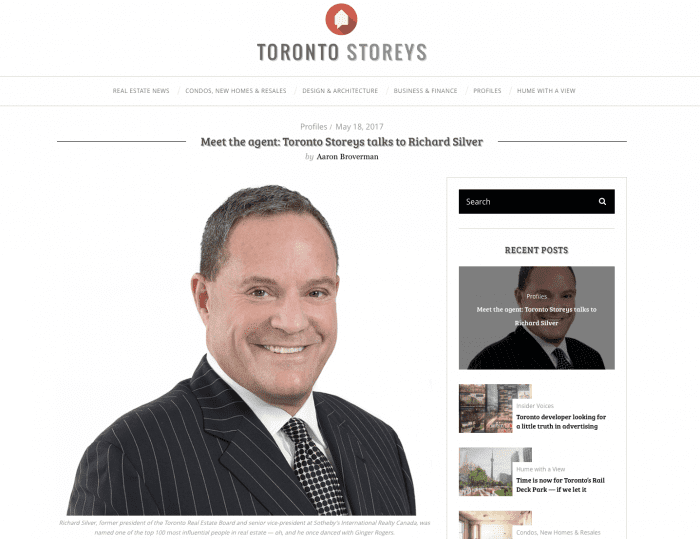
Richard Silver, former president of the Toronto Real Estate Board and senior vice-president at Sotheby’s International Realty Canada, was named one of the top 100 most influential people in real estate — oh, and he once danced with Ginger Rogers.

Richard Silver is the senior vice-president of sales for Sotheby’s International Realty Canada and a former president of the Toronto Real Estate Board in 2011. An expert in international real estate as a certified international real estate specialist, he is the former founding president of the Asian Real Estate Association of America – Toronto Chapter and was named one of the “100 Most Influential People in Real Estate” by Inman News in 2013.

A former song and dance man who once performed with Ginger Rogers, now Silver lends his expertise to leading Sotheby’s Torontoism team. On his mind? How Toronto will never be a world-class city as long as its infrastructure doesn’t grow with its population, and why rent control doesn’t really work to reel in housing prices.

How did you get involved with real estate?

Back in 1979, I bought my first house. I was working with an agent who was OK, but then I met an agent who was dynamite and showed me what I wanted in the first afternoon. I was very, very impressed. I was in a career that was very physical. I was a performer, but that same month I hurt my hip, so I couldn’t really do shows. I just decided that in the next break between performances I would take the real estate course. I eventually got my license and in the first month of selling real estate, I made the same money I had made as a performer for the whole year.

What attracted you to the industry?

I’ve always liked houses and I like the fact that you need to be self-motivated.

A lot of people think they won’t have any boss, but the reality is, the number of bosses you have is the number of clients you have. Everybody wants your time, so you have to be there, but you have to provide for everybody.

You have to be very disciplined, you have to be out there connecting with people and it’s all about your relationship with them. It’s a great business to be in.

As the president of the Toronto Real Estate Board in 2011, what was it like getting such a big picture of the city’s real estate market?

You learn a lot. That’s the wonderful thing about being on the Toronto Real Estate Board and about being a director. You learn a ton of stuff about what’s happening in the marketplace. You’re the first one to see the statistics before anybody, you notice the changes and you also get a view of the whole city. Even though it’s called the Toronto Real Estate Board, it’s basically responsible for a lot of sales in the whole GTA.

Can you recommend changes to the city’s municipal government if you’re noticing negative real estate impacts?

You can and they’re very political and it doesn’t mean they’re going to listen to you. You’re always wondering what they want. Part of the problem with the city we’re in right now is there’s a lot of “not in my backyard.” Everyone wants a world-class city. They all want world-class restaurants, sports and entertainment, but they want it to take place in a city that existed 10 or 15 years ago.

We need better transportation and an easier way of approving buildings. Right now, the process in Toronto as it stands is way too long. From the minute a developer buys a property and works through development until it’s actually finished, you go through a lot of stuff that’s redundant.

In Toronto you have the Committee of Adjustment, but you also have the Municipal Board, so it’s like having a mom and a dad. If you can’t get what you want from the mom, you go to the dad.

So the process is too wrapped up in bureaucracy?

It is and longer. They should set some guidelines for each year. Right now, what happens is there are guidelines, but the parents are the perfect analogy. You can go to the mom and the mom says, “No, no we can get you a little bit bigger,” so it keeps on setting new goals.

I know there are a lot of misconceptions about working with a realtor, why do you think that is?

Part of the problem is, just like any field, you’re always judged by your weakest link, so a lot of people judge realtors based on bad experiences with agents who did not act properly. It’s like anything. If I was getting someone to work on my house, I would make sure I did my due diligence, I checked and saw whether they had good references, I would ask people who worked with them before what their reaction was and I would search online. These days you can go online and find out a lot of information. You want a realtor who’s going to act in your best interest. Often times, I’ve blown people away because I say, “I don’t think you should be doing this.” I don’t think you should be buying right now, I think you should be renting right now and in the future.”

You can’t be afraid to tell people your thoughts and it’s important for clients to realize, realtors are there for the long term.

What do you think are the issues that will have the biggest impact on Toronto’s real estate industry in the future?

I think one of the biggest things is always net immigration. In other words, there’s always the drive for people to sell out and move to another area that’s less expensive. But, at the end of the day, the question is are there more people moving to the city than leaving it? You also have the issue of mortgage rates and do prices, because of financing, get out of whack? It’s difficult enough as it is with mortgage rates at two to three and a half percent, but can you imagine those rates going up to five or six percent? How would people be able to afford it? Those are the things that are most concerning. The other thing is

if we want to be a world-class city, we have to invest in things like transportation: subways, roads and bridges. The reality is we’re in this place, there’s not a lot of space — we can go up, but there’s not a lot of space to go out and all the services we have need to be improved.

Aren’t more and more people moving back to the city these days anyway?

Yeah because they don’t want to have to drive into the city all the time. They want to be able to work downtown and have their family downtown. I think we’re going to start seeing larger apartments and more rentals. It will be like New York where people rent in the city and buy in the country because they can’t afford the city. I think you’re going to start seeing larger apartments or smaller ones with three bedrooms rather than just the one.

You’ve been at this a long time. How can realtors become one of the top producers you hear about like yourself?

You have to be prepared to make changes and not stay static with any of your business goals. There are times when there’s new technology, so you have to try the new technology and see if you can make your business more efficient. With the influx of foreign buyers are you going to stay in a very restricted world or are you going to reach out to the foreign buyers? Are you going to have people on your team that speak multiple languages? Are you going to make changes? I think that’s really important. I speak English and French and now I am taking classes in Mandarin. I’ll never speak it, but at least I’ll be able to understand more just to get by. Also, it’s just a sign of respect.

Do you think the province of Ontario and the city of Toronto are doing enough to control housing prices?

I don’t know that you can control housing prices. We were already seeing a lot of people backing off from multiple offers and becoming afraid of the high prices. I get concerned whenever I see government intervention. We had rent controls once before and rent controls have a tendency to stop builders from building rental properties and then you end up with a shortage of rental properties, which drives the rents really high. It’s very popular and everybody likes that they can now get low rents, but what they don’t realize is down the road if rents are not increasing but every other cost is, people who own rental properties are going to go, “This is ridiculous. Why am I doing this? I’m not even covering my costs.” This stops people from building purpose-filled rentals. What they should’ve done is incentivize builders to build purpose-filled rentals.

SK00SK

People of Toronto: Silvia Guido

05.16.17 | People of Toronto

One of the things that makes Toronto such a wonderful city is how welcoming it is. Toronto is a metropolis that prides itself on inclusiveness, diversity, and a wide tapestry of people coming together to create a community feel despite a vast population.

Despite there being many excellent facets about the city, there are always ways that we can improve and better serve the needs of the population within our city, whether they’re tourists or call Toronto home. Thankfully there are inspired people who see a need and turn it into a reality.

Silvia Guido is one of these people; she saw a lack of information on accessibility and found a way to serve the needs of many people within the city.

Silvia Guido is a practicing physiotherapist specializing in neuro-rehabilitation. In April 2013, Silvia started the blog-based website AccessTO after she discovered the lack of accessible restaurants in the city. The website commits to highlighting fully accessible entertainment venues including restaurants, cafes and concert venues in Toronto by providing measurements and pictures in an easy to read format.

Can you tell me a bit about what inspired you to start AccessTO? How has it evolved from early days to what it is today?

I started AccessTO four years ago out of a genuine concern that no information was available for my family and friends who had different needs when looking for a restaurant. My profession as a physiotherapist also allowed me to meet people every day who shared the same concern for inclusivity within the local community.

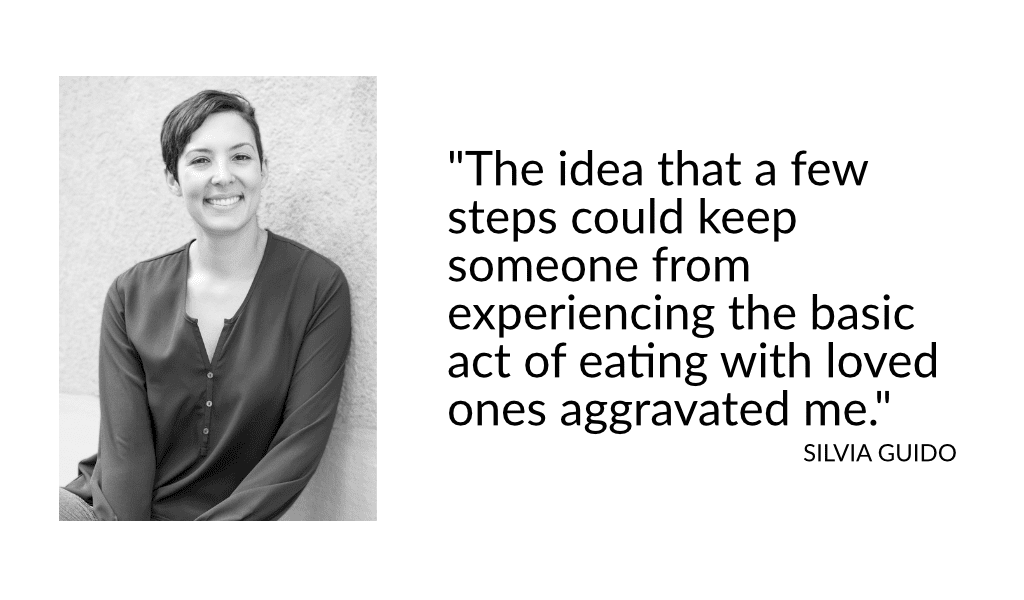
Based on my love of food, the idea that a few steps could keep someone from experiencing the basic act of eating with loved ones aggravated me. I began assessing the space of any new restaurant I was dining at so it was an easy shift to writing my thoughts on a blog. It also became apparent very early that I wouldn’t have a problem finding people who wanted to help, which ignited the project. Within six months, I had a group of volunteers who I trained to assist with creating more frequent and robust content.

Can you tell me about the people and partners who work to fulfill AccessTO’s vision?

AccessTO has partnered with the University of Toronto for several years to enhance the curriculum within the Department of Occupational Science Occupational Therapy Program. Students volunteer and learn about the auditing process while faculty members provide invaluable input into criteria used to determine accessibility.

AccessTO recruits volunteers from the community who are older adults or have experienced a disability. The venues reviewed are often visited by a pair of volunteers and these varying insights are recorded to produce a collaborative experience we are very proud of.

What are biggest barriers we’re facing in terms of making Toronto an accessible city?

Well I don’t want to speak to all sectors, but we cannot ignore how difficult it is to succeed in the food and entertainment business in Toronto. The Accessibility for Ontarians with Disabilities Act’s (AODA) intention to make all places accessible by 2025 may not be relevant for entrepreneurs who hope to make it past the first year of business. Retrofitting their space for a ramp or a washroom on the main floor is expensive.

Having said this, I always encourage business owners to consider the accessibility of their space because it can assist in generating a broader customer base. This is everyone from a wheelchair user to a family who uses a stroller. The lack of information available and perhaps an insight into this for business owners may also be a huge barrier.

Map of accessible restaurants, coffee shops and bars

What roles can both consumers and businesses take towards creating more accessible spaces in our city? What about health care professionals?

People need to start thinking of Toronto (or any city they live in) as a collective community and understand how inclusive spaces actually benefit everyone. It really should not be an afterthought for business owners or consumers as the population needs are always changing, especially as we age. As a health professional, I think there is a huge responsibility for us to keep up to date with the accessibility standards in Ontario and educate as many people as possible. We should also be modeling within our own businesses a barrier-free space.

What are some of the biggest misconceptions you’ve seen in terms of creating an accessible space?

Many people feel that an added cost is always necessary. There may be, but most likely it is less than you think. The Ontario government is also continually offering initiatives for individuals to increase the accessibility of their space such as the Enabling Accessibility Fund. Toronto’s very own StopGap Foundation is also available to assist with the manufacturing of an affordable ramp.

How do you find/ decide which places to feature in the Accessible Spaces section of your website?

Our volunteers usually make a list of new or tried and true venues and call to make an appointment to assess the accessibility. If the space meets our criteria, a review is posted on the website! Everything on the website has passed an onsite audit to simply make sure that when someone says something is accessible it really is!

Julian & Silvia make one review team
Julian & Silvia make one review team, photo by AccessTO

What are your favourite accessibility-minded places in the city? What can other businesses learn from them?

A great space is the new Tangled, which is Toronto’s first accessible art gallery for artists with disabilities. The venue can almost be a gold standard for any business to learn from. I am a big fan of coffee shops and my favourite right now is Page One Café near Ryerson Campus. Besides the physical construction of the space, I am always impressed with the attitudes of the owners and staff. This may be what is really lacking in Toronto.

Tangled Art + Disability,  New works by Persimmon Blackbridge
Tangled Art + Disability, New works by Persimmon Blackbridge

How do Toronto and Ontario compare to other cities and regions in terms of accessibility? What other places can we learn from?

I think Canada, in general, has a lot to learn about accessibility from the US who have had the Americans with Disabilities Act since 1990! It is frankly embarrassing that we still don’t have a federal disability policy and that the AODA has been so slow in producing set standards for physical spaces. A city that stands out for me is London, England which has built in an incredibly accessible infrastructure. We can definitely learn from them.

Which projects are you most proud of and why?

The main mission of providing the most reliable information for the community continues to make me the most proud.

Why did you choose to make Toronto your home? What is your favourite thing about the city?

I grew up in Toronto and am still stumbling into neighbourhoods that I have never visited. My favourite thing is everything that these neighbourhoods bring with them, including the people and the cuisine.

How do you define success, both professionally and personally? Has your definition of success changed over the past several years?

Success has always been for me how well I am able to care for myself and others on an equal level. If I could pull this off every day, I would be successful! It’s definitely a work in progress…

What’s next? Do you have any upcoming projects that you’d like to talk about?

AccessTO has recently joined forces with individuals in the art community to create a collective called Access Visual Art (AVA). AVA will focus on bringing accessibility related information about art venues to the Greater Toronto Area over the next 6 months. We believe this to be a great opportunity to shed some light on some very special places and educate those that may be lacking!

SM00KI

How to Become a Successful Real Estate Agent

05.10.17 | Business

Back when the photo above was taken, in 1979, I was just starting out as a realtor. Since then I’ve learned a lot about the real estate world. And while ‘the times they are a-changin’ the main laws of business—and I mean any client-oriented business, not just real estate—remain the same.

The realtor game isn’t easy. Long hours and hard work is the norm in the industry. I’ve never met a successful realtor who worked 40 hours a week. They all work 60-80 hours.

It’s a thankless job sometimes, but it can be very fulfilling as well. That’s why I’ve decided to share guidelines to help you through the difficult times.

1. When something comes up, do it right away.

It’s so easy to get distracted. Tasks that you can’t anticipate pop up all the time. When something unforeseen shows up on your schedule it’s best to get it over with so you don’t get bogged down by it.

2. Know your marketplace.

See as many houses as possible. It’s important to get out there and find out what the neighbourhood is like. You should know how many schools are in the area, where the nearest transit stop is, and when garbage day is.

Torontoism’s Neighbourhood guides

You should know everything about the neighbourhood you’re working in. From the best restaurants and best schools in the area to the best off-the-leash dog parks and farmers’ markets.


3. Work to be at the same level at all times.

It’s easy to get bogged down in the minutiae of it all. Sometimes you get tired and don’t want to work. But you need to push through that.

I see a lot of people who do really well in the first three months and then decide to relax. Instead, try and pace yourself. Don’t take on too much and never do just the bare minimum.

4. Always over-perform for your clients: go the extra mile.

Don’t wait for your clients to ask you for something. Instead, anticipate their needs. You want to create a situation where they look to you on an ongoing basis. So they may call you when they want to paint their house in five years, or when they want to sell in 10 years.

Making play-doh dumplings at a Mandarin class!
Making play-doh dumplings at a Mandarin class with Panda Mandarin Language School

5. Plan ahead 6 months, 12 months and 5 years and spoil yourself.

It’s important to give yourself something to look forward to. As I said, being a realtor is a very intense job. I think the only way you can keep up that pace is if you always have something to look forward to. 

I usually plan at least one trip to Mexico every year. Other times I head to Europe for a few weeks. But it’s all in the name of rewarding yourself for your hard work. There’s always something that I’ve booked and paid for that I’m going to enjoy months down the line.

6. Always be on the lookout for the next opportunity.

Finding new opportunities or niches can open doors and bolster your business.

I realized years ago I had to look to widening my customer base to people who speak different languages. Learning about foreign buyers and dealing with them opened entirely new markets and kept our business moving strong.

Richard and Sherille in London during The Torontoism international trip in December 2016.

7. Never take yourself too seriously.

Things will go wrong. Clients will decide to go with other realtors but that happens to everybody. Stuff happens. There will be disappointments and you just need to move on. Don’t let it get you down.

8. Focus on what you do well and outsource the rest.

Some people are good at public speaking while others are terrified by it. That’s normal. The trick is to figure out what you’re good at and concentrate on that. Wherever your shortcomings are, try and find people to fill those roles. So if you’re bad on the phone, find someone who’s good at it.

Meet Torontoism

We speak English, French, Mandarin, Hindi, Punjabi, Urdu and Portuguese!


9. Involve yourself in your community.

There are opportunities all over the web for realtors, but it’s important not to forget that there’s a community around you.

Go online and outside.

Getting involved in that community will help people remember you. So when they’re looking to buy or sell, you’ll be the first person they think of and the first person they call. If there are things you can do in the community get out there and do them.

You should also remember that the community doesn’t just mean the neighbours. Realtors are part of a community, and networking is a valuable tool.

There are a lot of realtors who don’t want to interact with other realtors. If you can send business to a peer, the odds are better that one day they’ll return the favour.

Torontoism in New York with the Nikki Field Team

10. Think long term.

Don’t just look at recent trends. A five-year plan is useful for anyone. A lot of realtors, when it comes to real estate, they think very short term. But picturing where you’ll be in five years can also help you figure out how you want to get there. Or how you can help clients get there.

11. If the market slows and the pie gets smaller, get a bigger piece. Don’t let a downturn affect you.

When there’s a downturn a lot of people become paralyzed. But there is always business to be had. It just means working a little harder during the lean times. People will always be buying and selling.

12. Anything worth doing is worth overdoing.

I once had a client who had trouble organizing his office. As a joke, I got him a paper shredder and it’s something the client still jokes about. The point is, you can always go the extra mile.

There are times you can do things in the community that people won’t even know about. In the past, it wasn’t unheard of for me to help my clients move, though you should be mindful of going overboard. But if there’s anything you can do that your clients will enjoy, don’t overthink it. Just do it.

Title Photo by Charles Pachter

Richard Silver for OREA | Real estate teams: Are they right for you?

05.2.17 | Business

Richard was recently interviewed for the OREA EDGE newsletter about the team approach in real estate, together with Melanie Piche who runs the BREL Team at Toronto’s Sage Real Estate in partnership with her husband, Brendan Powell. Here is an excerpt from the article, but you can find the  whole article here.

Richard Silver, who has worked in Toronto real estate for more than 37 years, is the Torontoism team lead and vice-president of sales at Sotheby’s International Realty Canada. He is part of a seven-member team comprising five Realtors and two support staff. He believes in the team model because “the whole is greater than the sum of its parts.”

Everyone brings different strengths. Each of us is better at something than others. Some people speak a different language. Our team contains different cohorts, Baby Boomers and Millennials, and they all provide different viewpoints.

Silver believes that in a successful team, members learn from one another and feed off one another’s ideas and energy. “We learn from the strengths of others, as well as from their guidance when problems arise,” he says. “Each of us is different and we celebrate our diversity.”

Silver employed a coach to help the team get organized, determine responsibilities and settle on the method of compensation. He believes the smooth running of the team flows from that approach.

I choose to share all my leads with the team and no longer solely represent anyone. I also wanted their compensation to be high so they would not be tempted to leave and go out on their own.

Real estate is a competitive business, but neither team has had much internal conflict. Silver’s team members are careful not to step on one another’s toes. Silver says the team can always turn to management at the brokerage if it encounters a problem that seems insurmountable.

Although Realtors are often viewed as rugged individualists, both sources say it is possible for real estate salespeople to work and thrive in teams if the right conditions are present.

People who can’t work as part of a team are the same people who might also have problems in an office environment. If it is all about you, don’t choose to be part of a team. Our team members have come to depend on each other and, for the most part, have become social friends, as well as business friends.

Keys to team success:

  • Realize that you’re in it for the long haul; it’s not just about getting one deal done.
  • If you’re thinking of joining a team, talk to the other team members and get a complete picture. Ask in-depth questions.
  • In considering a team, see what the track record is and the longevity of members.
  • Be sure that both the team and its affiliated brokerage are a good fit for you.
  • Remember, it’s not all about what you can get. What do you bring that can make the team better?
  • Consider hiring a coach or finding a mentor when you are starting a team so you can avoid painful mistakes.
  • Put people with complementary skills together on your team. The complexity of the market today means no single individual is an expert on every type of property or aspect of the business.

Originally posted in the EDGE newsletter and OREA site, by Elaine Smith.

SK00SK